Do Economic Policies Draw More Voters to Ballot Boxes?
Executive Summary
This paper examines whether economic policies in Iraqi election campaigns draw voters to ballot boxes ahead of the 2025 parliamentary elections. Through expert opinion analysis and an evaluation of the political parties’ campaign promises, the paper highlights economic policies to be at the forefront of Iraq’s growth trajectory. However, the significance of parties’ economic policy proposals is not central to voter decision-making due to decades of mistrust between the electorate and the Iraqi political class due to consistent failure in meeting voter demands in previous elections.
The November 2025 elections unfold at a critical juncture for Iraq, where international partners highly focus on economic development as the next frontier for the country and encourage the Iraqi government to make the country investable and prepare for a new era of economic growth in the region’s rapidly changing order. Furthermore, the paper showcases the growing focus of Iraq’s contesting parties and coalitions on the following major economic and financial fronts: (1) Strengthening economic stability by reducing fiscal imbalances; (2) Promoting economic diversification; (3) Creating job opportunities; (4) Improving delivery of public service provisions; and (5) Fighting corruption and improving governance.
The paper finds that the policy proposals outlined by contenders fundamentally lack practical policy roadmaps, which may lead to voter disengagement and further mistrust. Although the 2025 vote represents a critical opportunity for Iraq’s political actors to restore voter trust through credible policy proposals, it remains uncertain how the absence or presence of comprehensive policy proposals on the financial and economic fronts will influence public expectation and voter behavior.
The 2025 vote represents a critical opportunity for Iraq’s political actors to restore voter trust.
Elections through an Economic Lens
Generally, on public policy matters, adopting a specific policy course of action is not one of the strengths of Iraqi political parties and coalitions during and after election campaigns. Repetitive promises of reform populate political campaign platforms that vie for voter influence and popular support. Historically, the chronic lack of clear policies in the overall agenda of political parties on issues that directly concern voters, such as the economy, has translated into voter disengagement in the electoral process. Economic and financial matters lie at the heart of voters’ concerns throughout Iraq, including the Kurdistan Region. Often, people’s economic and financial struggles for their wallets reach the ballot boxes; voters use their voting rights as a check on the ruling parties, where election promises consistently fail to deliver tangible relief. Over the past two decades, persisting governance and service-delivery challenges incited anger and mistrust in the electoral process, pushing voters to either abstain during elections or support political parties that prioritize everyday financial pressures, even on vague reform promises. In a way, electoral choices focus on evaluating which policy options most directly improve voters’ economic well-being, thereby leading them to vote for parties that prioritize Iraqi household finances, jobs, and affordable essentials and services.
Iraq’s parliamentary elections in November 2025 represent a continuation of the country’s decades-long financial and economic troubles as a result of internal conflict and misgovernment, among other factors. Absentee or voted ballots may indicate an economic voting behavior testing whether the contesting parties can deliver tangible reforms and translate economic policy commitments into real improvements for the Iraqi electorates. On this basis, voter turnout and level of public trust seem to directly correlate with structural economic and financial issues that continue to weigh heavily on the Iraqi public. And certainly, public opinion views of the economy,1 although impacted by several multidimensional factors,2 change following significant political shifts, especially during and after elections.
Often, people’s economic and financial struggles for their wallets reach the ballot boxes; voters use their voting rights as a check on the ruling parties, where election promises consistently fail to deliver tangible relief.
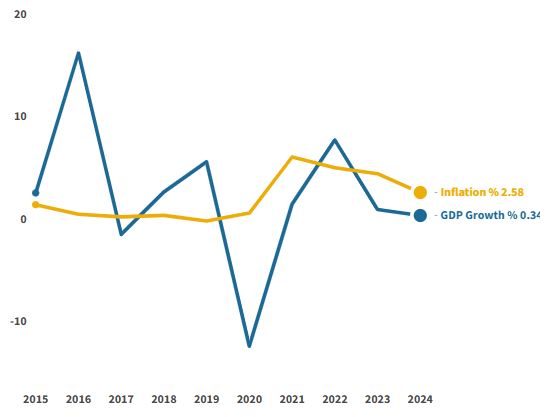
There are several factors at play that contribute to Iraq’s economic vulnerability, including heavy reliance on oil revenues, an ever-expanding public sector employing 4.5 millions of Iraqis,3 fiscal instability, underinvestment in public infrastructure, and high unemployment, especially among the youth, reaching 16.5% in 2025.4 Since the fall of the Baath regime in 2003, Iraq’s economic and financial sectors have undergone prolonged periods of severe instability. Most notably, the political instability following the withdrawal of US forces significantly destabilized Iraq’s fragile and young democracy. It also paved the way for extremist groups, such as ISIL (also called ISIS) to push their destabilizing impact on Iraq, further eroding the social fabric and severely undermining Iraq’s political, economic, and financial stability. The financial fallout of combating ISIL until its territorial defeat in December 2017 was further exacerbated with the arrival of the COVID-19 pandemic and its subsequent global recession, particularly as oil prices dropped to a historic average low of $32 per barrel globally in 2020.5 Again, Iraq took a severe financial hit, pushing millions of Iraqis into poverty6 as most of Iraq’s revenues depend on oil accounting for 85% of the government’s budget and 42% of gross domestic product (GDP).7
Iraq’s fragile democracy since its birth in 2003 has been part of the surmounting economic and financial troubles, giving rise to a potent patronage system, clientelism, and institutional weaknesses that effectively abort efforts towards meaningful structural reforms. Given this background, Iraq’s economic and financial troubles remain a key challenge and yet an opportunity for political actors who understand economic pressures may become a deciding factor in shaping the electoral process and voter behavior. Yet, arriving at an economically and financially stable Iraq has been a significant challenge for Iraq’s political actors and ruling parties. However, during elections, the contesting parties and coalitions, including independent candidates, particularly emphasize economic plans and reforms at the forefront of their agenda. The question, therefore, is whether the November elections represent opportunities for the contesting parties to gain voter trust through communicating well-structured economic plans and reforms that directly address voters’ demands for a better quality of life.
The following sections will shed light on the intersection of electoral dynamics with economic realities. The two exclusive interviews conducted for this paper aim to evaluate the contesting parties’ economic and financial reform promises, or lack thereof, and their impact on electoral success. The paper also highlights the challenges ahead of Iraq’s bumpy road towards a unified economic vision and financial stability. Additionally, how political actors attempt to address these issues through encouraging political participation is critically important to support Iraq’s transition toward a new era for economic growth and development.
Snapshot of Iraq’s Economy (2025)
- Iraq is an oil-dependent mixed economy dominated by the oil industry, which generates over 90% of government revenue and approximately 85% of total exports.8 The state sector controls and manages major resources, complemented by a nascent private sector and limited diversification efforts.
- In terms of fiscal and monetary structure, Iraq’s public budget is heavily reliant on oil revenues, causing vulnerability to oil price volatility that leads to recurring fiscal deficits.9 The government faces pressure to maintain high public sector wages and subsidies.10
- Exports and Imports: Iraq’s exports are overwhelmingly oil, and major import goods include food, machinery, vehicles, and manufactured goods. The trade balance fluctuates with global oil prices and domestic demand, and Iraq’s Foreign Direct Investment (FDI) stands at $8.6 billion.11
- Currency and Banking: The Iraqi Dinar (IQD) is the country’s national currency, which faces fiscal imbalances and instability. Its value is estimated at 132,000 IQD for each 100 US dollars. However, in the market $100 is exchanged for more than 140,000 IQD which adds further instability and different inflation rates in the market. The banking system remains mostly state-controlled, with gradual reforms underway to improve transparency and financial inclusion as well as efforts toward developing digital banking services to meet growing customer needs.12
- GDP Growth: Projected GDP growth is about 5.3% in 2025,13 primarily due to the oil sector, with modest contributions from agriculture, manufacturing, and services. The Iraqi government estimates non-oil revenues at 14% of the country’s total revenues, with plans to raise the figure to 20% in 2030 under the three-year budget law.14
The Case for Economic Voting and Public Confidence
When economic pressures compound, voters' behavior frequently shifts towards “economic voting.”15 The two types of economic voting consist of Sociotropic voting and pocketbook voting. In the former case, voters consider the overall health of the national economy, while in the latter case, voters focus on their personal financial situation.16 Economic voting thus impacts voter turnout, political engagement, and public confidence in the electoral process. Although there is no hard evidence to support whether either type of economic voting is prevalent among the Iraqi electorate, past performance provides a glimpse into how voters tend to reward incumbents when the economy is doing well and punish them when it is doing poorly. In either case, the ruling and contesting parties need to understand that failure to communicate inclusive economic and financial policy plans serves as a key signal for voters to boycott political actors who do not prioritize their economic sufferings, especially among the youth who are of working age and account for 60.96 % of the Iraqi population.17
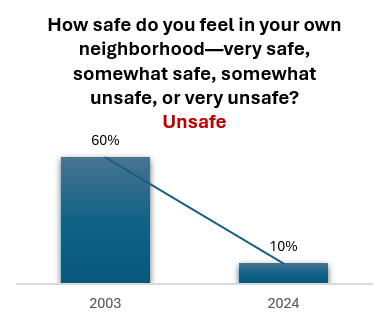
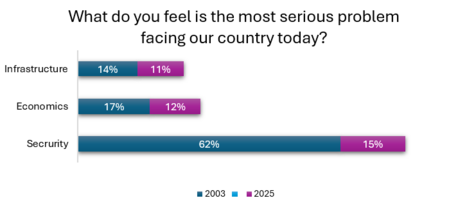
Iraqis perceive unemployment, economic hardship, and corruption as the country’s most pressing problems in 2025.
Gallup International Member IIACSS Group in Iraq
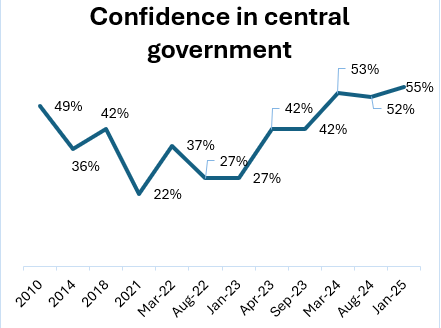
As for public confidence in government institutions, shown in Graph 3, Iraq’s public mood remains a complex reflection of hardship, resilience, and cautious hope, according to a recent survey conducted by Gallup International Member IIACSS Group in Iraq. The survey titled “Shifts in Iraq’s Public Opinion from 2003 to 2025” showcases how Iraq’s public opinion has changed over the last two decades and indicates a 55 % confidence rate among Iraqis in the current government.18 The survey also highlights the sharp contrast in public opinion regarding the most serious problem facing Iraq over the course of the two decades (2003-2025). Iraqis perceive unemployment, economic hardship, and corruption as the country’s most pressing problems in 2025 while physical safety and security were emphasized as dominant concerns in 2003. Showcased in Graph 1 and Graph 2, the survey encapsulates this broader shift in national sentiment from ”fear of violence to frustration over livelihood, a crucial insight for understanding Iraq’s future policy priorities and the expectations of its citizens today, compared to 22 years ago.“
Growth and Stability as Iraq’s Next Frontiers
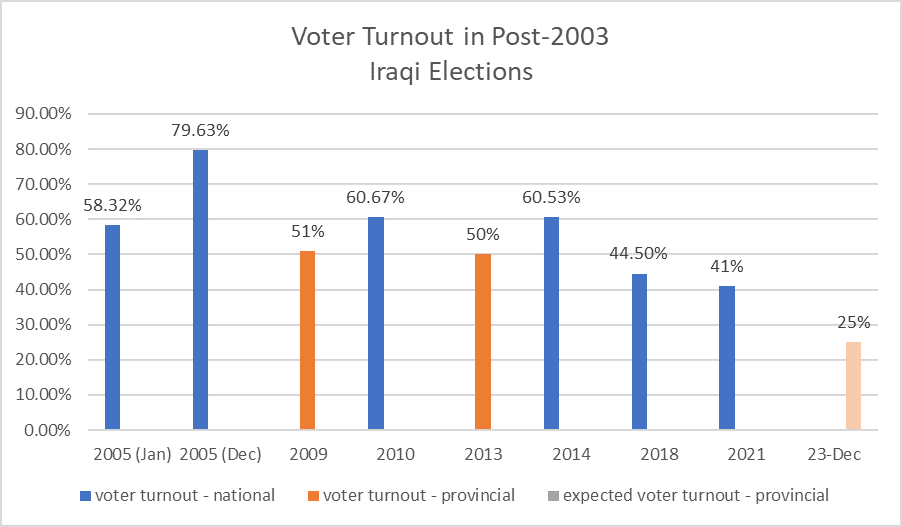
For decades, security and stability issues have been under the spotlight for Iraq’s consecutive governments and international partners. The security imperative meant that other policy issues, such as good governance and particularly economic and financial reforms, were secondary priorities. The existing lack of policy attention towards effective economic and financial management, coupled with weak democratic institutions, retrospectively consistently impairs consecutive governments’ capacity to formulate meaningful policies that target tangible areas of the economy. For Iraq’s democratic experience, the link between economic performance and electoral success cannot be proven historically, but signs of voter trust erosion are easily detected. Iraq’s first election voter turnout reached a high of 79.63 % in the 2005 parliamentary elections and ever since has drastically dropped to 60.67% in 2010, 60.53% in 2014, 44.50% in 2018, and 41% in 2021.19
Concerns over the economy20 qualify as one of the key factors that play decisive roles in determining voter behavior and turnout. Sometimes, economic pressures and financial instability have led to mass demonstrations across Iraqi provinces, such as the Tishreen movement in Baghdad and multiple demonstrations in Sulaymaniyah. In addressing the surmounting economic and financial issues, the Iraqi government takes passive measures in response to public demands. Or it employs policies that backfire and cripple the government’s economic and financial power, such as utilizing the deeply entrenched patronage system that offers employment opportunities in the public sector in exchange for loyalties. This is a non-starter strategy to address an overinflated public sector that takes up the largest portion of state revenues and government expenditure.
Mr. Semtner highlighted the importance of creating a business environment supportive of financing and investment, especially for EU companies to invest in Iraq’s infrastructure.
European Union Ambassador to Iraq
Addressing such incremental issues in Iraq’s economic and financial sectors requires incorporating local, regional, and international outlooks that aim at connecting Iraq to the Middle East’s ever-expanding geopolitical infrastructure and shared stakes in stability. More importantly, as the IMF country report showcases, the decline in oil prices in 2025 makes the policy response to major economic and financial issues even more urgent. International and regional actors involved in Iraq are particularly focused on helping the Iraqi government resolve key issues in the economic and financial sectors. The IMF indicates Iraq’s projected economic growth rate will rise to 3.6% compared to the MENA average growth dropping sharply from 4% to just 0.3%.21 still, it warns Iraq and other non-Gulf oil-exporting countries of facing mounting economic pressure due to declining oil production and shrinking public spending.22 The UN also issued a warning to Iraq this early October regarding the risks of continuing to depend heavily on oil revenues to pay government salaries and called on the Iraqi government to diversify and invest in agriculture, renewable energy, and technology, describing these sectors as “fundamental pillars for economic diversification.”23
Alicia Rico emphasized the importance of placing Iraq’s outlook in the geopolitical scenery and increasing multipolar competition in the broader Middle East and North Africa region.
Spanish Ambassador to Iraq
The new European Union Ambassador to Iraq, Klemens Semtner, during his panel in the Middle East Research Institute (MERI) forum, stressed the EU’s efforts towards curbing migration flows to Europe due to Iraq’s worsening economic situation. Mr. Semtner highlighted the importance of creating a business environment supportive of financing and investment, especially for EU companies to invest in Iraq’s infrastructure.24 During the same panel, the Spanish Ambassador, Alicia Rico emphasized the importance of placing Iraq’s outlook in the geopolitical scenery and increasing multipolar competition in the broader Middle East and North Africa region.
Ms. Alicia highlighted Spain’s major contribution in the security sector in Iraq in the larger context of EU mission and also having the biggest contingent in NATO mission in Iraq (NMI). However, she stressed the need for strengthening economic and commercial partnership as incremental next steps for Spain and the EU to support a transitioning Iraq toward stability, a thriving public sector, and a predictable investment climate. Overall, economic growth and stability take centerstage in Iraq’s growing partnerships, especially with the US,25 and the shift towards regional and global connectivity, such as through the Development Road Project,26 all provide opportunities to confront lingering economic and financial challenges and steer Iraq towards its economic renaissance.
Major Alliances and Parties Contesting in the November Vote
Key Sunni Alliances
- Sovereignty (al-Siyada): led by Khamis al-Khanjar; influence in Al-Anbar and Saladin
- Taqaddum (Progress): led by Mohammed al-Halbousi; urban strength in Al-Anbar, Baghdad, Saladin; governance/administration focus; open to post-election coalitions
- Azm: led by Muthanna al-Samarrai; operates mainly in Saladin and parts of Nineveh
- Al-Hasm al-Watani: led by Thabit Mohammed Saeed; five-party coalition, includes Hasm for Reform, al-Wafa, al-Hal
Major Kurdish Parties
- Kurdistan Democratic Party (KDP): led by Masoud Barzani; dominant in Erbil and Duhok; extends influence on disputed areas
- Patriotic Union of Kurdistan (PUK): led by Bafel Talabani; strong in Al-Sulaymaniyah, Halabja, parts of Kirkuk
- New Generation Movement (A-Jeel Al-Jadeed): led by Srwa Abdulwahid; reformist, youth appeal; presence mainly in Sulaymaniyah and some parts of Erbil and Duhok.
Leading Shia-majority Alliances
- Reconstruction and Development Coalition: led by Mohammed Shia al-Sudani; focus on reconstruction and economic reform
- State of Law Coalition: led by Nouri al-Maliki; 11 parties; central/southern bases
- National State Forces Alliance: led by Ammar al-Hakim; reform-oriented
- Badr List: led by Hadi al-Amiri; strong in Diyala, Basra, Wasit; part of Coordination Framework
- Al-Sadiqoun List: led by Qais al-Khazali with tribal outreach
- Ibshir Ya Iraq Alliance: led by Hamam Hamoudi; includes seven groups
- Iraqi al-Asas Coalition: led by Ali Mohsen Akbar al-Mandlawi; appeals to youth/independents
- Tasmeem Alliance: led by Amer al-Fayez; focuses on national moderation and local governance
- Hoquq Movement: led by Hussein Moanis
Other Alliances:
- Al-Badil (The Alternative): led by Adnan al-Zurfi; 11 parties
- Ishraqat Kanoon: led by Haider Al-Mutairi
- Democratic Civil Alliance: led by Kazem Ali al-Rifai
Sources: IHEC,27 Shafaq News28 and Peregraf.29
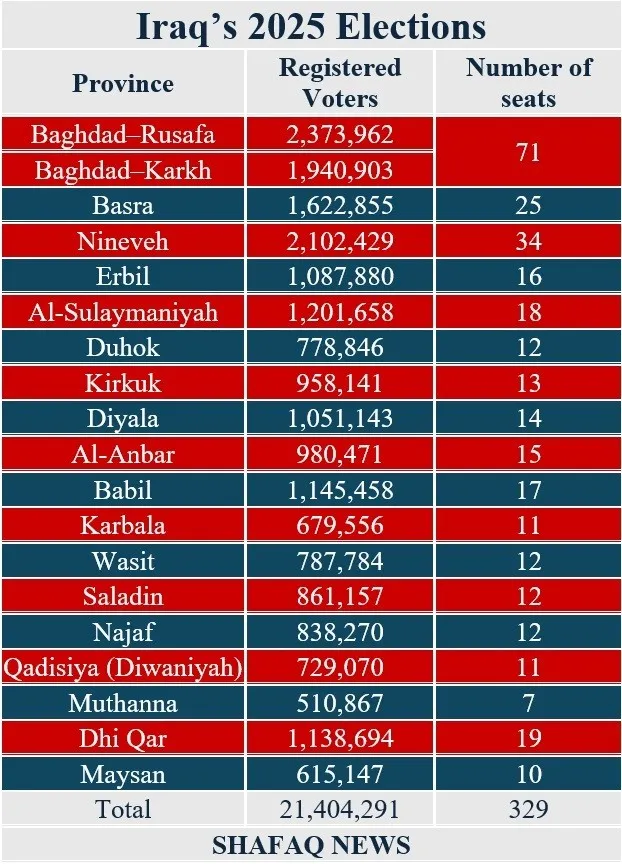
Key Economic Policy Debates of the Moment
Economic and fiscal reforms, job creation, and services provisions are popular items in the contesting parties’ campaigns. Besides individual political parties running, coalition-building has become central to this election to appeal to a large base of voters, particularly as economic reform plans are bartered politically.30 The November elections provide the opportunity for political parties and coalitions to frame their economic reform promises that aim to deliver a better quality of life. The challenge, however, lies in how voters can be enabled to decide what major policy issues are prioritized by contesting political parties and coalitions when the political culture of Iraqi elections fundamentally lacks a policy-driven election agenda. Additionally, the lack of voter awareness of policy priorities coupled with contesting parties’ short-term goals leaves little room for discussion on policy matters, especially when it comes to coherent economic visions. Given that Iraq's political structure is yet to mature democratically, it is unlikely that political parties and coalitions will emphasize their policy plans in a clear agenda in the near future. Nonetheless, the central issues discussed so far by the contesting political parties and coalitions include the following:31
- Strengthening economic stability by reducing fiscal imbalances
- Promoting economic diversification beyond oil
- Creating job opportunities, especially targeting high youth unemployment
- Improving delivery of public services provisions
- Fighting corruption and improving internal governance, including rule of law and financial transparency
Thinking Like an Economist
Iraq's unique economic challenges require a political class that understands the need for long-term planning to translate political promises into clear and credible policies. Campaign promises that fail to present detailed, actionable plans to the electorate once elections conclude struggle to materialize, which is the case for most parties and coalitions that later form the government. This also means that the government-elect has one choice: to prioritize immediate spending over long-term economic and financial reform. To arrive at an economically and financially stable Iraq, political actors should set clear economic and financial policies in the lead-up to the November elections and prioritize issues that will likely shape voters’ behavior in the ballot boxes. The November elections represent opportunities for Iraq to enter into a new era where it is not shaped by security issues but prioritizes a ready-for-investment Iraq with a functioning economy, financial stability, and equitable development for all Iraqis in the decades to come.
What Do Experts Think? The following interviews delve deeper into these policy themes, providing valuable insights into Iraq’s economic challenges, political structure and the country’s current electoral shape. They provide an outline for how economic realities intersect with political choices and voter behavior necessary to better understand the forces shaping Iraq’s 2025 parliamentary elections.
Ahmed Tabaqchali
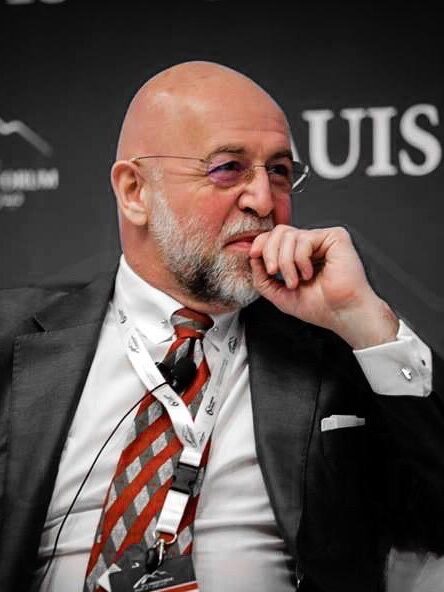
Ahmed Tabaqchali is a nonresident senior fellow with the Atlantic Council’s Middle East Programs. He is an experienced capital markets professional with over 25 years’ experience in US and MENA markets, and the chief strategist at the AFC Iraq Fund. He is also a visiting fellow at the LSE Middle East Centre, and a senior fellow at the Institute of Regional and International Studies (IRIS) at AUIS. He is board member of Arab Bank Iraq.
On the General State of the Economy and Political System in Iraq
When we look at Iraq’s economy and political scene, it's clear that neither the electorate nor the politicians are genuinely focused on serious economic reforms. This isn’t just an Iraqi issue; it’s a global trend. In many countries, including here in Iraq and the Kurdistan Region, real economic choices and reforms are often sidelined, especially when the economy seems stable on the surface.
Iraq faces significant challenges, like the heavy burden the public sector places on the national budget. This is particularly worrying because Iraq is still a very young country with a growing workforce, and continued high spending on current public expenditures is unsustainable. Simply put, the country cannot keep hiring people into the public sector indefinitely—it will hurt Iraq’s long-term prospects. When I co-authored the white paper in 2020, we emphasized the critical need to rethink the “social contract.” It’s clear that the old model of continually expanding public sector employment isn’t viable anymore.
Another core issue is Iraq’s overwhelming dependence on oil, a commodity over which the country has no pricing control. Although Iraq is a low-cost producer and likely to remain important in the market, long-term demand for oil is expected to decline. So, even if oil prices rise, it won’t solve Iraq’s deep fiscal challenges.
The government continues to hire many, often unproductive, public-sector employees, and this isn’t unique to Iraq but common in many resource-rich countries. Hiring is used as a tool to buy loyalty, but this approach strains the budget. The pension system is also under pressure because pensions and salaries are paid directly from the budget, not from a sustainable fund.
When it comes to Iraq's parliamentary elections, the economy tends not to drive policies or campaigns because the tough economic choices needed would be unpopular and politically risky. This short-termism extends well beyond Iraq—it's a global phenomenon.
On subsidies, efforts like the Runaki electricity project in the KRI show progress, but public resistance remains strong because people don’t want to pay their bills. Politicians know that attempting such reforms, which may involve raising prices or cutting subsidies, is politically unpopular. Even in established democracies like the UK, tax rises to fix imbalances are deeply unpopular and often avoided until absolutely necessary.
So, when it comes to Iraq's parliamentary elections, the economy tends not to drive policies or campaigns because the tough economic choices needed would be unpopular and politically risky. This short-termism extends well beyond Iraq—it's a global phenomenon. Iraq is heading toward a future where borrowing will increase, and major reforms are essential. But no politician wants to make those difficult decisions, especially not during election years.
In Iraq, voter trust is shaped more by overall political performance over the past 20 years and historical grievances than by specific economic issues.
Is There a Link Between Voter Trust and Economic Policies in Iraq?
This is a challenging question to answer in the Iraqi context. Generally, the population does not trust the political class. Many people accuse the government of wasting public money and taking resources for their own benefit. Because of this deep mistrust, economic policies do not significantly affect voter trust.
The lack of trust between the population and politicians has been growing over the past 20 years. This distrust is rooted in many factors, including the region’s complex geopolitical environment with neighbors like Türkiye, Syria, and Iran. In Iraq, voter trust is shaped more by overall political performance (over the past 20 years) and historical grievances than by specific economic issues. So, whether the economy improves or worsens, it doesn’t strongly boost or erode trust in political parties.
Do Iraqi voters have clear policy priorities in mind when they go to the ballot boxes?
I haven’t seen much maturity in the overall electorate when it comes to policy priorities. Certainly, young people are concerned with real issues and ask important questions, but most of the population isn’t focused that way. The challenge is that many young voters don’t show up at the polls.
For example, in the UK, most of those who voted for Brexit were older generations, even though the younger population largely supported remaining in the EU — but many of those younger voters simply didn’t vote. This pattern mirrors Iraq’s situation: those asking the right questions are often the ones least likely to vote. As a result, the political arena ends up shaped by older, less reform-minded groups.
The young generation must become active, not just critics. Being a citizen means creating dialogue, engaging constructively, and pushing for real change through the system, not simply opposing it.
Emerging signs of change are becoming evident. Various groups that arose from the Tishreen movement in Baghdad are now faced with the decision to engage directly in the political process. While this path will undoubtedly be challenging and require sustained effort over the long term, it is clear that revolution is not the solution. After decades of instability, Iraq is not prepared to restart from scratch; instead, gradual political engagement offers a more viable path forward.
While the political system is flawed, the people can work to improve it rather than dismantling everything and starting over. The young generation must become active, not just critics. Being a citizen means creating dialogue, engaging constructively, and pushing for real change through the system, not simply opposing it.
On the Youth’s Relationship with Politics, Jobs, and the Political Class
It’s tempting for youth to see themselves as subjects blaming the government for unemployment, but this overlooks the realities. The government’s role is limited; while it has expanded the public sector over the years, especially between 2007 and 2015-16, it cannot generate all the opportunities young people need.
Youth need to take a more proactive political role, engaging in constructive dialogue rather than expecting government fixes. For example, the Runaki Project is a practical step taken to improve electricity provision, but it requires political courage since it meant holding people accountable for payments — something very unpopular.
Iraq’s challenges today are the legacy of decades of conflict and poor policies, and the younger generation now faces a tough road ahead. However, they have the capacity to lead change if they approach it practically, involving themselves in the political process, understanding how government machinery works, and exerting pressure for genuine, long-term reforms.
Change won’t be easy, but Iraq’s unique context means reform is possible, especially if the youth actively engage as citizens, not just opponents.
Do governments pursue short-term economic policies before elections to please voters, even if it means sacrificing longer-term reforms?
This isn’t just an Iraq-specific problem; it’s common in many democracies. I haven’t seen a politician in any country with serious economic challenges who is willing to propose tough, long-term reforms before an election. For example, the UK endured 15 to 20 years of Conservative rule, which strained the economy along with crises like Brexit and Covid-19. Yet the opposition that replaced them has also avoided bold economic policies, partly because they want to win the next election in five years. Real economic problems simply can’t be fixed within such short political cycles.
Take KRI’s Runaki Project as an example: it has taken years to get to where it is, it’s only halfway there, and there are many challenges ahead. The project represents one of the few efforts to ration electricity—a sector that is costly to the budget, unproductive, and unable to sustain investment. The growing population and increasing consumption only make this problem more urgent. If Iraqis consumed electricity at the same rate as Iranians do, the country’s supply would quickly be overwhelmed.
Addressing this means sharing the cost, which requires people to pay their bills- a politically unpopular move. Most politicians in Iraq avoid such reforms because they fear public backlash. Imagine if the government tried to implement multiple reforms simultaneously, such as overhauling pensions, salaries, or raising taxes. That could trigger social unrest, yet these reforms are unavoidable if the country is to build a sustainable economy.
The issue is also pro-cyclical: when the economy is doing well, governments avoid tough measures; when it struggles, they resort to even harsher short-term fixes. Ideally, governments would increase taxes and save during good times and spend during downturns, but this requires a significant shift in mindset in Iraq. Real economic policies should feature in election debates, but politicians face a dilemma: public opinion is rarely ready to hear hard truths or accept sacrifices.
Ultimately, the Iraqi population must be convinced that governance is a two-way street—they cannot place all blame on politicians. The political class has faults, but the public also needs to move from seeing themselves as subjects to becoming citizens who actively participate in shaping their country’s future.
Most political parties lack a clear agenda. They often reflect society's divisions.
What about the political parties themselves and the candidates they choose? Do they have a real understanding of the economy and a genuine agenda or manifesto?
This is precisely where the problem lies. Most political parties lack a clear agenda. They often reflect society's divisions, centering around individuals, tribes, or other identities rather than coherent policy platforms.
For instance, in many Western democracies, political parties have well-defined manifestos outlining what they stand for. But in Iraq, people tend to vote based on group affiliation rather than policy considerations. The muhasasa system reinforces this, with Arabs rarely voting for Kurdish parties like the KDP or PUK, and Kurds generally not voting for Shia or Arab Sunni parties.
This voting behavior means Iraqis share part of the responsibility for their political context. Policies often reflect the nature of the electorate, where loyalty to groups overshadows ideology or genuine reform efforts, regardless of the party’s background or leadership.
Regardless of who forms the next cabinet, what do you see as the biggest economic challenges facing the next government, and how should they address them?
The foremost challenge is Iraq’s bloated budget and the question of how to finance it sustainably. This calls for long-term reform, but in the short to medium term, the government must focus on reducing the gap between spending and revenue — or otherwise face rising debt levels.
Specifically, the government should prioritize controlling expenditures gradually, while managing debt with effective policies to avoid further widening the deficit. Right now, oil prices are decent, but not high enough to cover all government spending. This limits the government’s ability to implement drastic cuts without hurting the economy and thus the people.
Therefore, gradual expenditure control is the most practical approach, allowing the government to avoid “killing” the economy. Managing debt carefully is also crucial to stabilizing public finances. So far, this issue has not received the attention it deserves from policymakers.
Follow-up: Do you expect shifts in non-oil revenues or economic diversification in the next five years?
Diversifying the economy is very difficult while the public sector remains so large. But two important measures can help.
First, technical reforms to enhance revenue collection can make a real difference. For example, improving border controls and integrating cash transaction monitoring with the banking system would reduce smuggling and corruption, allowing the government to capture more taxable goods and transactions.
Ultimately, reducing reliance on government handouts and expanding a vibrant, self-sustaining private sector is key to Iraq’s economic future.
Second, tax reform can support diversification without necessarily increasing rates. For instance, adopting progressive taxation or offering targeted incentives like tax holidays for startups or investments in infrastructure could encourage private sector growth. Unlike giving away free land or constant subsidies—which encourage dependency—the government should foster a commercial mindset in the private sector.
For young businesses, exemptions on taxes until they mature can provide crucial breathing room. Ultimately, reducing reliance on government handouts and expanding a vibrant, self-sustaining private sector is key to Iraq’s economic future.
Nabard Karim
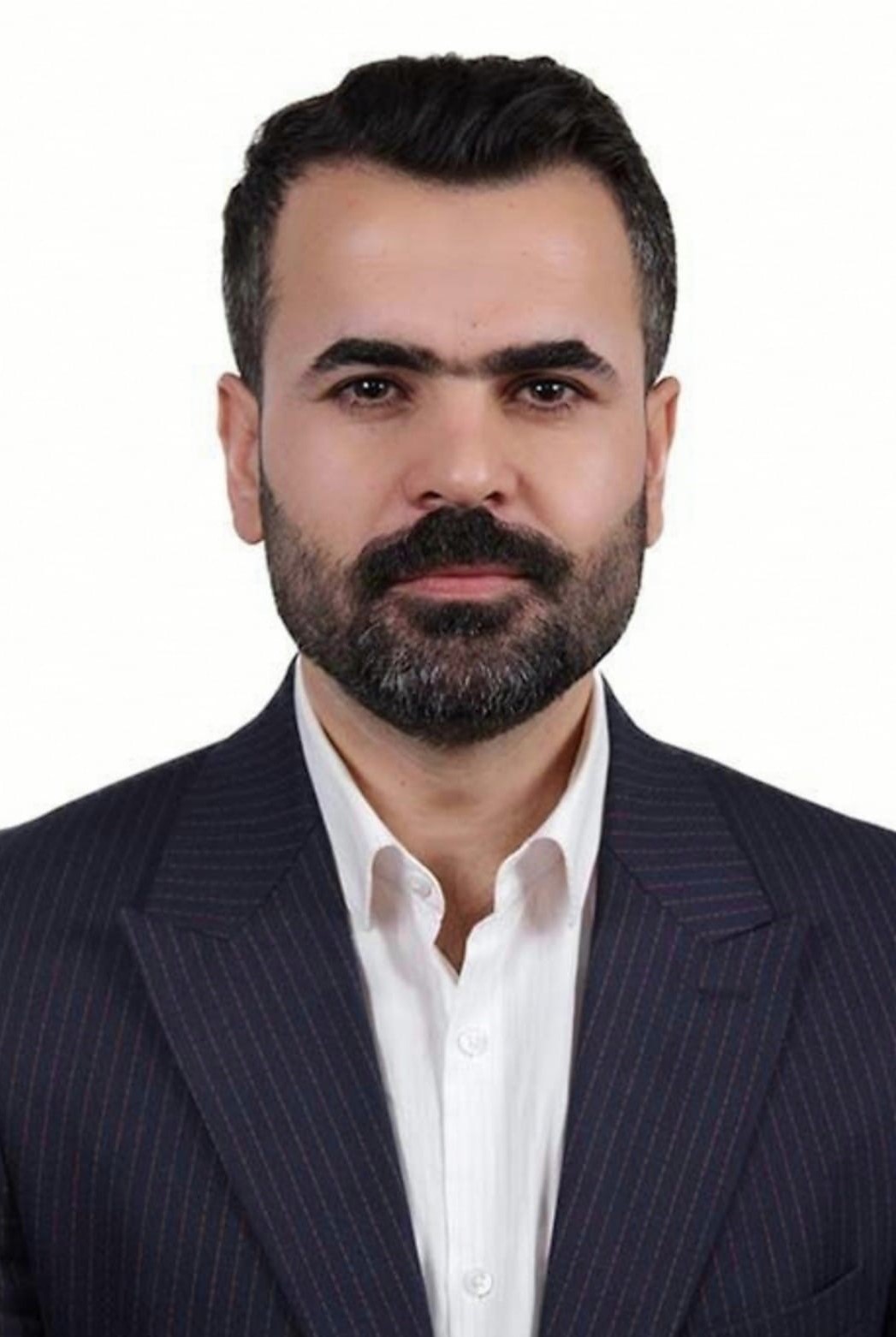
Dr. Nabard Karim Rahim is an accomplished academic and financial consultant with over 15 years of experience in higher education and professional training. He is a member of the International Association of Business Professionals for Financial Consulting in the 21st Century in India. Dr. Rahim currently serves as a Financial Advisor to the Sulaimani Provincial Council, offering expertise in fiscal management and public administration.
How important is it for political parties in Iraq to have a clear economic and financial plan to build voter trust and promote accountable governance?
It is the responsibility of political parties and coalitions to foster voter trust by presenting well-developed economic and financial policies during elections. However, a major challenge in Iraq is the widespread lack of trust in both the government and political parties, as evidenced by the 40 percent voter turnout in the 2021 elections.
To rebuild this trust, all participating parties should offer clear and robust policy proposals, particularly in the economic and financial sectors. While economic issues often feature in campaign rhetoric, for example, Prime Minister Sudani’s Development and Reconstruction campaign, these initiatives rarely address the financial reforms essential for sustainable economic growth.
Often, opposition parties also present economic proposals during campaigns, but once in office, the outcomes frequently contradict these promises because reconstruction efforts differ from financial reforms. Recent discussions between Prime Minister Sudani and President Donald Trump highlighted Iraq’s significant oil reserves yet noted the country’s inability to translate this resource into economic development.
This pattern suggests that successive governments have struggled to set Iraq on a stable growth path. It is possible that new alliances emerging after the elections in early 2026 may prioritize economic reform and help restore voter confidence. However, such efforts will face considerable challenges, as economic reforms require not only domestic political will but also coordination with Iraq’s neighbors and the broader international economic order.
What are the main economic and financial challenges Iraqis face now, especially ahead of the November elections? How well are these issues reflected in political parties' manifestos?
Since the fall of the Baath regime, economic reform and financial planning have consistently been central themes in every election campaign by Iraqi political parties. However, the critical question remains: to what extent have these policy promises been implemented? Practically, none has been fully realized.
For youth around the age of 24, the unemployment rate is even more alarming at nearly 32 percent.
One major indicator is employment. Recent data from 2024 show an overall unemployment rate of 16 percent in Iraq. For youth around the age of 24, the unemployment rate is even more alarming at nearly 32 percent. This lack of job opportunities not only undermines the workforce but also hampers broader economic development in key sectors such as tourism, manufacturing, and agriculture.
Historically, political parties have struggled to manage Iraq’s resources effectively, leading to persistent economic stagnation and lost opportunities for growth. Addressing youth unemployment and other financial challenges requires a robust commitment to tackling corruption and resource mismanagement.
Corruption stands as one of the most significant barriers to meaningful financial reform and is a major factor in eroding voter trust in both political parties and government institutions. For the upcoming November elections, it is imperative that contesting parties and coalitions prioritize anti-corruption measures across all Iraqi government offices if they intend to address the country’s pressing economic problems and regain the confidence of the electorate.
How can political parties create clear and effective economic policies that address Iraqis’ problems? Is it important for voters to understand these policies before elections?
It is essential for political parties to clearly communicate their positions on key issues that influence voter turnout, particularly economic policies. However, the critical question remains whether voters themselves are truly at the center of Iraqi elections. While voters ideally should be the focus of electoral processes, in reality, it is often the vote counting that takes precedence. In other words, it is not important who votes but who counts them.
Voters have not been placed at the heart of elections in a manner that sufficiently addresses their demands. As such, it is imperative for political parties to highlight their policies more transparently during campaigns. Additionally, Iraq’s rapidly growing population places increasing demands on basic services that must be met. Yet, if elections truly represented a meaningful opportunity for change, voter turnout would be higher than the 40 percent recorded in 2021. The persistent failure of political parties to deliver on their promises has contributed significantly to this lack of trust.
How do economic policies affect election results, voter turnout, and party success in Iraq and similar countries?
Election campaigns in Iraq and comparable Middle Eastern countries differ fundamentally from those in developed democracies. In Iraq, voter support is often driven more by nationalism, sectarianism, and tribal affiliations than by economic policies. Many political parties select candidates through tribal or sectarian loyalty to secure votes.
In Iraq, voter support is often driven more by nationalism, sectarianism, and tribal affiliations than by economic policies.
For example, Shia parties typically compete against Sunni parties, and alliances between Sunni and Shia groups against Kurdish parties shape voter turnout and election outcomes. Kurdish parties also emphasize nationalism, particularly in disputed territories under Article 140. These dynamics contribute to deep electoral divisions.
With about 60 percent of Iraqis abstaining from voting in recent elections, this reflects widespread distrust in political parties and their capacity to fulfill their promises based on two decades of failed governance. Consequently, political parties focus on the remaining 40 percent of voters, though attracting voters is rarely achieved through economic or development plans alone.
What are the biggest economic challenges the next Iraqi government will face? What political reforms are needed to fix these economic problems and promote growth?
The next Iraqi government faces a multitude of significant economic challenges. The primary concern revolves around the heavy reliance on oil revenues to finance government projects and expenditures to drive economic development. This is a challenge that has persisted across successive cabinets. It remains uncertain whether the upcoming cabinet will continue this dependency on oil to fund its expenditures.
Environmental challenges such as water shortages and drought have severely affected key natural resources like the ahwar marshes, adversely impacting agriculture and production, and triggering unemployment and migration due to desertification.
Another major issue is the bloated public wage bill. Approximately 10 million Iraqis receive salaries, pensions, or social safety net benefits from the government budget, placing a substantial and growing financial strain on public finances.
Iraq’s economy has experienced weak and sluggish growth in critical sectors such as manufacturing, agriculture, trade, and commerce over the past two decades. Additionally, environmental challenges such as water shortages and drought have severely affected key natural resources like the ahwar marshes, adversely impacting agriculture and production, and triggering unemployment and migration due to desertification.
Unemployment remains a grave concern, compounding the economic difficulties faced by the government.
Moreover, Iraq’s budget framework is ineffective and poorly aligned strategically. Historically, around 70 to 80 percent of the budget has been allocated to operational expenses, leaving only about 20 percent or less for investment in development projects. As of 2025, the budget law remains unpassed in parliament, and necessary amendments are likely to be postponed due to the proximity of the November elections.
Addressing these interconnected challenges is no simple task. Reforming Iraq’s economy will require coordinated, long-term efforts and political will across factions within and outside the government. Political obstacles and pressure campaigns are anticipated to complicate the reform process.
Nonetheless, some immediate actions are viable, including enacting an effective budget law, gradually reducing the budget deficit, and scaling down excessive public sector employment. Previous prime ministers have added about 100,000 government employees across military, security, and civilian sectors, which exacerbates wage burdens.
Reducing dependence on oil revenues by diversifying the economy, particularly through revitalizing agriculture and manufacturing, is crucial for increasing government revenues and creating employment opportunities.
However, repeating past strategies without adapting to new realities risks worsening the economic situation, especially if sudden changes cause oil prices to fall, potentially triggering a severe economic contraction and rising national debt, as witnessed during 2020–2022 COVID-19 pandemic.
- Pew Research Center. "In Many Countries, Views of the National Economy Are Closely Related to Partisanship." October 8, 2025. Read More. ↩︎
- Christensen, Love, Mikael Persson, and Jana Schwenk. "Dimensions of Economic Voting." Aarhus University, University of Gothenburg, October 1, 2024. Read More. ↩︎
- Vij, Samriddhi. “Iraq Heads to the Polls: The Stakes for its Economy.” ORF Middle East, ORF expert speech, October 8, 2025. Read More. ↩︎
- Shafaq News. "Iraq's Unemployment Crisis: A European Solution?." February 26, 2025. Read More. ↩︎
- Eurasian Research Institute. Horizons of oil era in light of the COVID-19 crisis. 2020. Read More. ↩︎
- World Bank. 2020. “New World Bank Report Calls for Urgent Fiscal Stimulus and Economic Reforms to Help the Poor and the Most Vulnerable in Iraq.” Press release, Baghdad, November 11, 2020. Read More. ↩︎
- World Bank. 2021. "Iraq Overview: Development news, research, data." World Bank, 2025. Read More. ↩︎
- Global Finance Magazine. "Iraq GDP and Economic Data." Last modified May 28, 2025. Read More. ↩︎
- Jahandost, Mohammed. “Iraq Records 12 Trillion Dinar Budget Deficit Despite Rising Oil Revenues.” CHANNEL8 English, October 8, 2025, Read More ↩︎
- International Monetary Fund Country Report. “Iraq.” IMF, Report No. 25/183, July 2025, Read More ↩︎
- IMF, ibid. ↩︎
- Riadi. "Iraqi Economic Indicators in the First Quarter of 2025: Performance and Growth Analysis." Last modified May 4, 2025. Read More. ↩︎
- International Monetary Fund Country Report. “Iraq.” IMF, Report No. 25/183, July 2025, Read More ↩︎
- Jangadost, Mohammed. "Iraq Aims to Boost Non-Oil Revenues to 20%, Says Prime Minister Sudani." Channel 8 English. September 21, 2025. Read More. ↩︎
- Söderberg, Fanny. "Economic Voting In The Developing Democracy - A Case Study of Voting Behavior in Ghana." Bachelor thesis, Lund University, 2024. Available at: Read More. ↩︎
- Healy, Anthony J., Persson, Mårten, and Snowberg, Erik. “Digging into the Pocketbook: Evidence on Economic Voting from Income Registry Data Matched to a Voter Survey.” American Political Science Review 111, no. 4 (2017): 771–785. Read More. ↩︎
- World Bank. World Development Indicators. 2023, Read More ↩︎
- Dagher, Rand, and Tamara Demasi. “Shifts in Iraq’s Public Opinion from 2003 to 2025.” Gallup International, Read More. ↩︎
- Hiwa Abdullah Hussein. “The Iraqi Political System’s Legitimacy Problem: Low Expected Turnout for Provincial Elections.” Washington Institute for Near East Policy. December 13, 2023. Read More. ↩︎
- Vij, Samriddhi. “Iraq Heads to the Polls: The Stakes for its Economy.” ORF Middle East, ORF expert speech, October 8, 2025. Read More. ↩︎
- CHANNEL8 News. "IMF Raises Iraq’s Economic Growth Forecast Amid Regional Slowdown; Sudan Leads with Fastest Growth." October 15, 2025. Read More. ↩︎
- "IMF Sounds Alarm: Economic Pressures Mount on Iraq, Non-Gulf Oil Producers." Shafaq News, May 2025. Read More. ↩︎
- CHANNEL8 News. "UN Official Warns Iraq Against Overreliance on Oil Revenues for Salaries." October 3, 2025. Read More. ↩︎
- Middle East Research Institute. "MERI Forum 2025: Shaping the Future: Visions for Peace and Prosperity." YouTube video, 4:35:45. Posted October 7, 2025. Read More. ↩︎
- Strengthening Ties: Iraq and US Take Steps Towards Economic Growth. News of Israel Economics, April 27, 2025. Accessed [date]. Read More ↩︎
- Adwan, Rim. “Iraq's Development Road: A Path to Regional Connectivity and Economic Growth.” Geopol Report. April 18, 2024. Read More ↩︎
- IHEC. “الانظمة والتعليمات لانتخابات مجلس النواب العراقي 2025 - IHEC Website.” 2025, Read More. ↩︎
- hafaq News. 2025. “Iraq's 2025 Parliamentary Elections — What You Need to Know.” October 7, 2025. Read More. ↩︎
- Peregraf. “Over 21 Million Iraqis Registered to Vote in 2025 Elections.” Peregraf. September14, 2025, 2025. Read More. ↩︎
- Human Capital Research Society (HCRS). "ثوابت ومتغيرات ما يجبر أن تكون عليه البرلمانية العراقية 2025." Human Capital Research Society. Last modified October 6, 2025. Read More. ↩︎
- Shabib Assad Kazim, Dr. "البرامج الانتخابية للكتل السياسية العراقية ٢٠٢٥." شبكة النبأ المعلوماتية. August 23, 2025. Read More. ↩︎