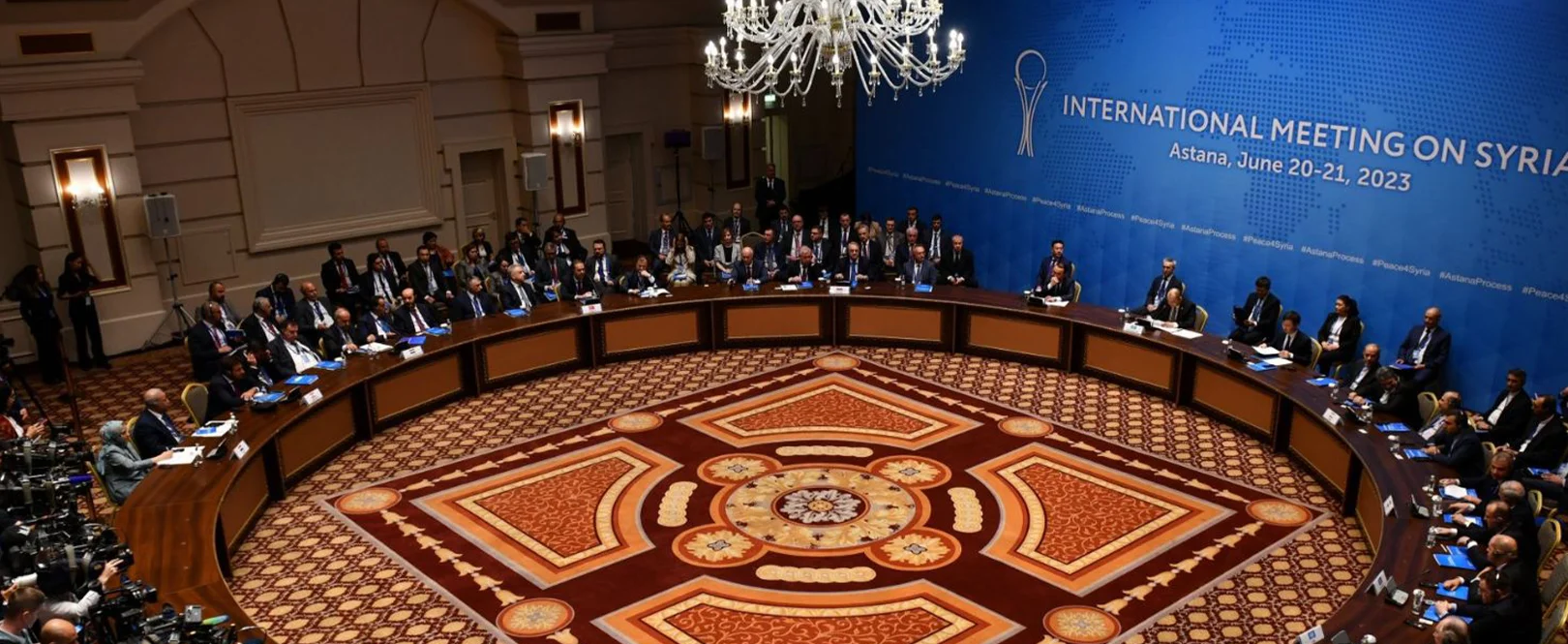
 20th round of Astana talks on Syria – Ministry of Foreign Affairs of the Republic of Kazakhstan
Türkiye’s Diplomatic Experience: Gaza and Astana Peace Processes
Executive Summary
This paper attempts to explain the role Türkiye played in the Gaza talks and how it drew on its past experiences while doing so. It examines past experiences through the example of the Astana Talks and highlights the similarities with Türkiye's stance in the Gaza talks. The most concrete outcome of these talks was preventing Iran and Russia from conducting military operations in Northwest Syria and paving the way for the collapse of the Baath regime on December 7, 2024. At the same time, it helped Russia and Türkiye-two actors that were in conflict at the beginning of the Syrian civil war-find common ground for cooperation.
Through these talks, Türkiye succeeded in developing its process-management skills and strengthening its negotiation experience. The Syrian civil war has been considered an important factor in shifting the momentum of Türkiye's foreign policy toward the Middle East.
What is Türkiye's diplomatic approach in Gaza, and how does the Astana experience frame it?
The Astana Talks resembles the September 29 Gaza Peace Plan in many respects. 1 The first similarity lies in Türkiye's role as guarantor. 2 Both the Astana and Gaza processes seem to be a stage for Türkiye's strategy of “controlled long-term strategy.”3 In both cases, Ankara tends to use the guarantor mechanism as a diplomatic springboard instead of rushing for a quick result.
The Gaza Agreement shows similarities to the Astana Talks. Especially the expectation of disarmament of HAMAS resembles Astana Talks’ foresight concerning “elimination of radical elements.” 3 Türkiye has utilized this foresight as a long-term diplomatic maneuvering room to consolidate its proxies and other armed groups in Idlib. 4 The clearest sign that Türkiye is maintaining the negotiation approach it adopted in Astana in the Gaza context is its active and decisive role in critical issues such as prisoner exchanges and the transfer of armed groups to “safe areas.”5
Unlike in Idleb, the absence of a land border with Gaza brings logistical and operational limits for Ankara.6 While such an arrangement eliminates the rhetoric of “migration waves” for Türkiye, which justified protecting its proxies in Idlib from Russian and Iranian attacks for a long time, it will not be valid in Gaza.7 Such a situation is an obstacle to Türkiye’s direct influence on the ground. Moreover, since Egypt is the only country, except Israel, with a land connection to Gaza, Türkiye must add Cairo to its diplomatic calculations.8 This new balancing factor in Ankara’s regional diplomacy can be described as “obligatory cooperation.”
The diplomatic foundation of the Astana Talks was laid by the 2016 Moscow Declaration.9 10 That has opened doors for Türkiye to effectively use a style of diplomacy based on “personal relations” between Erdoğan and Putin.11 These relations have also excluded Iran from significant parts of the Astana Talks, such as the Sochi Summit. Ankara gained a considerable advantage in negotiations, benefiting from the loose structure of the Russia-Iran alliance, which is mostly an on-paper alliance. Moscow’s low-profile reaction to Israel’s air operations in Syria and Iran’s limited moves in Idlib reflected a tendency to preserve the pragmatic balance between Türkiye and Russia.
Before the Gaza talks, a similar form of diplomacy has been seen between Erdoğan and Pres. 12 Trump during the 80th UN General Assembly. However, the multilayered institutional structure of the United States, unlike Russia, limited Türkiye's diplomatic maneuvering skills.13 The special alliance between the US and Israel has also made it difficult for Ankara to repeat the same method as in the Astana Talks.
Possible Military Implications of the Astana Model for Gaza
From Türkiye’s perspective, the Astana process represented not only diplomatic but also military balance management practices. Ankara developed a strategy based on deterrence through proxy elements in Syria through guarantor mechanisms and by preserving the status quo via targeted military interventions when necessary. 14
Turkish-backed armed groups relocated to Idlib after the evacuation of Aleppo, which has gradually become central to protecting and consolidating them.15 Türkiye deliberately and successfully spread the process over time, blocking Russia and Iran’s military pressure on Idlib. This allowed Ankara to reorganize and strengthen its proxies under its control.16 Türkiye responded to Iran’s military threats to intervene in Idlib with Operation Spring Shield, which reinforced its position as an actor unafraid to intervene on the ground when it is needed.17
The military dimension of the Astana model provided Türkiye with gradual crisis management. While disagreements remained on the diplomatic table, Ankara maintained the presence of its proxies and friendly forces on the ground and restored balance through tactical interventions. Traces of this approach can also be detected in the case of Gaza. Although Türkiye has no physical border or presence in Gaza, Türkiye has been bold to state its willingness to provide “technical support” and send its troops. HAMAS’s pretext for the delay in transferring the remains of Israeli hostages, portraying the issue as a "lack of technical equipment" alongside its request for assistance from a "friendly country," indicates Türkiye as a likely and acceptable external actor.
One of the clearest outcomes of the Astana model was the establishment of a 15 to 20 km-deep demilitarized zone under the Sochi Agreement, an example of transforming physical control on the ground into a diplomatic framework. Similarly, the uncertainty in the Gaza Peace Agreement regarding “the withdrawal of armed elements and the establishment of safe zones” reflects the same logic. In both cases, Türkiye’s approach is the “control the area” strategy that freezes the conflict while solidifying its diplomatic influence.
However, Gaza’s land connection through Egypt limits Türkiye’s ability to provide logistical support without Cairo’s approval. Egypt’s stance against both HAMAS and the Muslim Brotherhood severely limits Ankara’s chances of creating an Idlib-like protection zone in Gaza. Nonetheless, Türkiye partly compensates for these constraints through its tripartite security network with Qatar and Pakistan. Qatar’s financial resources and lobbying power in Washington, with Pakistan’s military ties to Gulf countries, give Türkiye diplomatic-military leverage in Gaza.18
The Astana-Idlib experience has created a model for being delisted from the list of banned terrorist organizations by changing names (e.g., Al-Nusra/Hayat Tahrir al-Sham). This model could possibly be applied in Gaza as well. HAMAS could similarly adapt rhetoric of “transformation” or partial dissolution to conceal its militant power. Although articles 6, 13, and 19 of the Gaza Peace Plan outline procedures regarding the fate of HAMAS, it and its thousands of well-trained militants remain critical issues. As in the Sochi Agreement, vague definitions such as “radical elements” in the Gaza Peace Plan give actors room for differing interpretations on the ground. Possibly, HAMAS’s statement that “laying down arms to the new government in Gaza” is advice from Türkiye. However, such statements clearly increase suspicions and distrust over HAMAS’s intent to keep its presence within the new government. Türkiye's plan for HAMAS’s future can be summarized as strictly adhering to the ceasefire without succumbing to Israel's “provocations” and preserving its presence.
Ultimately, the Astana Talks taught Türkiye the concept of an “indirect military presence,” which manifests in Gaza as influence-building with proxies. Yet, unlike the Astana Talks, where it faced a loose bloc of Russia-Iran, Türkiye now faces a stronger alliance, which is the US-Israel axis. This difference limits Ankara’s maneuvering space, forcing it to consider more the way of mediation, technical support, and guarantor roles than direct military capacity.
Conclusion
The outcome we have witnessed in Syria shows that Türkiye has implemented a long-term strategy that consisted of small steps designed for the short term. In both cases, Türkiye designed its primer strategy to spread over time as much as possible. By doing so, it aimed to consolidate its proxy elements. The aim of this method is to achieve a gain at the earliest opportunity with preserved and consolidated forces. To briefly recall how the Baath regime in Syria fell: At the end of November 2024, the armed Syrian opposition, which had launched an offensive from Idlib, delivered the final military blow that ended 13 years of civil war within weeks.
Although elements of the Syrian National Army (SNA), affiliated with Türkiye, took part in this military operation, it is common knowledge that the main force was the armed forces based in Idlib. Another indicator is that Russia bombed Idlib very frequently both immediately before the armed opposition's movement and during the operation.
This doesn’t mean that the Astana and Gaza processes are completely identical in every aspect. It is common knowledge that states, especially when it comes to foreign affairs, build on their experience and traditions.
The Turkish state is now reaping the fruits of its foreign policy, which it quickly shaped and put into practice in response to the chaotic Middle East and North Africa landscape following the Arab Spring. Although initially stunned by the events in Libya after the Arab Spring, it applied the lessons learned there in Syria and is now applying the experience gained in Syria in Gaza.
Türkiye has aimed not for permanent conflict resolution but for strengthening its influence through prolonged negotiation until taking the opportunity to counterattack, as it happened in Idlib. The Idlib example remains the clearest manifestation of this strategy. Ankara preserved the armed groups under its influence despite Russia-Iran pressure and rebalanced the situation through limited military interventions when necessary. We can see hints of this strategy in the Gaza situation, where Türkiye is trying to gain influence by providing technical help, mediating talks, and acting as a guarantor instead of sending troops directly.
However, the actors have changed. The maneuvers that Türkiye once had due to the loose alliance between Russia and Iran in Astana have been replaced with the institutional and stronger alliance of the US and Israel in Gaza. This new scenario pushes Ankara into a more complex, multilateral, and constrained balance management. It would also be fair to add that Israel has fewer reasons to keep the peace in Gaza than Iran had in Idlib.
- The Astana Process Six Years On: Peace or Deadlock in Syria?” Carnegie Endowment for International Peace, August 2023, Read More ↩︎
- Elçin Neciyev, “The ‘Astana Talks’ in the Context of Russia–Türkiye Cooperation,” Dergipark, accessed 2024, Read More ↩︎
- Galip Dalay, Turkish–Russian Relations in Light of Recent Conflicts: Syria, Libya, and Nagorno-Karabakh, SWP Research Paper 2021, Read More ↩︎
- The Future of Idlib After the Tehran Summit: Settlement or Confrontation?” Arab Center for Research and Policy Studies, Read More ↩︎
- Pavel Baev, Russia and Türkiye: Strategic Partners and Rivals, IFRI Russia/NIS Center, 2021, Read More ↩︎
- Five Reasons Why the Astana Talks Are Back,” Jusoor Center, January 29, 2024, Read More ↩︎
- Mattia Giampaolo, “Egypt and Türkiye,” Brief 65, CeSPI, November 2024, Read More ↩︎
- Enes Mert Demir, “Barış Pınarı Harekatı’nın Türkiye Açısından Önemi ve Sonuçları,” January 2020, Read More ↩︎
- Mattia Giampaolo, “Egypt and Türkiye,” Brief 65, CeSPI, November 2024, Read More ↩︎
- Elçin Neciyev, “The ‘Astana Talks’ in the Context of Russia–Türkiye Cooperation,” Dergipark, accessed 2024, Read More ↩︎
- The Astana Process Six Years On: Peace or Deadlock in Syria?” Carnegie Endowment for International Peace, August 2023, Read More ↩︎
- Galip Dalay, Turkish–Russian Relations in Light of Recent Conflicts: Syria, Libya, and Nagorno-Karabakh, SWP Research Paper 2021, Read More ↩︎
- Haydar Oruç, “Türkiye’s Role in Trump’s Gaza Plan,” November 2025, Read More ↩︎
- Qatar–Pakistan–Türkiye (Türkiye), the Unholy and Evil Nexus: Its Implications for Global Geopolitics,” USANAS Foundation, Read More ↩︎
- Umut Uzer, “Guarantorship Model for Palestine: An Alternative Approach to Peace,” SAM Papers, Read More ↩︎
- The Future of Idlib After the Tehran Summit: Settlement or Confrontation?” Arab Center for Research and Policy Studies, Read More ↩︎
- Hossein Aghaie Joobani, “İran’ın İdlib Müdahalesi Ne Anlama Geliyor?” March 2020, Read More ↩︎
- Enes Mert Demir, “Barış Pınarı Harekatı’nın Türkiye Açısından Önemi ve Sonuçları,” January 2020, Read More ↩︎
- Gloria Shkurti Ozdemir and Rizwan Zeb, “Dynamics of Pakistan–Türkiye Relations in a Challenging Global Order,” ISSI Policy Paper, 2024, Read More ↩︎
Content Type:Analyses