The Kurdish Paradox of 2026
Key Takeaway:
2026 shattered the assumption that Kurdish political fortunes move together. Iranian Kurds (Rojhalat) unified, the KRI fractured, Syria's Kurds (Rojava) traded autonomy for a decree, and Türkiye's peace process stalled, most under comparably weak central governments. Political fragmentation and cross-border solidarity are moving in opposite directions.
Executive Summary:
The year 2026 marked the most consequential turning point in Kurdish politics in all parts of the region since the fall of the Assad regime, and its central conclusion goes against the general consensus of overall Kurdish weakness. In Iran (Rojhat), Kurdish parties achieved an unprecedented level of formal cooperation. In contrast, in the Kurdistan Region (Bashur), it experienced one of the deepest political deadlocks throughout the history of the region, despite both contexts being governed by weak central governments. In Syria, the Syrian Democratic Forces (SDF) surrendered battlefield leverage in exchange for a presidential decree that granted significant, although untested, cultural and civil rights. In Türkiye, a fragile but ongoing peace process with the PKK continued, even as Ankara supported Damascus’s campaign against Kurdish forces. Taken together, these four examples indicate that in 2026 Kurdish political fortunes depended less on the strength or weakness of the surrounding states and more on whether Kurdish actors were seen as excluded opposition or entrenched ruling parties, and on the ways patronage networks and international supporters shaped their incentives to cooperate. A second finding of this paper is that, even as Kurdish party and governmental institutional fragmentation has deepened. There is little indication that institutional fragmentation signifies a reduction in cross-border collaboration among Kurdish movements; rather, the two seem to be diverging in particular instances. This analysis focuses on specific events rather than overarching evaluation: Kurdish factions in Iran lack constitutional political recognition and responded to an unforeseen wartime crisis, whereas Kurds in the Kurdistan Region possess constitutional autonomy and did not encounter a similar emergency during this timeframe.
Kurdish Political Developments Timeline – 2026
Iran, Türkiye, Syria, and Iraq/KRI
| Date (2026) | Region/Actors | Event | Significance |
| Jan 5 | Iran/Kurds | Seven major Iranian Kurdish parties (KDPI, Komala, PAK, PJAK, etc.) hold a “high-level meeting” and express full support for nationwide protests. | Indicates unprecedented Kurdish political unity in Iran, aligning with wider unrest. |
| Jan 7–8 | Iran/Kurds | The same Kurdish parties call a general strike (Jan 8) in support of nationwide protests. | Demonstrates coordinated civil action by Iranian Kurds. (Rojhalat) |
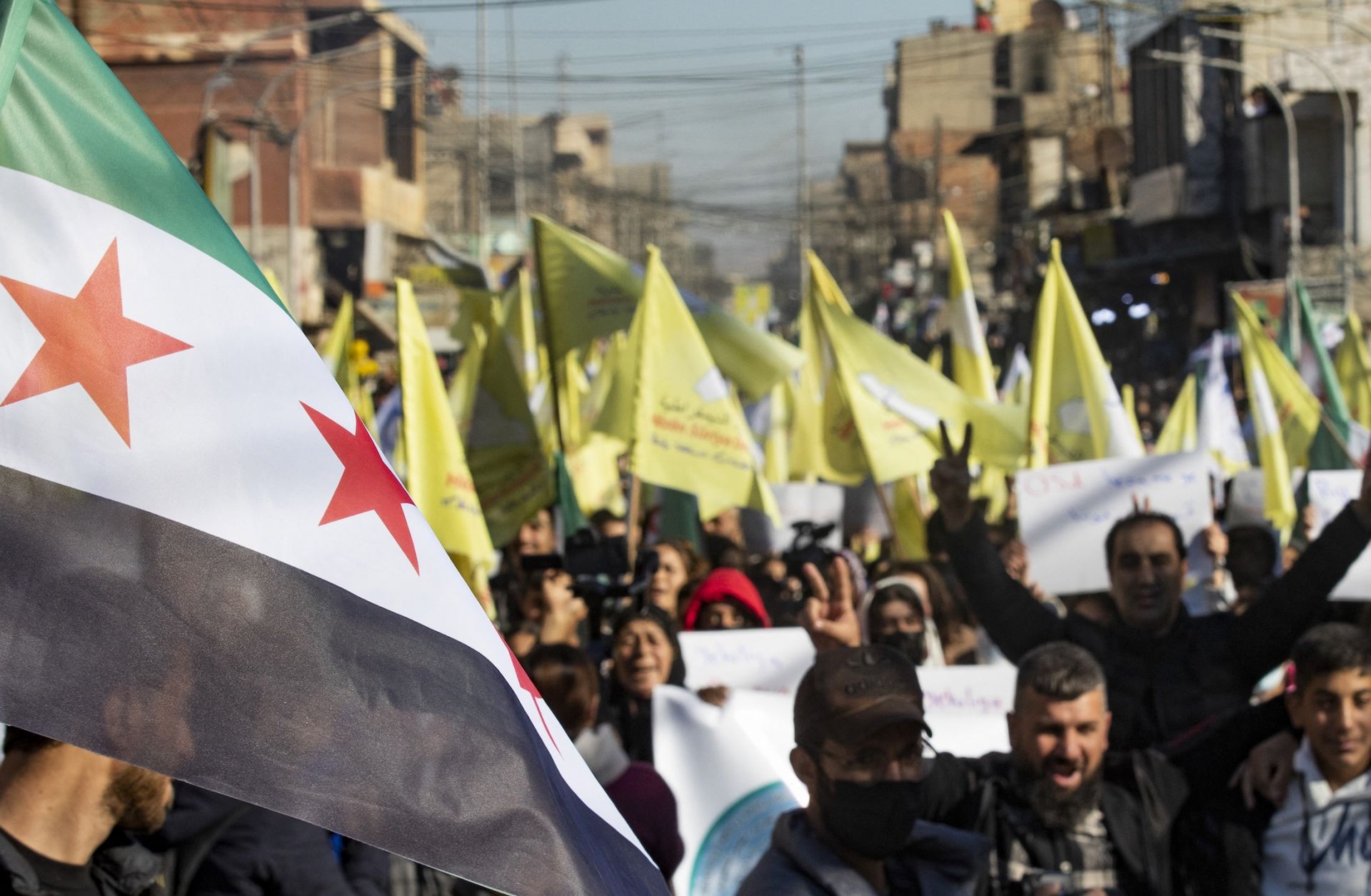
| Jan 8 | Türkiye/Kurdistan | Pro-Kurdish protests in Diyarbakir, Istanbul, and Ankara against the Syrian government offensive in Aleppo. | The Kurdish community in Türkiye reacts strongly to the SDF crisis, pressuring Ankara. |
| Jan 13–18 | Syria/Kurds | Syrian transitional government launches offensive against SDF in Aleppo/Hasakah/Deir ez-Zor; SDF eventually agrees to withdraw from Raqqa and Deir ez-Zor; ceasefire/integration deal finalized (US-mediated). | Power shift: Damascus regains control of Kurdish-held oil/gas areas; sets stage for SDF integration. |
| Jan 16 | Syria/Government | President al-Sharaa issues a decree recognizing Kurdish language and identity, restoring citizenship to Kurds, and declaring Newroz a public holiday. | Landmark: first formal Kurdish rights in Syria since Assad’s ouster, aimed at reconciliation. |
| Jan 30 | Syria/SDF & Govt | Damascus and SDF announce a “historic” ceasefire deal: phased incorporation of SDF fighters into the Syrian army, deployment of Interior Ministry forces in Hasakah/Qamishli, merging of local administrations. | Major transition: averted war, begins end of autonomous Kurdish militias; U.S. hails it as a stability step. |
| Feb 22 | Iran/Kurds | A coalition of political forces in Iranian Kurdistan is formed, uniting KDPI, PAK, PJAK, Komala, etc., seeking self-determination. | Formalizes opposition unity in Iran; signals long-term strategy beyond street protests. |
| Mar–Jul | Iraq/Türkiye (Energy) | Türkiye and Iraq agreed in July to extend the 1973 oil pipeline treaty by 12 months (after flows resumed late 2025). | Ensures Iraqi oil exports continue via pipeline (key to KRI’s revenues and Iraq-Türkiye ties). |
| Apr 29 | Iraq/KRI | “political deadlock” in KRI after 18 months without a new government; KDP–PUK rivalry eroding KRG autonomy and readiness for external crises. | Analysis highlights KRI’s internal divide and vulnerability amid regional turmoil. |
| June 16 | Iraq/KRI & Syria | Kurdistan Region President Barzani meets U.S. Envoy Barrack and SDF Commander Mazloum Abdi in Erbil. | US-facilitated cross-border Kurdish dialogue signals coordination between KRI and Rojava actors on the Syria issue. |
Syria/Rojava: From Battlefield Defeat to a Contested Legal Bargain
What Happened
Tensions between Damascus and the SDF boiled over in early January 2026, culminating in open warfare in Aleppo. On January 6, 2026, violence erupted involving government forces, the SDF, and SDF-affiliated Asayish. Within days, the Syrian Army advanced into Kurdish-controlled areas of Aleppo (Sheikh Maqsud and Ashrafiye), leading thousands of people to flee their homes in just 48 hours. A local ceasefire was negotiated, and the SDF withdrew from Sheikh Maqsud and Ashrafiye by January 10-11. However, the conflict soon spread to Raqqa, Deir Ez-Zur, and Hasaka.
On January 16th, during the conflict, not after—President Ahmed Al-Sharaa issued presidential decree number 13 of 2026. The decree declared that Kurds are a vital component of the Syrian population, Kurdish is designated a national language, Newroz will be declared a paid national holiday in Syria, and that all Syrians who were denationalized by reason of a 1962 Hasakah census based upon discrimination will have their Syrian citizenship restored.1 Implementation of this decision began in late January, with a February 5th deadline established for the completion of applications from those who were previously considered to be without nationality. By January 30th, talks on phased military and administrative unification were ongoing, and interior ministry personnel were being deployed to Hasakah and Qamishli.
Why It Matters
Kurdish political parties have reacted positively to the decree; however, they emphasized that the decree does not fully reflect what they want: full constitutional representation as well as guaranteed legal rights for Kurds rather than being based on a presidential decree, which could potentially change.2
By January 25, UN organizations documented over 170,000 displaced people in Aleppo, Hasakah, and Raqqa. UNFPA reported over 128,000 displaced individuals since February.3
The process in which rights will be recognized (rights being given in exchange for SDF participation in the removal of their autonomous governing structures) now makes the sustainability of Kurds’ rights dependent on whether or not Syria follows through in its commitments rather than the ability of the SDF to influence such an outcome.
For Whom It Matters
The outcome primarily affects Kurdish areas, as the Al-Sharaa Government seeks to integrate northeastern Syria without sparking a new insurgency. This outcome also has implications for Türkiye, which views the SDF as merely an extension of the PKK and supported the Damascus campaign against the SDF.4 In addition, this outcome will have implications for U.S. policymakers, as they have maintained ties with the SDF since January 30th (the date when the agreement was reached), despite their increasing desire to engage with Damascus.5 Additionally, the outcome will have implications for the leadership of Iraq's Kurdistan region, as shown by the June meeting in Erbil, where there appears to be growing recognition that Rojava's fate is tied to theirs.
Türkiye: Advancing Domestic Process, while supporting SDF-weakening projects across the border.
What Happened
Türkiye's Kurdish question took a very different path in 2026 compared to the future of the Syrian Democratic Forces (SDF). In February 2025, Abdullah Öcalan, the imprisoned leader of the PKK, called for an end to armed struggle, urging both the PKK and the YPG/YPJ to be disarmed.6 By the time of the PKK’s 12th Congress in late May 2025, it had already issued a formal statement declaring that it would dissolve.7 It also held a symbolic “burning” of arms in Iraqi Kurdistan in July 2025. By October 26, 2025, all but perhaps a handful of the PKK fighters had withdrawn from Türkiye. A Turkish Parliamentary Peace Commission met over twenty times, heard testimony from some 137 organizations and individuals, and reviewed approximately 4,199 pages of minutes prior to passing a comprehensive report. The report outlined how the disarmament process could be verified, how the fighters who remained could be reintegrated into society, and what legal and democratic changes would need to occur to accommodate this reintegration. The commission voted 47-2, with one abstaining, in favor of implementing these actions beginning on February 18, 2026.8
Since then, however, progress has been inconsistent. As of May 2026, reports stated that the process had reached a standstill.9 The PKK claimed that Ankara was intentionally delaying the necessary legal and political changes the PKK argued were necessary before their weapons are fully disarmed, especially regarding prosecution, political participation, and Ocalan's situation, whereas the Turkish government said that complete disarmament by the PKK is a prerequisite to achieving complete demilitarization. At the same time, Ankara allied itself closely with Damascus against the SDF.10 On January 15th, Foreign Minister Hakan Fidan stated that Syria could intensify its actions against Kurdish forces if negotiations failed.11 On January 18th the Turkish Ministry of National Defense issued a statement declaring that, for security purposes, Syria and Türkiye would be treated as “one country, one army," which pledged to provide support to Damascus to fight what they referred to as the SDF “terrorist organization."12 On January 20th, pro-Kurdish protesters and Turkish security personnel clashed at the Syrian border crossing of Nusaybin in solidarity with the Syrian Kurds. In addition, Turkish authorities launched investigations into the burning of flags during subsequent protests. The important thing is the difference in approach: While the Kurdish issue in Türkiye is moving toward some form of settlement (albeit one that remains unfinished and disputed), Syria’s Kurdish minority faces increased hostility from Türkiye externally. In this way, this reflects not a contradiction in how Ankara acts, but rather, a distinction Ankara makes—an internal PKK open negotiation provided full disarmament, versus the SDF as an external offshoot of the same ideology that needs to be destroyed by force if possible.13
The important thing is the difference in approach: While the Kurdish issue in Türkiye is moving toward some form of settlement (albeit one that remains unfinished and disputed), Syria’s Kurdish minority faces increased hostility from Türkiye externally.
Iran: Unprecedented Party Unity in the Shadows of a Visibly Strained Regime
What happened
Iran's economy was in disarray, with widespread protests throughout the country at the beginning of 2026. Seven leading Kurdish organizations in Iran, including the KDPI, PAK, PJAK, Komala, and Khabat, met to express their solidarity with all other protest movements and to organize a common response to the national protests on Jan. 5, 2026.14 The seven Kurdish organizations called for an eight-hour strike on Jan. 8, 2026; the strike was considered a show of unity among Kurds supporting the larger anti-government demonstrations taking place around the country.15 It is rare to see so many of these organizations act together due to previous accusations by the government that Kurdish opposition groups had fueled unrest during the 2022 Mahsa Amini protests.16
The groundwork laid by these political forces came together on February 22, 2026, when five of the six political groups involved in the Coalition of Political Forces of Iranian Kurdistan made it official.17 On March 4th, the remaining group, the Komala Party of Iranian Kurdistan, joined the others.18 This joint effort's founding charter was more than just a shared announcement of their collaboration, as they established a "joint military operations center" (a coordinated command center) for the armed wings of each party member, a diplomatic committee, and rotational leaders for all members. Also outlined guidelines regarding how future elections would be administered in any territory that might fall into opposition hands during a transitional phase. The alliance also bridged long-standing ideological differences, bringing together PJAK's PKK-linked democratic confederalism and the PDKI/KDPI's more traditional political program.
The government has responded with military forces. Iran has bombed Kurdish opposition posts throughout Iraq through airstrikes, and a drone strike hit Kurdish opposition targets, injuring the secretary general of Komala and one other person.19 In their analysis published in March 2026, Iranian Kurdish Parties were faced with a "genuinely difficult strategic choice" because of uncertainty about what position the United States will take regarding whether it will continue to support them.
Why It matters
The best example among the four-front comparisons shows how the weakness of the central authority allowed Kurdish political groups to develop a clearer organizational structure. In contrast, Kurds from Bashur political parties became even more divided as a result of Baghdad's greater strength, while Kurds from Rojava were forced to relinquish independent control over their units due to Damascus's increasing pressure. Kurdish parties in Rojhalat, however, were able to use a period of regime instability to create, for the first time, a functional coalition where previously there had only been a declarative one. How effectively this coalition can translate its battlefield coordination into political power will depend largely on the trajectory of Iran's broader crisis, which has already seen the economy severely impacted by the effects of the 2025-2026 Iran War with the U.S. and Israel.
This unity should be read as a response to acute crisis rather than a stable political trend: Iranian Kurdish parties operate outside any constitutional framework, and the coalition emerged only once the US war placed the regime's survival in visible doubt.
Iraqi Kurdistan (KRI): The Clearest Case of Kurdish Political Weakness
What Happened
The KRI offers the most dramatic example of how Iran’s narrative of political consolidation is challenged. Parliamentary elections were held in the Kurdistan Region on Oct. 20, 2024, in which the KDP secured the majority (39-40 MPs), followed by the PUK (23 MPs), with other minor parties dividing up the remaining number of seats.20 A full two years after these elections, there has yet to be an agreement to form a new coalition government.21 This was the first time ever that the KRI had experienced such a prolonged stalemate after parliamentary elections. It is a warning that if KDP and PUK continued their infighting, they would leave themselves vulnerable, particularly as the wider regional war against Iran threatened to destabilize the broader region.
The disagreement was not merely rhetorical. A senior PUK representative in April 2026 stated that there are no longer any political ties between the two parties.22 Suggesting that the two parties may communicate under external pressure only. Their dispute has affected national-level Iraqi politics. On 11 April, Iraq’s parliament elected Nizar Amedi, the PUK’s candidate, as president with 227 votes after the two Kurdish parties failed to agree on a unified nominee. The KDP rejected the process, describing it as inconsistent with the principles of partnership, balance, and consensus, and subsequently boycotted parliamentary sessions and cabinet meetings while recalling its representatives to Baghdad for consultations. However, the KDP reversed this boycott in early May and resumed parliamentary participation after negotiations with Baghdad and other political forces.23
Baghdad has taken advantage of the long-standing political vacuum in the Kurdistan Region to entrench federal government control over oil revenues. In March 2023, Kurdish crude exports through the Iraq–Türkiye pipeline were halted due to an arbitration dispute between Iraq and Türkiye.24 The exports were gradually resumed in September 2025 under an interim arrangement in which the Kurdistan Regional Government exported its oil to Iraq’s State Oil Marketing Organization (SOMO).25 In March 2026, Baghdad and Erbil reached an agreement to restore and increase flows under federal supervision, with revenues to be directed to the federal treasury and the KRG compensated through the agreed-upon financial mechanism. Late July/early August 2026 – Iraq and Türkiye agreed to extend the pipeline-transit framework for another year. U.S. envoy Tom Barrack discussed possible solutions to the wider Baghdad-Erbil oil dispute during his June visit to Erbil. Kurdish officials reportedly countered, however, that Iraq’s dire financial crisis made the prospect of a permanent federal law regulating oil and gas unlikely in the near future.26
Why It Matters
On June 16, 2026, KRI President Nechirvan Barzani hosted Tom Barrack, U.S. Special Presidential Envoy to Syria and Iraq, and Commander Mazloum Abdi of SDF in Erbil.27 The Kurdistan Region Presidency described the meeting as discussing the political and security situation in Syria and cooperation between Kurds and Damascus. That same day Barrack separately met leaders of KDP Masoud Barzani and Prime Minister Masrour Barzani, framing the visit around cooperation in energy and economic affairs, as well as relations between Erbil and Baghdad.28 This meeting is less evidence of the strength of KRI itself and more a sign that actors outside the region, especially Washington, are actively working to connect tracks of Kurds in Iraq and Syria at a time when internal institutions in KRI are not capable of doing this themselves. Tehran's position during this period was far more precarious than Baghdad's: the regime faced a full-scale war with the United States and Israel, whereas Baghdad treated the broader conflict as a sideshow and used the period to consolidate power, diversifying revenue sources and moving to disarm militia groups rather than confronting an existential threat.
For Whom It Matters
The political deadlock in the Kurdistan Region of Iraq has resulted directly in governance costs. As a result of this paralysis, the normal functioning of government, including its administrative duties, budgeting decisions, and ability to respond to crises, has been significantly impaired. This comes at a particularly bad time, as the KRI has endured hundreds of missile and drone attacks stemming from the broader conflict with Iran. The consequences are felt at multiple levels; citizens have faced disrupted services, elite members within KDP and PUK experience their legitimacy diminished with each unproductive cycle, and the officials in Baghdad can take advantage of a paralyzed Erbil when it comes to exerting control over KRG finances.
Cross-Front Comparison: Why Iran Unified While the KRI Fragmented
The central puzzle of this paper is that in the same several-month window in 2026, Kurdish parties in Iran moved toward unification while Kurdish parties in the KRI moved toward fragmentation while both fronts were operating under comparably weakened central governments (Tehran under war and mass protest, Baghdad under its own paralysis). This contradicts the common assumption that Kurdish actors fragment or coalesce mainly as a function of central-state weakness.
If only weak central authority drove Kurdish behavior, both should have moved in the same direction. They didn’t.
● Opposition status versus governing status: Kurdish parties in Rojhalat operate as excluded, outlawed opposition that have little to lose working together, given the stain of the current government. In contrast, parties in KRI are the ruling political actors. For the KDP and PUK uniting would require them to relinquish their individual control over the KRG’s de facto governance.
● External patronage structures: The Kurdish coalition in Rojhalat brings together parties with different foreign backers and different ideological traditions but united with a single common adversary (the Iranian regime). By contrast, the KDP and PUK have historically cultivated separate patrons abroad and built distinct economic networks inside Iraq and the KRI itself. As a result, each has less incentive to yield ground to the other, even under outside pressure.
● Regime weakness cuts differently: The 2025 Israel–Iran war and the 2025 mass protests across Iran placed enormous strain on Tehran and created an opening for Kurdish political opposition groups in Iran, who had been preparing for this opportunity as early as 2024 to capitalize on the situation. In contrast, Baghdad’s position grew relatively stronger during this time period. Iraq’s federal government consolidated control over KRG oil revenues and, through the disputed election process, extended its authority over Kurdish representatives in Baghdad. This consolidation of power around Baghdad made unification among KRI parties less likely, not because of diminished external pressure, but because of Baghdad’s increased influence.
The Syrian and Turkish cases fall somewhere in the middle. In Syria, by early 2026, Kurdish forces had become the most powerful non-state military actor in the country. However, they lost this advantage within weeks, as Washington shifted its diplomatic focus towards supporting Damascus' reintegration efforts. This illustrates how quickly an organized and experienced fighting force such as the Kurds could lose its bargaining power once it loses the backing of its primary international supporter.
● Fragmentation of power versus willingness to coordinate: A key distinction must be identified by the political fragmentation among Kurdish parties, which does not represent a decrease in Kurdish nationalism or Kurdish unity; and in 2026 both appear to be moving in opposite directions. Fragmentation at the party, patronage network, and institutional levels is illustrated by the KRI’s political gridlock, the divergent paths of the PKK’s disarmament process and the SDF’s compulsory integration, and the compromises in Decree No. 13. Yet, at the same time, cross-border solidarity among Kurdish communities has grown stronger. During the Aleppo offensive, Kurdish groups in Türkiye expressed solidarity with Syrian Kurds. After decades of ideological division, Iranian Kurdish parties joined together to form an alliance. The June gathering in Erbil symbolizes the increasing recognition of Kurdish people in Iraq that the success of Rojava is linked to their own.
Limitations and Counter-Readings
| Case | Main interpretation | Limitation | Evidence and implication |
| Iranian Kurdish unity | The February 2026 coalition indicates increased coordination among Iranian Kurdish parties.29 | It does not yet prove durable political or military unity; earlier solidarity during the 2022 protests did not produce an equivalent lasting coalition.30 | The coalition followed months of negotiations and continued organizing after its formation. It should be treated as an important but still provisional development. |
| Syrian rights decree | Decree No. 13 represents a significant formal departure from Syria’s previous exclusionary policies toward Kurds.31 | The decree may also serve diplomatic or wartime purposes, and implementation remains incomplete and uncertain.32 | Citizenship procedures and implementation began in 2026, but the decree’s long-term durability cannot yet be established. |
| Turkish peace process | The process retains institutional continuity despite serious delays. | The parliamentary vote did not guarantee a peace agreement or legal implementation; reforms remain linked to PKK disarmament. | The commission approved its report by 47–2, with one abstention, including DEM Parti support. Later reporting described delays, although a draft legal framework was submitted in August. The process is stalled or fragile, not definitively collapsed. |
| KRI political paralysis | The KDP–PUK deadlock reflects serious institutional dysfunction. | It may also be a recurring form of elite bargaining rather than institutional collapse. | The Gulf International Forum interpretation describes a restructuring of bargaining power through federal channels. The 2018 precedent is documented, but the claimed 2022 precedent requires an additional source. The current deadlock risks long-term institutional deterioration. |
Conclusion and Outlook
The four cases examined in this paper challenge the assumption that “Kurdish weakness” or “Kurdish strength,” regardless of how such terms are defined, can be treated as a single factor throughout Kurdistan. Comparably weak central governments produced different responses in Iran and in the KRI depending on whether Kurdish actors held positions within or without the formal powers of the respective states and/or how closely those actors’ patronage networks and economic interests were tied to surrounding states. This logic also explains why Syrian Kurds (Rojava) rapidly lost their battlefield leverage once U.S. diplomatic priorities shifted toward Damascus’s reintegration and why the Kurds in Türkiye (Bakur) grew skeptical of democratic negotiations even as Ankara supported military operations against Kurdish groups across its southern border.
None of the outcomes identified above represent the final conclusions for the events. The stability of Iran’s Kurdish coalition (Rojhalat) remains dependent on whether it can outlast the regime's acute crisis. The stability of Syria’s Decree No. 13 depends on whether the citizenship and language provisions are codified into constitutional or statutory law or left vulnerable to possible revocation through executive order. The success of Türkiye's proposed peace process remains dependent on whether the draft legislative framework introduced in August leads to the reintegration and guarantees of participation in politics demanded by the PKK. Finally, the current paralysis affecting the KRI remains dependent on whether the KDP and PUK establish a new government prior to receiving some type of external shock—either from Iran, Baghdad, or elsewhere—that tests the fragile nature of the region.
The important takeaway, as the title indicates, is that Kurdish political fragmentation in 2026 does not signal the erosion of transnational Kurdish solidarity. Instead, the two trends have developed in opposition. Party and institutional fragmentation have deepened. Cross-border solidarity among Kurdish movements has strengthened in response to specific crises. Tracking institutional unity and cross-border solidarity as independent variables, rather than treating one as a proxy for the other, will be essential in shaping how Washington, Ankara, Baghdad, and Damascus engage with Kurdish actors moving forward.
- Decree No. 13 of 2026, President Ahmad al‑Sharaa, art. 1–8, Syrian Arab News Agency (SANA), Read More. ↩︎
- Ibid ↩︎
- Humanitarian Response in Aleppo and East Syria, Situation Report No. 1, 27 January 2026, UN Office for the Coordination of Humanitarian Affairs (OCHA), ReliefWeb, Read More. ↩︎
- Turkey Puts Fragile Deal Between Damascus and Kurdish Forces at Greater Risk, 10 December 2025, Ahmad Sharawi, Foundation for Defense of Democracies (FDD), Policy Brief, Read More. ↩︎
- Syria Deal Could Remove Main Obstacle to Turkey–PKK Peace, 19 January 2026, Reuters, Middle East Politics, Read More. ↩︎
- Turkey: Ocalan Calls for PKK to Lay Down Weapons, 27 February 2025, Saim Dušan Inayatullah with AFP, AP, and Reuters, Deutsche Welle (DW), Read More. ↩︎
- Kurdish PKK Dissolves After Decades of Struggle with Turkey, 12 May 2025, Reuters, Middle East Politics, Read More. ↩︎
- Millî Dayanışma, Kardeşlik ve Demokrasi Komisyonu Raporu, 18 February 2026, Türkiye Büyük Millet Meclisi (TBMM), Read More. ↩︎
- Erdogan Says PKK Bill to Reach Parliament Soon, 28 August 2026, Anewz TV, Middle East Politics, Read More. ↩︎
- Türkiye Signals Readiness to Aid Syria Against Kurdish‑Led Forces, 29 August 2026, Yeni Şafak, Middle East Politics, Read More. ↩︎
- Syria’s Use of Force Against Kurdish‑Led SDF Seems an Option, 15 January 2026, Reuters, Middle East Politics, Read More. ↩︎
- Turkey’s Strategy in the Kurdish Peace Process, 29 July 2025, A. Kadir Yildirim, Baker Institute for Public Policy, Issue Brief, Read More. ↩︎
- Why Iran’s Protest Movement Cannot Succeed Without the Kurds, 14 March 2025, JINSA (Jewish Institute for National Security of America), Policy Report, Read More. ↩︎
- Iran Update, 8 January 2026, Institute for the Study of War (ISW), Middle East Research, Read More. ↩︎
- Iran Update, 8 January 2026, Critical Threats Project (CTP), American Enterprise Institute, Middle East Analysis, Read More. ↩︎
- Iran’s Kurdish Coalition and the Future of the Opposition, 22 April 2025, JINSA (Jewish Institute for National Security of America), Policy Report, Read More. ↩︎
- Turkey’s PKK Bill Sparks Debate in Kurdistan, 27 August 2026, Peregraf, Regional News, Read More. ↩︎
- Turkey’s PKK Bill Raises Concerns Among Kurds, 28 August 2026, BBC News, Middle East Politics, Read More. ↩︎
- Kurdish Groups in Iran Face Risky Dilemma Amid Unclear US Endgame, 9 March 2026, Winthrop M. Rodgers, Chatham House – Middle East and North Africa Programme, Expert Comment, Read More. ↩︎
- Political Deadlock Has Left Iraq’s Kurdistan Region Dangerously Exposed Amid Iran War, 4 April 2026, Chatham House – Middle East and North Africa Programme, Expert Comment, Read More. ↩︎
- Kurdistan Region Faces Political Deadlock Amid Regional Turmoil, 26 April 2026, Rudaw, Kurdistan News, Read More. ↩︎
- Iraqi Parliament Elects Nizar Amedi as Country’s New President, 11 April 2026, Reuters, Middle East Politics, Read More. ↩︎
- What Is Iraq–Turkey Oil Pipeline Dispute and Who’s on the Hook?, 31 March 2023, Reuters, Middle East Energy Politics, Read More. ↩︎
- Iraq Halts Northern Crude Exports After Winning Arbitration Case Against Turkey, 25 March 2023, Reuters, Middle East Energy Politics, Read More. ↩︎
- Barrack Pushes Baghdad and Erbil Toward Oil Dispute Settlement, 28 August 2026, Asharq Al‑Awsat, Arab World Politics, Read More. ↩︎
- Syria’s Sharaa, Nechirvan Barzani Meet in Damascus, 3 August 2026, The New Region, Kurdistan–Syria Relations, Read More. ↩︎
- Erbil Talks Focus on US Investment and Energy Cooperation, 16 June 2026, Shafaq News, Kurdistan Politics, Read More. ↩︎
- Country Bulletin: Iran – Kurds and Kurdish Political Groups, May 2026, UK Home Office (UK Visas and Immigration), Country Policy and Information Note, Read More. ↩︎
- Mahsa Amini Protests in Iran, 7 October 2022, Philip Loft, UK Parliament – House of Commons Library, Insight Report, Read More. ↩︎
- The Fundamental Kurdish Rights in Decree 13: A Foundational Step in the Right Direction, 22 January 2026, Syrian Network for Human Rights (SNHR), Human Rights Blog, Read More. ↩︎
- Syrian Interior Ministry Begins Immediate Implementation of Decree on Kurds in Syria, 29 January 2026, Welat TV, Erbil, Kurdish Affairs, Read More. ↩︎
- Turkey’s Parliament Advances Reforms on PKK Disarmament After Ocalan’s Call, 28 August 2026, Associated Press (AP), Middle East Politics, Read More. ↩︎
Content Type:Analyses