Pipelines and Power: US Foreign Policy and the Iraqi Kurdistan’s Gas Venture
Disclaimer: This paper was presented to the US Foreign Policy Working Group’s Annual Conference 2025 at University College London.
Executive Summary
Since the 2003 overthrow of Iraq’s former regime, the United States has consistently promoted the “One Iraq” policy as the bedrock of its stated commitment to Iraq’s sovereignty. However, this principle has been complicated by the U.S.’s open support for the Kurdistan Regional Government (KRG), including military aid, diplomatic engagement, and backing for Kurdish paradiplomacy efforts. Most controversially, the United States has endorsed multi-billion-dollar energy contracts directly between U.S. companies and the KRG, sidestepping the Iraqi federal government—an act officially deemed a violation of Iraq’s sovereignty and internally contested as unconstitutional. This contradictory stance clearly highlights the paradoxical US policy in Iraq by principally advocating for the unity and sovereignty of the country and simultaneously enabling and endorsing divisive business and trade arrangements, hence weakening America’s credibility and undermining its influence in Iraq and the wider Middle East.
Introduction
Since 2003, when the former regime of Iraq was toppled and the US-led Coalition Provisional Authority (CPA) was formed, the United States, which led the invasion/liberation of Iraq and spearheaded all political and military operations in the country, made the One Iraq Policy a cornerstone of its stated principle (CPA order, Section 1, Subsection 3).1 This policy has been in place throughout all the changes in Iraq’s place and standing in the international community, during the stormy times of relations with the US, and even at the time of the unsuccessful independence referendum in the Kurdistan Region in 2017.
US foreign policy in Iraq has been consistent on that front; however, the one continued exception has been the perceived favoritism towards the Kurdish enclave defined by the territory known to the US government as the Iraqi Kurdistan Region (IKR), which is also known as the Kurdistan Region of Iraq (KRI) by the rest of the world. The United States of America has been the main supporter of the regional administration, namely the Kurdistan Regional Government. US has been the enabler and guarantor of the success of the semi-democratic process in the Region, by supporting its consecutive cabinets and supplying the local security forces with weapons, ammunition, and training directly, separate from the Iraqi Security Forces. KRI is home to the largest US Diplomatic Consulate Mission in the world; it also houses one of the largest US military bases in Iraq.
At times, this special relationship between the US and KRI has been the subject of heated debate in the capital of the federal state of Iraq, Baghdad. Baghdad, under pressure from the undeniable influence of Iran, tends to use US-KRI relationship as leverage against the US. In the case of high-level diplomatic relations between Erbil and Washington, as well as Erbil and the European capitals, oftentimes the official line in Baghdad has been against such direct bilateral relations, bypassing the Ministry of Foreign Affairs of the Government of Iraq (GoI). Historically, the United States has been the major enabler of KRI’s “Paradiplomacy” efforts.
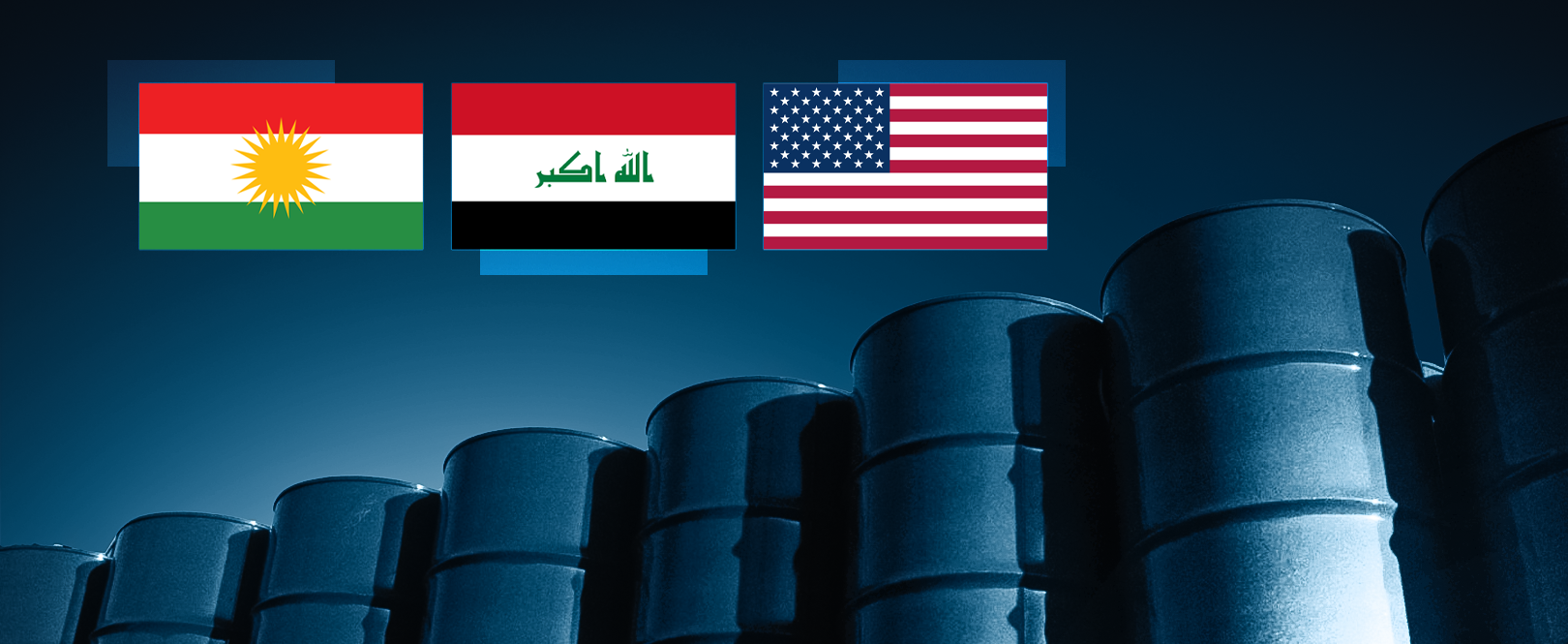
The most recent case in point is the signing of two multi-billion-dollar contracts between the KRG and US oil companies for the development and sale of oil and gas extracted from KRI. While the US continues to practice the one Iraq policy as its stated principle, on the pragmatic front it seems to be violating that same stated sovereignty by allowing, sponsoring, and defending the signing of oil deals directly with the Regional Government of Kurdistan, an action that was immediately labelled by Baghdad as a violation of its sovereignty and deemed the contracts illegal. However, the supreme court rejected a lawsuit filed by an Iraqi MP aiming at nullifying the KRG deals and labelling them as illegal.
The Kurdistan Region Within the Framework of U.S. Foreign Policy
The Kurdistan Region of Iraq is home to the largest US Consulate in the world; it is also home to the soon-to-be largest US military base in Iraq. The US military not only conducts its Iraq business in KRI, but it also uses the base near Erbil International Airport as the supply line for its operations in Northeast Syria, also known as Rojava.
The successive diplomatic missions to KRI have been able to establish relations with their local hosts on various levels and at different strength levels over the years. Despite the many ups and downs in the relationship due to momentary disagreement on certain issues, overall, the relationship can be considered positive.
US’s mission in KRI has been multi-faceted, ranging from securing scholarship grants to prospective students, to exerting pressure on Kurdish politicians and MPs to vote certain ways in favor of US-backed policies aimed at curtailing and containing Iran's influence in Iraq.
Background
The KRI was officially recognized as a federal entity after the 2003 US-led Operation Iraqi Freedom. As a consequence of the toppling of the previous regime, and under the auspices of the Coalition Provisional Authority (CPA), Iraq held its first democratic elections on January 30, 2005.2 The election led to the establishment of a parliament, a government, and a constitution that would regulate every aspect of Iraq and its political process. The US, with its CPA still in the driver seat, and its deal makers continuously assessing the process, weighed in heavily in favor of their long-term allies, the Kurds.3
The US presence in the KRI was not new, however it had transitioned from being mere intelligence collection operation from 1991 onward, to formal diplomatic presence. Post the 1991 invasion of Kuwait, and the following popular uprising against the Baath regime in the north and south of Iraq, and the brutal crackdown by regime forces, a safe-haven was established in the northern enclave where the Kurds lived. Saddam’s forces were not allowed to cross north of the 36 Parelle line by order of the UN Security Council Resolution number 688.4 The US took charge in enforcing the resolution from the skies, using its airbase in Incirlik, Türkiye. On the ground, the CIA established a permanent station in Salahaddin, north of Erbil, to monitor the movement of the military on the ground and to collect intelligence on the Iraqi regime and to urge defection within its military ranks.5
The first diplomatic mission to the newly constitutionally recognized Kurdistan Region of Iraq was opened in 2008, and its new campus is set to open later this year to house the physically largest consulate in the world. KRG's representative office in Washington, DC was opened two years earlier in 2006. Formal diplomatic ties were established between KRI and the United States, often times bypassing the Iraqi Ministry of Foreign Affairs in many of their direct dealings in trade, cultural, tourism exchanges and even high-level congressional visits to KRI.
US’s mission in KRI has been multi-faceted, ranging from securing scholarship grants to prospective students, to exerting pressure on Kurdish politicians and MPs to vote certain ways in favor of US-backed policies aimed at curtailing and containing Iran's influence in Iraq. One such example was in 2020 during the Iran-backed, Shiite bloc endorsed, voting process in the Iraqi national assembly on the ousting of the US military from Iraq and ending the Status of Forces Agreement (SOFA)6 with the Government of Iraq. Kurdish MPs in Baghdad were instrumental in swaying the vote by abstaining from attending the session and disabling a quorum in the parliament and hence making the vote invalid and legally non-binding.7
Baghdad has always watched the relationship between KRI and the US, as well as major European countries and the UK, with apprehension. Never openly, but subtly they have always considered the relationship between the Kurds with the US and the international community as a threat to the unity and sovereignty of Iraq. Baghdad is not ignorant to the fact that KRI’s paradiplomacy, enabled by the US, is a powerful tool for the Kurds to further their case of independence and their nationhood aspirations on the international arena.8
In stark contrast, the November 2017 referendum on independence held in the Kurdish region, including the disputed territories under the control of KRG authority at that time, unified Washington, Baghdad, as well as Tehran’s positions against what was labeled as a secessionist move. US’s stance on preserving the unity of Iraq and protecting its sovereignty was not shaken by the previously perceived biased relationship with the Kurds. Iraq’s sovereignty became center stage of US’s foreign policy in rejecting the idea of an independent Kurdistan in northern Iraq, citing the timing of it just as the last chapter of the war against ISIS was being written in Iraq and ISIS continued to be an active threat to the region as their remnants were still holding on to large swathes of land in Syria.9
The built-in ambiguous language of the Iraqi constitution, the section that deals with natural resources and the sale of resources, led to the exasperation of the situation and fostered further tension between KRG and the GoI.
KRI Energy Deals
Early attempts at drilling oil in the Kurdistan region of Iraq date back to the mid-90s of the previous century. However, the official accounts of actual drilling for the purposes of sale of oil on domestic and international markets goes back to 2005-2006,10 when DNO, a Danish oil company, signed a deal and started drilling at Tawka mountains. This venture started producing oil in 2007, thus marking the new era in oil production in KRI.11
KRI’s pursuit of the sale of the oil produced within its boundaries on the world market, independent of the central government of Iraq, via pipelines that ran through Türkiye, sparked the first round of tensions between the government of PM Nouri Al-Maliki and the Regional Government of Kurdistan. PM Maliki threatened to cut the federal budget allocated to KRI, if the latter did not halt the export of oil through Türkiye.12 According to a previous agreement between Baghdad and Erbil in October 2012, the KRI agreed to export an average of 250,000 bpd in 2013 if Baghdad paid the operators in the region. In return, KRI would receive 17% of the budget share. PM Maliki issued warning to the state of Türkiye and cautioned that it should not interfere in an internal matter that violates the sovereignty of Iraq.
The built-in ambiguous language of the Iraqi constitution, the section that deals with natural resources and the sale of resources, led to the exasperation of the situation and fostered further tension between KRG and the GoI. Even at the time of the heightened threat during the war against ISIS, the disputes over the sale of oil by KRI and Iraq’s steadfastness on cutting the allocated budget continued. The US often times interfered by pressuring the GoI to send salaries of civil servants, which included the security forces engaged in fighting ISIS, while on the side supplying the Kurdish Peshmerga forces with weapons and ammunition independent of Iraq’s Ministry of Defense.13
By 2017, the frozen relations between Baghdad and Erbil led to the push for the independence referendum. KRI’s narrative was that if the central government of Baghdad wasn’t willing to negotiate a deal for the budget and salaries, then an independent state of Kurdistan will have ample self-sufficiency to sell its oil on the global market and fund its own budget. The major ramification of the failed referendum was that the KRG lost control over major oil fields in Kirkuk, part of the disputed territory that was previously evicted by the Iraqi security forces due to their engagement in protecting Baghdad from ISIS’s advancements towards the capital.14
US’s Push for Energy Independence
The US Special Presidential Coordinator for Global Infrastructure and Energy Security, Amos Hochstein, has been a frequent visitor to Iraq and the Kurdistan Region. In an early 2023 visit to KRI, Hochstein emphasized the need for and importance of coordination and collaboration between the two ruling Kurdish parties the Patriotic Union of Kurdistan (PUK) and the Kurdistan Democratic Party (KDP). His particular focus during this trip was the natural gas and the importance of providing Europe with an alternative to the Russian natural gas that was no longer available to them because of the war in Ukraine. Hochstein had similar talks with Baghdad during a following trip, reaffirming resolving disputes between Baghdad and Erbil within the framework of the Iraqi constitution.151617
It is imperative that Iraq passes a robust oil and gas law to complement the broad-brush strokes of the constitution and to address a spectrum of issues related to the administration of revenues and budget allocations associated with the sale of oil and gas.
This push may have been misinterpreted by KRG authorities as a green light to sign deals with US firms directly, while sending a different message to the central government of Iraq. The Iraqi Constitution leaves much to interpretation and speculation when it comes to the natural resources and specifically the oil and gas sector. Ony two articles, 111 and 112, address this rather critical issue with a language that is general and vague. Article 111 suggests that all of Iraq’s oil belongs to the people of Iraq, and the federal government is the sovereign representative of the people. It further suggests that the resources should be managed by the federal government.
Then there is the issue of “present oil fields” and “newly discovered fields” within the language of the constitution. These terms are also contested between KRI and the federal government. In the absence of a federal oil and gas law; the vote on the proposed draft has been stalled by political rivalries for over a decade; KRI passed its own oil and gas law in 2007 and thereby granting itself the right to produce oil independent of the central government and the ability to deal directly with international oil companies (IOC).
It is imperative that Iraq passes a robust oil and gas law to complement the broadbrush strokes of the constitution and to address a spectrum of issues related to the administration of revenues and budget allocations associated with the sale of oil and gas. Any hydrocarbon law should spell out the exact provisions of:18
- Iraqi ownership and management of resources
- Power sharing between the federal government and the regions
- The allocation and control of revenues
- The management of existing production relative to new exploration
Iraq Takes Legal Action
To settle some of the disputes, the Iraqi Federal Supreme Court (FSC) initiated a series of hearings. Although the hearings were initiated and backed by politically driven agenda, some very critical rulings were passed. Under the verdict of the FSC, the oil sector lies constitutionally within the rights of the federal government to manage, control, and distribute, citing Article 112 of the Iraqi constitution. Following this ruling, the FSC ruled in January 2023 that budget transfers previously delivered to the KRI were illegal given that the KRG did not honor its agreement to send the agreed-upon volume of oil to Baghdad.19
Additionally, the court of arbitration of the International Chamber of Commerce (ICC) ruled in favor of Iraq in a hearing as a result of a formal complaint filed by Baghdad against Türkiye for allowing the use of its pipelines to export KRI’s oil. Given the Iraq-Türkiye's 50-year-old pipeline agreement, the court found Türkiye of blatant breach of the 1973 pipeline agreement for allowing KRI oil sales without Iraq’s consent. On March 23, 2023, the ICC ruled that Kurdish oil exports through Türkiye's Ceyhan port was in breach of the 1973 pipeline transit agreement citing that Iraq’s State Oil Marketing Organization (SOMO), was the only party that would manage exports through Ceyhan. Türkiye was fined $1.5 billion in damages to Iraq (after settling old debts Iraq owed Türkiye). KRI was ordered to handover the oil industry in its entirety to Baghdad.
Fastforward to May 18, 2025, and a new wave of disputes over the legality of direct oil sales by KRI surfaced. In Washington DC, KRG’s PM Masrour Barzani signed two “contracts” with two US energy companies, HKN Energy and ONEX Group. These “contracts” are reported to be worth $110 billion in long-term value.20 The announcement of these contracts was mired in ambiguity, on the one hand the official statement of the KRG PM’s office labeled the agreements as “contracts”, while the official joint statement of HKN and ONEX called the agreements “binding term sheets.”21 In a direct inquiry to APIKUR, The Association of the Petroleum Industry of Kurdistan, the spokesperson for the association described the nature of the agreement as “term sheets that would need sales agreements for the marketing and payment of the gas.”22
Baghdad’s immediate reaction was to reject such direct deals between KRG and US companies. The Ministry of Oil issued a statement in which it clearly stated, “any direct agreements between US companies and the Kurdistan Regional Government, conducted outside the authority of the federal government, violate the Iraqi Constitution.”23 This official statement was followed by action from the Ministry of Finance which decided to withhold KRI’s share of the remaining budget and stopped the disbursement of salaries to civil servants in the KRI. This action was quickly labeled as “punitive” by KRG authorities.24
In an effort to soften the impact of the deals, the KRG responded by framing the deals as part of the broader strategy aimed at revitalizing the energy sector and developing economic infrastructure, with the focus on generation of electricity.
The United States showed its full support for the two newly signed deals between US oil companies and the KRG.25
Regionally, the US can benefit from a more trustworthy posture while it tries to decouple Iraq from Iranian influence, politically and in the energy sector.
Implications for U.S. Credibility and Regional Politics
The US professes a steadfast commitment to the Iraqi sovereignty under the “One Iraq” policy, but simultaneously supports the Kurdistan Regional Government’s diplomatic, economic, and disputed energy deals directly with US companies. This contradictory posture is viewed as selectively honoring Iraqi sovereignty-rhetorically supporting federal unity but partaking in divisive actions by the KRG in practice.
The deteriorating relationship between KRG and Baghdad over budget allocations and distribution of salaries for civil servants can benefit from direct mediation by the United States, however; US’s perceived siding with the KRG on the oil deals only exasperates the tensions by emboldening the KRG, and hence escalating the tensions and contributing to impeding national reconciliation and putting the country in the risk of further fragmentations.
Regionally, the US can benefit from a more trustworthy posture while it tries to decouple Iraq from Iranian influence, politically and in the energy sector. For US policy in Iraq to be trusted, PM Sudani must be assured that the US is serious about the preservation of the unity of Iraq in the face of any, and all, internal and external meddling. The US will lose considerable political ground and capital if it is perceived as a flip-flopper in this very critical time in Iraq. US’s perceived favoritism towards the KRI may even jeopardize the Kurdistan Region, if US’s mixed messaging is misinterpreted as prelude to full-scale support for the Kurds in their pursuit of further independence from the rest of Iraq. The continuation of this dynamic complicates the U.S.’s ability to unify Iraq as a stable partner in an increasingly competitive Middle East geopolitical landscape.
Conclusion
The paradoxical U.S. stance on Kurdish autonomous dealings versus the sovereignty of Iraq, presents serious challenges for America’s foreign policy credibility. It also complicates efforts to achieve a stable, unified Iraq. It is only with clear messaging and strong credibility that the US can pull Iraq away from the Iranian sphere.
This contradictory US stance carries with it significant implications for both its credibility and regional politics. The US exposes itself to clear perceptions of double standards and selective commitment. This paradox undermines the credibility of the United States as a steadfast and principled actor in Iraq and the broader Middle East.
Mixed messaging also exposes the US foreign policy to the danger of not being able to deliver on commitments. Iraq requires coherent, consistent US policy attention, ambiguous messages and stances blur the lines and allows for selective interpretation at a time when the US must exhibit credibility as a consistent and trusted actor in Iraq.
In Summary, the paradoxical US policy in Iraq weakens its diplomatic standing, fuels internal discord, and complicates the geopolitical landscape.
- Coalition Provisional Authority, Coalition Provisional Authority Regulation Number 1, May 16, 2003, Read More. ↩︎
- U.S. Department of State, "IRAQI ELECTIONS: January 25, 2005," Read More. ↩︎
- Brendan O’Leary and John McGarry, Constitution Building and Federal Options in Iraq: The Kurdish Challenge, seminar report, Rights & Democracy, September 24, 2004, ReliefWeb, Read More. ↩︎
- United Nations Security Council, Resolution 688, S/RES/688 (April 5, 1991), Read More. ↩︎
- Timothy Cake, "America’s Alleged Intelligence Failure in the Prelude to Operation Iraqi Freedom: A Study of Analytic Factors" (PhD diss., University of Calgary, 2017), Read More, doi:10.11575/PRISM/24784, Read More. ↩︎
- R. Chuck Mason, U.S.-Iraq Withdrawal/Status of Forces Agreement: Issues for Congressional Oversight, Congressional Research Service, July 13, 2009, Read More. ↩︎
- Washington Kurdish Institute, "THE IRAQI PARLIAMENT’S VOTE TO END U.S. PRESENCE IN IRAQ IS ILL-ADVISED. BUT IT CAN STILL BE NULLIFIED," January 6, 2020, Read More. ↩︎
- Bekir Aydoğan and Mehmet Alaca, "Kurdistan’s Fading Dream: The Struggle and Despair Behind Erbil-Baghdad Relations," Gulf International Forum, Read More. ↩︎
- United States Department of State, “Iraqi Kurdistan Regional Government’s Planned Referendum,” press statement by Heather Nauert, September 20, 2017, Read More. ↩︎
- Noor Omer, "Kurdistan Region’s Oil Exports Entering a Year-Long Halt," iNNOV8 Research Center, March 25, 2024, Read More. ↩︎
- Halil İbrahim Telli, Kiya Pourshariati, and Muhammed Emin Beritan, “The Kurdistan Region of Iraq: From Resources to Reserves: A Decade of Challenges and Increased Oil and Gas Production,” August 2024, Read More ↩︎
- "Maliki warns Kurdistan over oil exports," Al Jazeera, January 12, 2014, Read More. ↩︎
- Saul, Heather. "US to Directly Arm Kurdish Peshmerga Forces in Bid to Thwart Isis Offensive," The Guardian, August 11, 2014, Read More. ↩︎
- (Telli, Pourshariati, and Beritan, “Kurdistan Region of Iraq.”) ↩︎
- Presidency of the Kurdistan Region of Iraq, "A Statement from the Kurdistan Region Presidency," January 18, 2023, Read More. ↩︎
- Deputy Prime Minister and Foreign Minister Fuad Hussein, "Deputy Prime Minister and Foreign Minister Fuad Hussein Meets Special Presidential Coordinator for Global Infrastructure and Energy Security Amos Hochstein," Ministry of Foreign Affairs of the Republic of Iraq, March 22, 2024, Read More. ↩︎
- Enabling Peace in Iraq Center, ISHM: January 12 - 19, 2023, Read More. ↩︎
- Iraq Legal Education Initiative (ILEI) and American University of Iraq, Sulaimani, Introduction to the Laws of Kurdistan, Iraq Working Paper Series Oil & Gas Law of Iraq, PDF document, Stanford Law School, August 2024, Read More. ↩︎
- (Telli, Pourshariati, and Beritan, “Kurdistan Region of Iraq.”) ↩︎
- Kurdistan Regional Government, "KRG Signs Landmark Energy Agreements in Washington to Boost Investment, Energy Security, and Economic Growth," May 21, 2025, Read More. ↩︎
- HKN Energy and ONEX Group, "U.S. Investor HKN Energy and ONEX Group Launch Miran Energy to Develop Major Gas Field in Kurdistan," press release, Washington, D.C., May 18, 2025, Read More. ↩︎
- Myles B. Caggins III, spokesman for the Association of the Petroleum Industry of Kurdistan (APIKUR), statement to author, August 2025. ↩︎
- "Oil Ministry: U.S. Companies’ Direct Deals with Kurdistan Region without Federal Approval Are Unconstitutional," Iraqi News Agency, May 23, 2025, Read More. ↩︎
- Emirates Policy Center, "How Will the Crisis Over the Kurdistan Region’s Gas Contracts with US Firms Reshape Baghdad-Erbil Relations?," May 2025, Read More. ↩︎
- United States Department of State, "Department Press Briefing – May 27, 2025," May 27, 2025, Read More. ↩︎
Content Type:Expert Insights