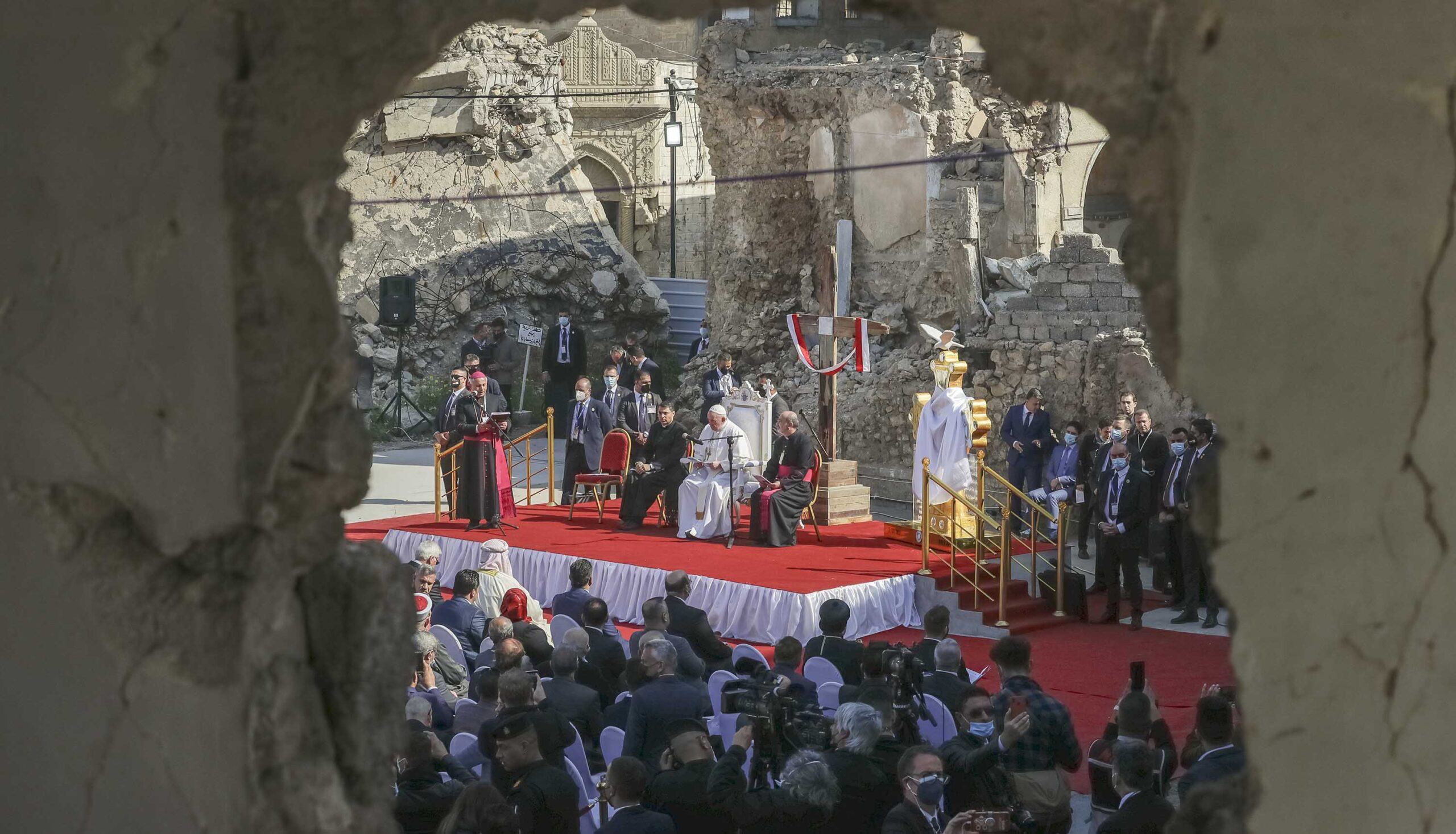
 Pope Francis, surrounded by the remains of destroyed churches, attends a prayer in Mosul, Iraq. Francis called for "harmonious coexistence" of people from different backgrounds and cultures. Andrew Medichini/AP.
Religious Freedom and Legal Protection of Minorities in Iraq
Executive Summary
This paper examines the constitutional and legal protection for religious minorities in Iraq and explores the status of religious freedom in Iraq and to what extent the constitution adopts religious freedom and provides legal protection to religious minority groups in the country. A thorough analysis of the constitution, legal provisions, and previous literature, this paper aims to provide a comprehensive examination of religious freedom in Iraq.
Religious freedom is considered one of the fundamental pillars of human rights and democracy, and every individual should be able to hold and practice their beliefs and worship freely. Communities that embrace religious freedom and pluralism tend to be more secure and stable, as maintaining these values can enhance overall human rights conditions and support the foundations of peace and prosperity. In Iraq, the 2005 constitution serves as a legal framework for protecting religious minority groups and has made positive changes toward religious freedom and promoting religious tolerance within society.
This paper finds that despite having constitutional articles that emphasize freedom of religion and belief, in practice there are restrictions on religious freedom, and religious minorities sometimes face governmental and non-governmental backlash. Besides the legal and constitutional limitations, religious minorities also encounter political, social, and economic challenges. Additionally, there are paradoxical articles in the Iraqi constitution, and some pre-2005 constitutional legislation exists that explicitly restricts religious freedom in Iraq and deprives some minority groups of declaring themselves as a religious group and registering with the Iraqi government.
Despite constitutional guarantees of religious freedom and worship, the gap between legal protection and practical provisions that religious minorities receive remains remarkable.
Introduction
Iraq has been recognized as one of the most diversified countries in terms of having different ethnic and religious groups. The population of Iraq consists of Arabs, Kurds, Christians, Yezidis, Kakais, Mandaeans, Bahais, and Shabaks, who have contributed to the heritage and historical identity of the country. The Iraqi constitution sets Islam as the official religion of the country, while it recognizes Iraq as a diverse country in terms of ethnicities and religions, with constitutionally guaranteed freedom of religion for religious minorities, including Christians, Yazidis, and Sabaean-Mandeans, and provides freedom for all individuals to practice their beliefs and worship. Despite constitutional guarantees of religious freedom and worship, the gap between legal protection and practical provisions that religious minorities receive remains remarkable.
This paper studies religious freedom in Iraq and explores the legal protection provided to non-Muslim religious groups in the constitution. Moreover, besides the constitutional and legal obstacles, this paper also highlights the political, social, and economic challenges that these minority groups encounter.
The significance of the findings resonates in the fact that Iraq is one of the most diverse countries, and religious freedom is a fundamental pillar of human rights and democracy that all individuals should be entitled to and exercise their belief freely. Providing religious liberty and protecting religious minority groups by law remains essential. Therefore, this research paper explores the legal protections that religious groups in Iraq maintain and how the constitution protects them while it introduces Islam as the official religion of Iraq, and no legislation should contradict Islamic traditions.
Who Are Minorities? Key Concepts and Criteria
“Minority” refers to a group of people who are fewer in number than the majority, distinguished from them by ethnicity, religion, or language. Minorities are usually not in a position of political, economic, or social dominance. Francesco Capotorti, an Italian lawyer who worked as Italy’s representative in the United Nations General Assembly, in 1979 offered the following definition: “a group, numerically inferior to the rest of the population of a State, in a non-dominant position, whose members, being nationals of the State, possess ethnic, religious, or linguistic characteristics differing from those of the rest of the population.”1
On the other hand, the Canadian judge Jules Deschênes, defined the minority concept as: “A group of citizens of a state, constituting a numerical minority and in a non-dominant position in that state, endowed with ethnic, religious, or linguistic characteristics that are different from those of the majority of the population.”2
Both definitions emphasize the differences in language, belief, and worship between the minorities and the rest of the population, which, as a result, designates them as a minority within the country. However, the American Encyclopedia, alongside the religious and social differences, also focuses on power and dominance within society when defining religious minorities as: “Groups have less power and influence and exercise fewer rights compared to dominant groups in society.” The concept of minority changes over time and across locations. However, scholars agree on the fact that, in order to define the concept of a religious minority, one should consider a set of criteria. Quantitative and numeric criteria are a major factor, which refers to “the demographic group that makes up the smallest proportion of the population, less than half,” although there is no specific range or number to define minority groups. However, in 1972 the Supreme Court of India adopted an indicator in the (Am-Patroni- Ve Shesvan) case, and identified a minority as "any religious or linguistic group whose population is less than 50% of the population of the state's group of people."3
The quantitative indicator alone is not sufficient to describe or identify a minority group within a country. Therefore, a large number of studies emphasize the objective criterion, which means a minority is not just different in number from the rest of the population, but rather it maintains distinct social characteristics and receives unequal treatment. This can be observed in areas such as education, employment, and criminal justice. Moreover, minority groups can often be distinguished by their clothes, religious rituals, skin color, and language. They usually marry within their groups due to traditional and legal pressures that limit exogamy. Overall, minority groups share a sense of identity and a mutual destiny among their members.4
Within the minority types, religious minorities are considered one of the most problematics types of minorities to handle due to the importance of religion and belief systems to human beings, and because religions have historically been a source of conflict regardless of the religion's type, values, and validity. Religious minorities are present in every country; however, their circumstance and the degree of justice and respect they receive, as well as their well-being, depends on the state that they are presence in.5
Understanding Religious Freedom: Meaning and Importance
A religious minority refers to a group of people or communities whose practices and beliefs differ from those of the majority in the country. Religious freedom has been recognized in the 1948 Universal Declaration of Human Rights and subsequent international agreements, which emphasize that all individuals must be able to enjoy and practice religious freedom.6 Religion refers to “an organized collection of beliefs, behaviors, and spiritual practices that connect or relate humanity with the divine.” This concept practically means having the liberty to choose what one wants to follow and believe with regard to doctrine and theology. In other words, religious freedom refers to the ability of individuals to select and change their religious beliefs and to organize their lives in accordance with those principles.7
Religious freedom is considered one of the critical pillars of human rights, and scholars agree that it can enhance overall human rights conditions and serve as a foundation for peace and prosperity in any nation. In a survey conducted by Pew Global Attitudes in 2007 across five diverse continents, covering citizens in 34 countries, participants were asked about the importance of practicing their religious freedom. The responses were overwhelmingly high, “ranging from 84 percent in Eastern Europe to 98 percent in Africa. On average across the 34 countries, 93 percent indicated that it is important to be able to live in a country where they can practice their religion freely, with less than 2 percent indicating that it wasn’t important at all.” Historically, religions have driven many security dilemmas in numerous countries. In the first years of the 21st century alone, millions of people were killed or displaced due to religion-related conflicts.8
While all religions are different and conditioned by their context and culture, all of them strive to reach the same reality and bond people with something bigger and spiritual.
John Hick, English philosopher of religion and theologian
The core of religious freedom and pluralism stands on the idea that multiple religious beliefs can coexist within one society and maintain mutual understanding and harmony with each other. This perspective strongly challenges the notion that one religion is true and holds the absolute truth in society. John Hick, an English philosopher of religion and theologian, contends that while all religions are different and conditioned by their context and culture, all of them strive to reach the same reality and bond people with something bigger and spiritual. Pluralism theory drives societies to understand that each religion has its own philosophy and values and is worth respect and acceptance. Fostering this theory inspires people to understand each other’s faith rather than asserting that only one religion is right and God belongs to them alone.9
Historical evidence reveals that maintaining religious freedom and pluralism leads to greater security and stability. Societies that allow their citizens to freely practice their religion and live in agreement with these beliefs and values are prone to attract talented and educated people from around the world and will have better economic engagement. Pluralistic societies that value human dignity and do not view religious groups or beliefs as a problem to be eliminated will not suffer from the violence fostered by religious discrimination.10 Additionally, religious tolerance can enhance social cohesion. When a specific state and its constitution foster dialogue and mutual respect among people with different beliefs, the society, in turn, will be more unified and better equipped to prevent or mitigate tension and conflict.11
Brian J. Grim, in his paper titled “Religious Freedom: Good for What,” highlights the correlation between religious freedom and political life, stating that when there is greater religious freedom, there is more political participation, “and religious participation in turn can lead to a wide range of positive social and political outcomes.” Over time, religious minority groups engage and contribute to society, becoming an accepted part of it, which in turn will foster a more unified and interconnected community. These dynamics are conceptualized as a religious freedom cycle. This approach has been applied in 143 countries, and the findings steadily demonstrate that when “here are no limiting barriers for religious freedom, but respect and protect such activities as conversion and proselytism, religious violence is less. Countries with no restrictions on conversion, in particular, tend to have higher levels of fundamental freedoms and less overall armed conflict.”12
Religious intolerance and discrimination are on the rise globally, according to recent surveys, with one-third of nations reporting "high" or "very high" restrictions on religious freedom or religiously motivated social conflicts.
Government is not the only institution capable of violating religious tolerance by rejecting one or more religious faiths within the community. Religious freedom can also be undermined through social aggression when it targets a religious minority group or more. Social hostilities and governmental limitations are both present in countries where religious freedom is not respected.13 Religious repression is a specific type of government control over an individual's beliefs and collective behavior. The government can suppress freedom of religion in several ways and methods, including imposing administrative constraints such as tax laws and registration requirements, as well as prohibiting public worship or proselytizing. Different from generic political repression, religious repression specifically targets an individual's beliefs and collective behavior.14 Religious intolerance and discrimination are on the rise globally, according to recent surveys, with one-third of nations reporting "high" or "very high" restrictions on religious freedom or religiously motivated social conflicts. Nearly 77% of the world's population now resides in countries with strict government regulations on religious freedom.15 In summary religious freedom promotes stability, helps consolidate democracy, and reduces religious violence.
The number of minorities was notably absent from the official results of Iraq's 2024 general population census, and there was no explicit breakdown for religious minorities in Iraq.
Identification of Religious Minority Groups in Iraq
Iraq, or Mesopotamia, which is often referred to as the cradle of civilizations, is the birthplace of numerous ethnic and religious groups. Iraq’s main minority groups consist of Christians, Yezidis, Mandaeans, Shabaks, Kaka’i, Turkmens, Bahai’s, and until recently, Jews. The latest statistics concerning the Iraqi population, which date back to 2010, show that 97% of Iraq’s population is Muslim. Of this majority, nearly 55–60% are Shia Muslims (Arabs, Turkmen, and Faili Kurds), while around 40% are Sunni Muslims (Arabs, Kurds, and Turkmen). Religious minority groups make up only 3% of Iraq’s population and are mainly Christian, Yazidi, Sabean-Mandean, Baha’i, Kaka’i, and Jews.16
It is worthwhile to mention that, regardless of the inclusion of a section for religious identification in the forms issued by the Central Statistical Organization of the Iraqi Ministry of Planning, the number of minorities was notably absent from the official results of the country's 2024 general population census, and there was no explicit breakdown for religious minorities in Iraq. This situation has caused concern among these groups, as the lack of data and their absence might impact representation, rights, and resource allocation.17
Christians
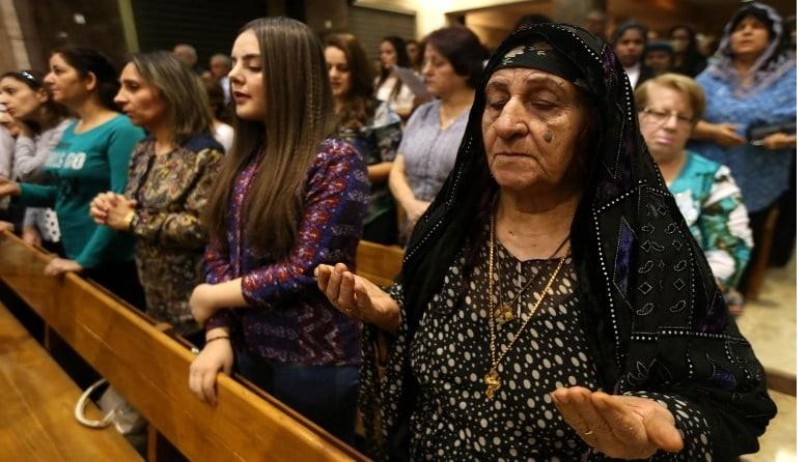
The Iraqi Christians are among the oldest Christian communities in the world, with roots tracing back to the 1st century. Christians arrived in the lands of Mesopotamia during the apostolic age, making them the earliest followers of the religion. They have maintained their presence in the area for almost 2,000 years, preserving their ancient traditions and religious practices.18
Christians in Iraq are called by different ethnic names, such as Chaldeans, Assyrians, Syriacs, and Armenians. Chaldeans are Eastern Rite Catholics, Assyrians belong mainly to the Church of the East, Syriacs are mainly Eastern Orthodox, and Armenians are both Roman Catholic and Orthodox. The Chaldean Catholic Church is the largest group of Christians in Iraq. The Christian community in Iraq speaks Eastern Aramaic dialects, preserving the language Jesus himself spoke. However, most of them also speak Arabic and consider themselves Christian Arabs.19
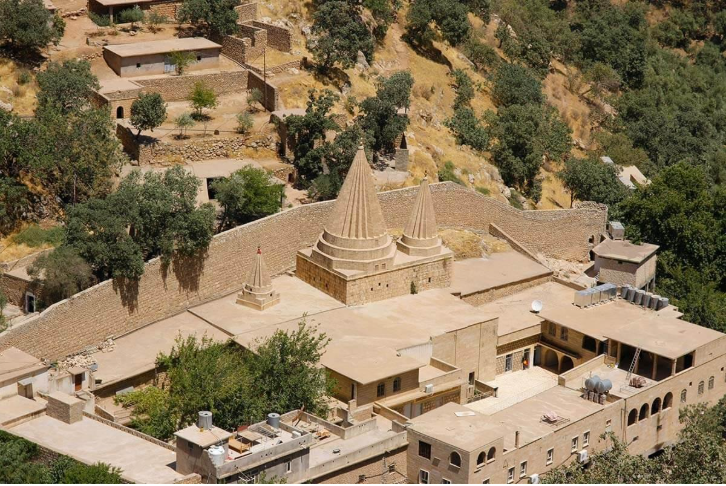
Yezidis
The name is derived from Yazd or Yazdan, the god of goodness in Parsi tradition, and the religion is rooted in Iranian religions blended with elements of pre-Islamic Mesopotamian religious traditions, Mithraism, and Islam. Confusion still surrounds the origin of the Yezidi community, but their beliefs include elements of ancient Persian worship, Christianity, and Islam. They have a strong sense of calm and patience.20 Yezidism is one of the oldest religious beliefs, dating back to the Sumerian period. Yezidis are an ethnic Kurdish group, and they speak the Kurmanji Kurdish dialect. They primarily reside in the western part of the Nineveh Governorate; nevertheless, some also live in the Kurdistan Region, particularly in Duhok Governorate. Yezidism is a closed religion in terms of conversion, does not permit its followers to convert to other religions, and has its own interpretation of God and the concepts of good and evil. Yezidism is considered one of the most persecuted religions in Iraq, Islam does not recognize its followers as part of the “People of the Book”, whereas Christians are mentioned in the Qur'an and are recognized as people of the Book.21 Historically, Yazidis faced several campaigns aimed at eradicating them, from Abbasid rule to the Ottoman Empire. Between 1809 and 1876, the Ottoman Empire launched a military campaign against the Yazidis, terrorizing them, destroying their homes, selling their women, and killing their sheikhs.22
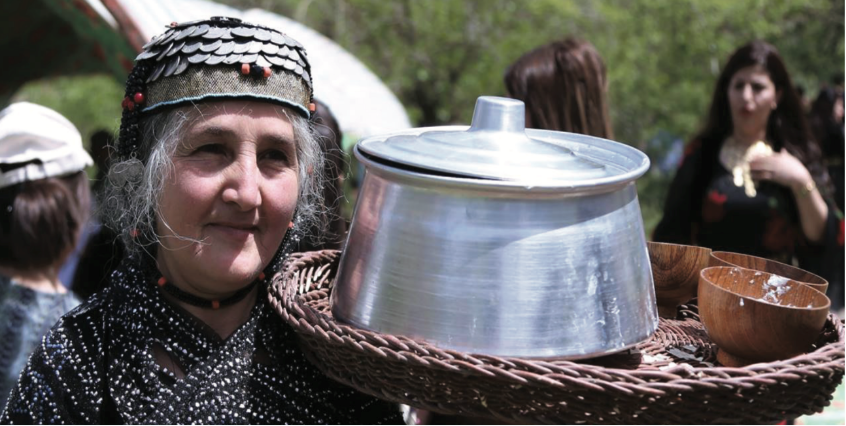
Kaka’is
Kaka’i, who are also known as Ahl-e Haqq or Yarsan, are one of the religious minority groups in Iraq, with their number estimated to be between 110,000 and 200,000. They mainly live in Kirkuk, Daquq, and Hamdanya in the Nineveh Plains. Some also reside in Diyala, Erbil, and Sulaymaniyah. The Kaka’i faith is regarded as part of Kurdish ethnicity, and its followers speak a dialect known as Macho. However, there are also Arabic speakers among them. They uphold and practice a unique syncretic religion that originated in western Iran in the fourteenth century and incorporates aspects of Shi'a Islam and Zoroastrianism. The Kaka’i embrace mystical practices and engage in spiritual ceremonies that are shrouded in secrecy.23
Masti Qalati is one of the ceremonies in the Kaka’i faith. It is a very special occasion for the followers of this religion, and they prepare themselves in their finest attire. This ceremony is named Qalati, as it takes place in the area of Qalati, where the followers of this belief meet each other and bring milk and other crops as contributions. They also exchange gifts and provide grain, wheat, and food for birds and animals.24
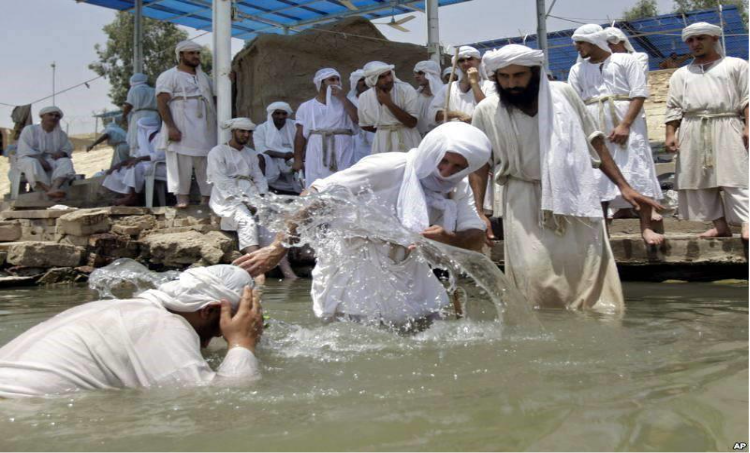
Mandaeans
The Mandaeans are followers of an ancient Gnostic religious creed. Their presence extended to places such as Palestine, Harran, and the southwest of Iran, but they consider the original populations of Mesopotamia and Iraq as their home since ancient times, and “the Sumerian heritage is evident in their water-related rituals.”25 Their number is estimated to be between 30,000 and 40,000 in Iraq, and their main base is in southern Iraq. Mandaeans also recognize Adam as the first prophet. However, John the Baptist is a central figure in this religion, and they follow him, considering him their last prophet. Baptism is the most vital ceremony for the Mandaeans, and they perform it in a river. Similar to the Kaka’i, followers of this religion are also perceived as unclean by some radical Muslims.26
In the Sabean-Mandaean faith, the use of weapons is prohibited, even for self-defense purposes, which makes them vulnerable to violent attacks and unable to defend themselves. Nearly 90% of this small community have either left Iraq or been killed. Mandaeans’ experiences with persecution and violence have led “The Mandaean Associations Union and Mandaean leaders, refugees, and asylum seekers to universally declare that they do not see any future for their community in Iraq and have asked that the entire group be collectively resettled to a third country so that their religion, language, and culture can survive.”27
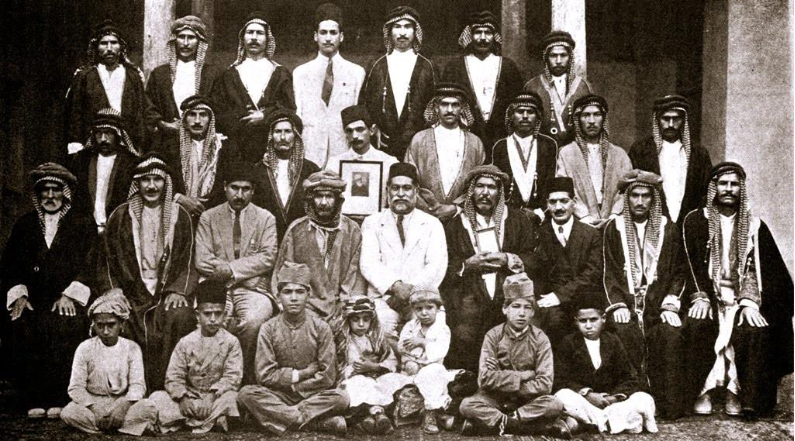
Baha’is
Baha’i is a word derived from Bahaullah, the founder of this religion, which emerged at the end of the 19th century; that is why it is considered one of the youngest religions in the world. Religious harmony, gender equality, and the unity of mankind are the major principles that the Baha’i faith adopts.28
The house of Bahaullah in Baghdad used to be a house of worship for Baha’i followers and had been donated by Shia Muslims to Bahaullah after he and his family were exiled from Iran to Baghdad. The house was destroyed during the rule of Saddam Hussein and turned into a center for intelligence services. According to its believers, “Baha’i is a religion” similar to other monotheistic religions, with its messenger, book, and sharia law. Most Bahai’s practice their rituals in homes, and there are religious scholars among them, such as those called “Mulla” in Islam. The calendar year in the Baha’i faith consists of 19 months, each with 19 days, and the months are named after the most beautiful names of God. They have a special month for fasting called Al-Ala, which starts on March 2 and ends with the festival of Nowruz on March 21. Baha’iare not involved in political life, claiming that they do not pursue interests similar to other groups; rather, their religion has a greater purpose and aims for the unity of the human race.29
Historical Background of Religious Minorities in Iraq
“Freedom of religion in Iraq faces significant challenges, emerging out of a tumultuous history marked by dictatorship, war, and sectarian violence.”30 Archaeologically, Iraq has been ruled by different authorities, including a number of great civilizations and foreign empires, such as the Persians, Greeks, and Sassanids. Prior to the introduction of Islam in 634 CE by Arab invaders, Babylon was the main center of the Jewish community. However, with the spread of Islam, this changed, and Baghdad became the cultural heart of Islam until 1258 CE. The Sunni Muslim leaders of Iraq, the Abbasid Caliphate, who were ruling the land of Mesopotamia, lost their control in 1258, and Turkish rulers took over After ruling for approximately a century, the Ottoman Empire was overthrown, and Iraq remained under British rule until 1920, which was followed by a series of British-backed monarchies. In 1948, most of the Jewish community left Iraq and moved to the newly established state of Israel. In 1958, through a violent coup, the monarchy system ended in Iraq, leading to the declaration of the Iraqi Republic in 1979, which resulted in years of political tension and power struggles.31
The focus of Saddam’s regime shifted from secular to more religious when he initiated a policy in 1994 called the “Faith Campaign.” Consequently, the Iraqi community transitioned from being one of the most secular in the region to a more religious one.
Although the Baath Party had a secular focus, its dominant ideology was Arab nationalism rather than religion-based government. However, religious minorities under Saddam Hussein’s rule faced severe oppression and were forced to deny their identity due to the Arabization process, which was initiated in the 1970s and remained until the 1980.32 Religious minority groups faced harsh restrictions, and their existence was threatened by the Arabization process. Yazidis were one of the religious groups who faced the denial of their Yezidi identity and were forced to identify themselves as Arabs; as a result of the process, nearly 150 Yazidi villages were destroyed and demolished. Additionally, Yazidis were not allowed to study their faith in schools or practice their beliefs freely. Christians had limited liberty and were permitted to visit churches; however, they were restricted from printing their religious literature freely and from owning radio or TV stations. In the national survey of 1977, Christians had to select either Arab or Kurdish as their identity on official forms. Further restrictions on religious liberty at that time included the arrest of five hundred students from a Bible study group that formed under the name “the Mary’s Army”; they were suspected of being involved in armed and political plans rather than being perceived as having a religious and spiritual purpose.33
The focus of Saddam’s regime shifted from secular to more religious when he initiated a policy in 1994 called the “Faith Campaign.” To promote greater Islamic influence in the country and the region, the campaign embraced different Islamic values and ideas. Consequently, the Iraqi community transitioned from being one of the most secular in the region to a more religious one, especially after the fall of the Soviet Union, which created a vacuum that the Baath Party sought to fill with Islamic influence.34 The US invasion in 2003 overthrew the Baath Party from ruling Iraq, and the country entered a transitional stage marked by conflict and crises. In the absence of a national government, the people of Iraq sought protection, which led them to rely on tribes and religious groups to ensure their survival. The power vacuum at that stage strengthened religious influence. Political Islamic parties emerged stronger in the country and gave rise to Islamic fundamentalism that targeted all other religious groups except Islam. Thousands of minority families were left with no option but to flee in 2006, when the conflict between Sunnis and Shias intensified and the process of ethnic cleansing took place to create homogeneous Sunni and Shia neighborhoods.35
In the post-Saddam era, the Yazidis have suffered the most and were specifically targeted by Islamic groups. Hundreds of Yazidis were killed, executed, or injured during the violence. Over 500 Yazidis were killed in a single day in August 2007, when four suicide bombers detonated four trucks loaded with explosives in the Yazidi towns of Til Ezer (al-Qahtaniyah) and Siba Sheikh Khidir (al-Jazirah), in the Ninawa governorate. It was the deadliest suicide attack since the invasion of Iraq in 2003.36 During the Baath Party rule, the conditions of Shiites and Kurds were also awful, as they were suffering under Sunni dominance. However, with the fall of Saddam, the equation changed, and the Shi’a, who had been targeted and subjected to violence, gained power and political control. Shi’a political parties successfully influenced the new constitution by giving Islam a dominant role and “lobbied for the addition of the so-called repugnancy clause in the recent Iraqi constitution, which requires that no law can contradict Islam.”37
While the Iraqi Constitution formally guarantees religious freedom and equality, in practice, the protection of minority rights remains inconsistent and is often undermined by political instability, sectarianism, and a weak rule of law.
The Constitutional and Legal Framework for Religious Minorities in Iraq
From a legal perspective, the 2005 Iraqi Constitution serves as the principal framework for providing protection and freedom for religious minorities in Iraq. On 15 October 2005, the Iraqi Constitution was officially adopted through a highly disputed referendum, which contained a set of rules and regulations regarding minority rights in Iraq. While the Iraqi Constitution formally guarantees religious freedom and equality, in practice, the protection of minority rights remains inconsistent and is often undermined by political instability, sectarianism, and a weak rule of law.38
Article 2 of the Constitution recognizes Islam as the official religion of Iraq and sets it as a legal source and foundation: “No law may be enacted that contradicts the established provisions of Islam,” and guarantees the freedom of religion and worship for religious groups, including Christians, Yazidis, and Sabaean-Mandeans. Nevertheless, the law prohibits followers of the Baha’i faith from practicing their beliefs, along with the Wahhabi branch of Sunni Islam. While the Constitution protects the Islamic identity of Iraq without making any specific mention of Sunni or Shia Islam, it also affirms that “No law may be enacted that contradicts the principles of democracy” nor “the rights and basic freedoms stipulated in this Constitution.”39
In addition to the religious freedom that minority groups are entitled to, the Constitution offers religious minority groups several specific rights and protections. For instance, Iraq is described as "a country of many nationalities, religions, and sects" in Article 3 of the Constitution, even though both Arabic and Kurdish are acknowledged as the nation's official languages under Article 4. However, the same article affirms the rights of other minority groups by indicating that “Iraqis can educate their children in their mother tongue, such as Turkoman, Syriac, and Armenian.”40
Iraqis are equal before the law without discrimination based on gender, race, ethnicity, nationality, origin, color, religion, sect, belief or opinion, or economic or social status.
Article 14 of the Iraqi Constitution
While the Constitution recognizes Iraq as a diverse country in terms of religion and provides freedom for all individuals to practice their beliefs and religion, some scholars argue that the Constitution resembles a religious document rather than a secular constitution. The introduction begins with an Islamic invocation used when opening a speech or reading a Qur’anic text: “In the name of God, the Most Merciful, the Most Compassionate. We have honored the sons of Adam.” The document prioritizes religious references over Iraq's ancient heritage and is full of Islamic religious terminology and quotations. The introduction only refers to Islamic ethnic groups such as Arabs (both Sunni and Shia), Kurds, and Turkmen, while non-Muslim groups such as Chaldeans, Assyrians, and Yazidis are not mentioned; therefore, the Constitution is biased toward Muslim individuals.41
Equality of the Iraqi people is safeguarded by Article 14 of the Constitution, which states that “Iraqis are equal before the law without discrimination based on gender, race, ethnicity, nationality, origin, color, religion, sect, belief or opinion, or economic or social status.” Moreover, under Article 41, Iraqis are free in their “commitment to their personal status according to their religions, sects, beliefs, or choices, and this shall be regulated by law.” The state is also obligated to ensure the freedom of worship and the protection of places of worship based on Article 43.42
The religious groups that are registered with the Iraqi government and officially recognized by the personal status law are Christians, Yezidis, Jews, and Mandeans. This recognition enables these religious groups to conduct legal transactions, such as buying and selling property, and to have a legal representative. On the contrary, the law does not grant the same recognition to the Baha’i, Zoroastrian (Zardashti), and Kaka’i communities, and they remain unregistered religious groups, suffering from a lack of legal protection.43
It is worthwhile mentioning that the Baha’i faith, from being a legally recognized religion during the Monarchy rule, became a forbidden faith during Saddam’s rule. The Baha’i religion had limited recognition under the royal authority and was able to have citizenship cards that marked religion as Baha’i, and its followers were also able to identify themselves as Baha’i in public life. However, in 1970, the Iraqi government passed Law No. 105, which prohibited the Baha’i faith in Iraq and removed any mention of the faith from official documents.44
Apostasy and religious conversion are unfamiliar concepts in Iraqi society. It typically seems strange to witness open conversions from Islam to another religion. According to the European Union Agency for Asylum (EUAA) report entitled “Country Guidance: Iraq,” the Constitution recognizes Iraq as a diverse ethnic and religious state. However, it "prohibits the conversion of Muslims to other religions. Civil laws provide a simple process for a non-Muslim to convert to Islam; conversion from Islam to another religion is forbidden by law.” Non-Muslim citizens in Iraq have the full right to convert to Islam, while Muslim people cannot convert from Islam to other religions, and changing from Islam to Christianity might put the person at risk of being killed.45
Under Iraqi law, there is no punishment for conversion between religions, although a punishment is mandated for conversion from Islam in some interpretations of Sharia law. In Iraq, a criminal penalty can only be imposed by civil, not religious, law. Christians, Sabaean-Mandeans, Yazidis, and Muslims were the only religions that have been legally mentioned on the non-biometric ID cards. As per Article 26 of the National Identity Card Law, Muslims were unable to change their religion on their IDs in the case of converting to another religion. Additionally, based on the 2015 National Identity Card Law, in the case of a child born to a Muslim and a non-Muslim, the child was legally registered as Muslim without considering the non-Muslim parent.46 However, since 2016, with the implementation of a new system—the biometric national ID card—the religion is no longer shown on the ID card; however, “the government stores it on the biometric data chip within this card.”47
By contrast, the situation in the Kurdistan Region of Iraq (KRI) appears to be different, with greater space for religious freedom and tolerance.
By contrast, the situation in the KRI appears to be different, with greater space for religious freedom and tolerance. In the KRI’s draft constitution, which has not been passed yet, Islamic Sharia has been included as a source of legislation; however, unlike Iraq’s federal constitution, it permits issuing laws and legislation based on Shari’a and recognizes the rights of non-Muslims.48 In 2015, the Kurdistan Regional Government issued a law to safeguard different religious groups. Christian converts are generally safer in the KRI. The number of Christian converts in the KRI is estimated to be around a few hundred. Individuals who are considered to have committed blasphemy or apostasy face risks; however, the KRG - cannot fully protect them from their families and tribes, as the community is close-knit and traditional, which makes religious conversion very difficult and challenging.49
The KRI officially recognizes the Baha’i, Zoroastrian, and Sabaean-Mandaean faiths, and it embraces the cultural, economic, and political representation of minority groups. It also prohibits “religious or political media speech, individually or collectively, directly or indirectly, that incites hate, violence, terror, exclusion, or marginalization based on national, ethnic, religious, or linguistic grounds.” Moreover, unlike federal Iraq, there is a Syriac Curriculum Directorate within the Ministry of Education in the KRI, and Christians are not obligated to participate in or study Islamic education, including the Qur’an. Christians in the KRI are also entitled to receive Christian education in areas populated by a majority of Christians.50
The Anatomy and Pathways of Religious Inclusion
There are several levels of inclusion and recognition of non-Muslim religious minorities in Iraq. Official acknowledgment, which means mentioning them in laws and the constitution, is the first level. While this level is critical, it is insufficient because it does not lead to the actual inclusion of minority groups. The second level is recognition by the traditional Islamic authorities. The third, and possibly most significant, level is public recognition. This level is often flawed by presumptions, biases, and stereotypes that regularly encourage hate speech and discrimination.51 In the Iraqi federal system, no regulations are provided on how a new religious group can obtain legal recognition and registration as a new religion. Nevertheless, in the Kurdistan Region, religious groups can still get recognition by registering with the KRG Ministry of Endowment and Religious Affairs (MERA). For this purpose, any religious group must have a minimum of 150 followers. They are also required to submit documentation regarding their financial support and resources and should demonstrate that their faith is not anti-Muslim or opposed to any other religious group. In the KRG, eight religions or faiths are officially registered with MERA, including Islam, Christianity, Yezidi, Judaism, Baha’i, Sabaean-Mandaean, Zoroastrian, and Kaka’i (Yarsan).52
Iraqi people hold biased views and misunderstandings about religious minority groups, their worship, beliefs, and symbols. This is mainly due to flaws in the education system in Iraq, which mostly focuses on studying Islam. Religious education is unequal in focus and has failed to acknowledge the presence of other religions and ethnicities. Minority groups are not given the opportunity to study their religion, values, and culture. Additionally, majority groups also do not have the opportunity to learn about other religious minority groups. In the absence of a curriculum that reflects the diversity in Iraq and promotes pluralistic values among the Iraqi community, people develop misunderstandings about non-Muslim religious groups both at school and at home.53
Religious persecution and widespread violence since 2006 have displaced millions; nearly 2 million have sought safety and security in foreign countries. A remarkable fact about Iraqi displacement is that 52% of those who fled reported doing so because of a direct threat to their lives based on their religious or sectarian identity.
Laws and Politics of Religious Inclusion
There are still some effective laws that predate the 2005 constitution and restrict the practice of religious liberty, placing challenges for religious minorities in Iraq. For instance, the Baha’i faith is clearly forbidden by a 1970 law (No. 105). In the same vein, the Wahhabi branch of Islam is also forbidden by a 2002 law, and according to a 2006 law, Jews who lost their citizenship under any circumstance cannot regain it. The effectiveness of these legal principles has influenced the condition and presence of religious minorities in Iraq. Religious persecution and widespread violence since 2006 have displaced millions; nearly 2 million have sought safety and security in foreign countries, and approximately 2.8 million have been internally displaced and forced to flee their land. A remarkable fact about Iraqi displacement is that 52% of those who fled reported doing so because of a direct threat to their lives based on their religious or sectarian identity.54
In terms of political representation, religious minorities in Iraq face many obstacles, and their representation is not effective in various roles. Out of the 329 seats in the Council of Representatives (COR), the law reserves only nine for ethnic and religious minorities: five for candidates from Baghdad, Nineveh, Kirkuk, Erbil, and Duhok; one for a Yezidi from Nineveh; and one for a Faili Kurd from Wasit. Typically, one of the administrative positions is designated for a Christian parliamentarian and another for a Turkmen.55
The Iraqi Kurdistan Parliament used to have 11 of its 111 seats reserved for members of ethnic and religious minority groups. However, in February 2024, the Federal Supreme Court of Iraq declared that the earlier distribution of 11 quota seats in the Kurdistan Parliament was unconstitutional. Only five seats in the Kurdistan Parliament are now allocated for minority groups. After implementing this decision, the five seats were distributed among Kurdistan's three main provinces: Erbil and Sulaymaniyah were allocated two seats each, representing the Christian and Turkmen communities, and Duhok was assigned one seat for the Armenians, with none allocated for Yazidis or Shabaks.56 This action has been understood as constraining the participation of minority groups in Iraq, mainly in a key institution such as parliament.
Some sources claimed that the dominant parties attempted to manipulate the quota seats in their favor by appointing candidates affiliated with them, which, as a result, led the Iraqi Federal Supreme Court to decrease the quota seats in the Kurdistan Parliament. For instance, following the October 2021 parliamentary elections, religious and ethnic leaders complained that the dominant parties—specifically Kurdish and Shia parties—succeeded in nominating their preferred candidates to seats legally reserved for minorities, rather than allowing minority communities to select and nominate their representatives. These actions resulted in the exclusion of minorities from national power-sharing talks regarding government confirmations, reducing their roles in political representation. Consequently, their representation in various political positions does not always translate into the effective fulfillment of their community’s demands.57
Religious minority groups reported that during the fight against ISIS, when political tensions between the KRG and the Iraqi central government intensified, Kurdish forces attempted to “Kurdify” some ethnically diverse areas by preventing residents from returning to their homes and abolishing their property.
Despite the ostensibly better treatment of religious minorities in the KRI compared to Iraq, the rule of law favors ethnic and religious minorities. However, religious minority groups reported that during the fight against ISIS, when political tensions between the KRG and the Iraqi central government intensified, Kurdish forces attempted to “Kurdify” some ethnically diverse areas by preventing residents from returning to their homes and abolishing their property. Some claimed that they were also denied financial support and humanitarian aid. Christians recognized the KRG’s support, but Yazidis claimed that they felt pressured by the Kurdish authorities. government identify themselves as Kurds.58
Social Perceptions Toward Religious Minorities in Iraq
In addition to the legal and constitutional obstacles that religious minorities face in Iraq, they also encounter substantial challenges on the social level. Non-Muslim minorities have reported that during Ramadan, they are obligated to adhere to certain Islamic practices, such as wearing a hijab for females or fasting. Moreover, during Ashura, both non-Shia Muslim and non-Muslim women feel pressure from the community to wear hijabs and all-black clothing during the month of Muharram, particularly during Ashura. “Shia Muslims consider it inappropriate and disrespectful to wear bright colors or to hold public celebrations during this month when they mourn the death of Imam Hussein.” Numerous women, including Christians and Sabaean-Mandaeans, reported opting to wear the hijab after being harassed.”59 According to Muslims, Christians are considered “too liberal” or “too loose” socially, and during social and cultural events they allow mixing of both genders and promote values or practices that are socially unacceptable. “In the Yezidi and Christian faiths, the segregation of men and women is not seen as necessary. By contrast, in Islam such interactions should be kept at a modest level.”60
Depending on their geographic location, economic status, and local power dynamics, members of religious minority groups hide their religious identity to varying degrees and seek to assimilate to majority behaviors and traditions.
UNHCR 2025 Report
Many minority groups are caught in a vicious cycle, isolated from the community, and practice their religious beliefs in secrecy to protect their cultural identity in the face of threats. A UNHCR January 2025 report entitled “International Protection Considerations with Regard to People Fleeing the Republic of Iraq” stated: “Depending on their geographic location, economic status, and local power dynamics, members of religious minority groups hide their religious identity to varying degrees and seek to assimilate to majority behaviors and traditions.” This particularly impacts women and girls of minority groups, who are regularly faced with harassment and violence if they do not abide by prevailing customs.”61 This is especially the case for non-evangelistic “non-Abrahamic” beliefs, which are compelled to keep their religious rites and rituals confidential.
Particularly during times of intense political tension, non-Muslim religious minorities often face widespread verbal abuse and hateful speech. Some religious minority groups are easily recognized by their appearance, which makes them vulnerable to harassment and offensive comments in public places, such as bazaars and on social media platforms. Kaka’i and some Yezidi men are frequently identified by their long mustaches, which, according to Islamic values and tradition, should be kept short and trimmed; consequently, they are often subjected to abusive language and insults. Furthermore, non-Muslim religious minorities report that Muslims either avoid attending their social occasions or attend only after eating, in order to avoid consuming their food.62 because according to Muslims, their food is not halal to eat; therefore, their produce and foodstuff like meat, yogurt, and bread, are boycotted in the market.
On the economic level, non-Muslim religious minorities face discrimination. The lack of employment opportunities has adversely affected their financial situation and contributed to migration.
On the economic level, non-Muslim religious minorities face discrimination. The lack of employment opportunities has adversely affected their financial situation and contributed to migration. The hiring process is dominated by Muslims, who are often given priority over minority groups. Sabaean-Mandeans, in particular, suffer from limited economic opportunities, as they are legally prohibited from selling alcohol.63 In a similar manner, Yezidis and Kakai’s face exclusion from the labor market because of society’s wrong perception of them. They are not allowed to work in restaurants or bakeries, and, due to not following Islamic rituals when slaughtering animals or preparing meals, they are also not welcomed in butcher shops.64
Post-ISIS and Global Observation of Religious Freedom in Iraq
In 2014, religious minorities faced severe oppression when, in early August, ISIS attacked Nineveh and targeted the ethno-religious minorities living in these areas, including Assyrian, Chaldean, Kaka’i, Shabak, Syriac, Turkmen, and Yezidi communities. ISIS took control of several Yezidi villages, leaving residents with the choice of converting to Islam or facing death. However, they refused to change their religion. Sinjar, the main city where Yezidi population resides, was seized by ISIS, and approximately 400,000 Yazidis were displaced; hundreds were killed, more than 3,000 women were taken as sex slaves, and the fate of thousands remains unknown. The rise of ISIS and the declaration of the caliphate exacerbated religious and sectarian divisions, causing a major setback for religious freedom in Iraq.65
ISIS wasn’t a threat only to the lives of non-Muslim minorities but also targeted Shia Muslims. In Camp Speicher in Tikrit, the group murdered more than 1,000 people, mostly Shia, “sending a terrifying symbol of their intention to exact revenge for the years of humiliation suffered by Iraq’s Sunnis at the hands of the Shia-dominated government.” Years of conflict and sectarianism caused by ISIS have generated a great deal of pessimism among the Iraqi community, and its caliphate, which was declared in contrast to Iraq’s religious diversity, collapsed in 2017.66
After the defeat of ISIS, the international community and institutions that advocate for religious freedom worldwide began to pay greater attention to religious freedom and emphasized the promotion of religious liberty in Iraq. The EUAA, in January 2022, in a report titled Iraq: Targeting Individuals, stated that: “Even though religious freedom is guaranteed by the Iraqi constitution, national laws continue to violate the rights of non-Muslim minorities, including Christians. Iraqi laws do not allow conversion from Islam to another religion; however, they facilitate the reverse process of converting to Islam.” Furthermore, the U.S. State Department (USSD) highlighted the same concern in its annual report on human rights and indicated that Iraqi laws forbid Muslims from converting to another religion. However, “In the IKR, this law was rarely enforced, and individuals were generally allowed to convert to other religious faiths without KRG interference.”67
Innocent victims of senseless and brutal atrocities, persecuted and killed for their religion, and whose very identity and survival was put at risk.
Pope Francis remarks on the plight of the Yezidi genocide
Global attention to religious freedom in Iraq increased when, for the first time, the Pope visited Iraq, particularly engaging with Christian and Yezidi groups. The late Pope Francis expressed his deep sorrow, especially for the Yazidis, and stated; “innocent victims of senseless and brutal atrocities, persecuted and killed for their religion, and whose very identity and survival was put at risk.” The Pope highlighted the importance of genuine dialogue and harmony among the different ethnic and religious groups in Iraq and emphasized that, for these changes to happen, “it is essential to ensure the participation of all political, social, and religious groups and to guarantee the fundamental rights of all citizens,” urging that no one be considered a second-class citizen. The Pontiff also highlighted the longstanding presence of Christians in Iraq and their contribution to Iraqi civilization and heritage, pointing out that: “Their participation in public life, as citizens with full rights, freedoms, and responsibilities, will testify that a healthy pluralism of religious beliefs, ethnicities, and cultures can contribute to the nation’s prosperity and harmony."68
The most current report on religious freedom and tolerance in Iraq was issued by United States Commission on International Religious Freedom (USCIRF) in 2024, which urges immediate intervention to enhance religious liberty conditions in Iraq, especially for those groups who face continued oppression and discrimination. While there are reports by international institutions about religious liberty in Iraq, there is a lack of governmental and civil society projects to address minority issues there. The sources that provide potential safety and relief for religious minority groups in Iraq are decreasing, which leaves these groups in danger. For example, suspending the work of the Investigative Team to Promote Accountability for Crimes Committed by Da'esh/ISIL (UNITAD) in Iraq pauses the effective efforts to hold ISIS accountable for their crimes against religious minorities. Likewise, not failing to compensate survivors of ISIS atrocities has hindered the recovery and rehabilitation of affected communities.69
On 1 March 2021, the Iraqi Parliament enacted the Yazidi Female Survivors Law. This is considered the first official instrument by the government that seeks “to provide compensation, rehabilitation, and care to women and girls who have survived sexual abuse, including sex enslavement, forced marriage, forced pregnancy, or abortion, by members of ISIS.
The Government’s Initiatives Toward Religious Freedom in Iraq
Over the past few years, the Iraqi government has initiated measures and policies to improve religious tolerance and the conditions of non-Muslim religious minorities. On 1 March 2021, the Iraqi Parliament enacted the Yazidi Female Survivors Law. This is considered the first official instrument by the government that seeks “to provide compensation, rehabilitation, and care to women and girls who have survived sexual abuse, including sex enslavement, forced marriage, forced pregnancy, or abortion, by members of ISIS.”70 In March 2023, the government began distributing the first compensation payments to Yazidi female survivors. Consistently, the Iraqi cabinet officially acknowledged the Yazidis’ ownership of their residential properties in the Sinjar area of northern Iraq.71
Another cooperative initiative aimed at enhancing religious tolerance in Iraq is the Iraq Religious Freedom and Antidiscrimination Roundtable (IRFAR). The roundtable has become a platform that brings together representatives of different religious groups, community leaders, and civil society organizations to draw attention to restrictions on religious liberty and to present collective resolutions. IRFAR has worked strategically with the parliament to draft religious freedom legislation to improve the overall situation of religious minority groups in Iraq. Furthermore, IRFAR has coordinated with universities to conduct research to help understand and deepen knowledge of the challenges that religious groups face. IRFAR is considered one of the pivotal initiatives that mobilizes supports for religious freedoms.72
Conclusion
This paper concludes that, despite the critical amendments and progress made by the 2005 constitution regarding religious freedom in Iraq, non-Muslim religious minorities continue to face significant oppression, violence, and social challenges. Furthermore, several pre-2005 legislations remain active, restricting these groups from exercising their beliefs freely. The 2005 Iraqi constitution recognizes Islam as the official religion of the country and asserts that no legislation should contradict the principles of Islam. It also guarantees the freedom of religion and worship for religious groups, including Christians, Yazidis, and Sabaean-Mandeans. Nevertheless, the constitution contains a paradox: despite articles that guarantee freedom of religion and belief for all Iraqi citizens, religious groups such as Baha’i, Kaki, and Zoroastrians remain unrecognized and unregistered with the Iraqi government.
Consistent with this, the research paper also reveals that religious conversion is not a common phenomenon under Iraqi law; while it facilitates conversion to Islam, the reverse process is not recognized. Another critical finding of the research paper is that, besides constitutional obstacles, religious minority groups also encounter social and economic barriers. Verbal abuse and hate speech are widespread in Iraqi society, and some groups, due to their appearance, are easily recognized and targeted in public places. The hiring process is dominated by Muslims, and minority religious groups are frequently excluded from the labor market. Groups like Kaka’i and Yezidis are not able to get jobs in the-food industry due to societal misconceptions that consider them unclean, and their produce and food are boycotted in the market, assuming they are not halal or clean.
This paper also found that the KRG treated religious minorities better compared to the Iraqi federal government. In the KRI, laws exist that officially recognize the Baha’i faith, allow religious conversion, and provide clear instructions on how a new religious group can register with the government; however, in Iraq, there is no such instruction. Even though over the past few years there have been initiatives by the Iraqi government, such as enacting the Yazidi Female Survivors Law, establishing the Religious Freedom and Antidiscrimination Roundtable (IRFAR), and removing religion as a category on the ID cards to reduce discrimination, challenges continue to persist. To enhance religious tolerance and improve the condition of religious minority groups, the Iraqi government is required to maintain the constitution, legislation, and institutional systems that align more closely with international human rights standards, ensuring national laws that respect and protect human rights without discrimination based on religion and ethnicity, it is further necessary to provide an environment that allows for healthy dialogue among the many religious groups that coexist in the country to avoid a future resurgence of hate- based movements.
- Stausberg, Michael, Erica Baffelli, and Alexander. “Religious Minorities: Conceptual Perspectives,” July, 2023,Read More ↩︎
- Deschene’s, Jules, “Proposal Concerning a Definition of the Term Minority” United Nations Digital Library System. UN, May 14, 1985, Read More ↩︎
- Munir Hamood Alshami, “Protection of the Religious Minorities’ Rights under the Iraqi Constitutions”, International Journal of Innovation, Creativity and Change,2022, Accessed November 7, 2025, Read More ↩︎
- Easy Sociology, “Understanding Minority Group.” Easy Sociology. August 14, 2025, Read More ↩︎
- Abd al-Wahhab Kayyali, “Political Encyclopedia.” Noor-Book.com. Noor Book. March, 24, 2007, Read More ↩︎
- Marshall, Jennifer, “Why Does Religious Freedom Matter?” December 20, 2010, Read More ↩︎
- Arielle Del Turco, “Why Is Religious Freedom so Uniquely Important?”, April 12, 2021, Read More ↩︎
- Brian J. Grim, “Religious Freedom: Good for What Ails US”, The Review of Faith & International Affairs, Volume 6, 2008, Read More ↩︎
- Abas Kadar, Mark Elijio. “Understanding Religious Pluralism: The Role of Schools in Teaching Multiple Beliefs”, Research Gate, April 2025, Read More ↩︎
- Arielle Del Turco, “Why Is Religious Freedom so Uniquely Important?”, April 12, 2021, Read More ↩︎
- Jaren Yeager, “The Importance of Religious Pluralism in Modern Society”, Zoom Academia, 2024, Read Here ↩︎
- Brian J. Grim, “Religious Freedom: Good for What Ails US “,2008. ↩︎
- Office of Religious Freedom, “The Importance of Freedom of Religion or Belief”, Read More ↩︎
- Seyedehbehnaz Hosseini,” The Kaka‘i: A Religious Minority in Iraq”, Sage Journals, April 5 ,2018, Read More ↩︎
- Office of Religious Freedom, “The Importance of Freedom of Religion or Belief”. ↩︎
- Home Office, “Country Policy and Information Note Iraq: Religious Minorities, September 2024, Read More ↩︎
- What Remains of Iraqi Christians? The Chaldean Patriarchate Responds” Alawla.tv, November 1, 2025, Read More ↩︎
- “Iraqi Christians: 6 Fascinating Facts You Should Know”, Aid to the Church in Need, Read More ↩︎
- Shak Hanish, “Christians, Yazidis, and Mandaeans in Iraq: A Survival Issue.” Digest of Middle East Studies, March 16, 2010, Read More ↩︎
- Sattam Hamad Khalaf, Coexistence between Christian, Muslim & Yezidis: In Ba’a Shiqah -Bah Zany Region in Nineveh Province/ Iraq, Global Journal of Islam and Society, July 2022, Read More. ↩︎
- Shak Hanish, “Christians, Yazidis, and Mandaeans in Iraq: A Survival Issue”. ↩︎
- Shak Hanish, “Christians, Yazidis, and Mandaeans in Iraq: A Survival Issue”. ↩︎
- “Kaka’i in Iraq”, Minority Rights Group, November 2017, Read More ↩︎
- Omar Aziz, “The Kakai People: Hidden Religious Practices and Struggle for Recognition”, July 01, 2023, Read More. ↩︎
- The Mandaean Sabians, twenty years after the American occupation”, Eismena, 5th January 2024, Read More ↩︎
- Shak Hanish, “Christians, Yazidis, and Mandaeans in Iraq: A Survival Issue”. ↩︎
- USCIRF, “Countries of Particular Concern: Iraq”, 2009, Read More ↩︎
- Dida Faridoon, “Untold Stories: The Bahá’í Faith in Iraq”, Eismena, June 2,2025, Read More ↩︎
- What is the Baha’I Faith and why did it become a pariah sect in Iraq, Bahai Research, Sep 21, 2020, Read More ↩︎
- Salah Ali, “Challenges to Religious Freedom in Iraq and the Critical Need for Action”, Religious Freedom Institute, June 26, 2024, Read More ↩︎
- Religious Freedom in the Republic of Iraq”, institute on Religion and Public Policy, September 2024, Read More ↩︎
- Lazgin Barany, “Teaching of Religious Education in Iraqi State Schools and the Statues of Minorites in Iraq” , International Journal of Arts & Sciences, 2013, Read More ↩︎
- Shak Hanish, “Christians, Yazidis, and Mandaeans in Iraq: A Survival Issue”. ↩︎
- Shak Hanish, “The Role of Islam in the Making of the New Iraqi Constitution”. ↩︎
- Majid Hassan Ali, “The Forced Displacement of Ethnic and Religious Minorities in Disputed Areas in Iraq: A Case Study of the Post-2014 Yazidi Minority”, AlMuntaqa, May 2022, Read More ↩︎
- Shak Hanish, “Christians, Yazidis, and Mandaeans in Iraq: A Survival Issue”. ↩︎
- Brian J. Grim, “RELIGIOUS FREEDOM: GOOD for WHAT AILS US?”, 2008, Read More ↩︎
- Bill Bowring, “Minority rights in post-war Iraq: An impending catastrophe” International Journal of Contemporary Iraqi Studies, 2011, Read More ↩︎
- Jewish Virtual Library, “Reports on Religious Freedom: Iraq 2022”, May 2023, Read More ↩︎
- Vanessa J. Jiménez, “Iraq’s Constitutional Process: Challenges and the Road Ahead”, Human Rights Brief, 2005, Read More ↩︎
- Shak Hanish, “The Role of Islam in the Making of the New Iraqi Constitution”, Digest of Middle East Studies, March 2007, Read More ↩︎
- Iraq 2005 Constitution, Read More. ↩︎
- Home Office, “Country Policy and Information Note Iraq: Religious Minorities. ↩︎
- Dida Faridoon, “Untold Stories: The Bahá’í Faith in Iraq”. ↩︎
- Home Office, “Country Policy and Information Note Iraq: Religious Minorities. ↩︎
- individuals considered to have committed blasphemy and/or apostasy”, European Union Agency for Asylum,2021, Read More ↩︎
- European Union Agency for Asylum. Country Guidance: Iraq, January 2021. Luxembourg: Publication Office of the European Union, 2021. Read More ↩︎
- Religious Freedom in the World Report, “Legal framework on freedom of religion and actual application”, 2018, Read More ↩︎
- individuals considered to have committed blasphemy and/or apostasy”, European Union Agency for Asylum,2021, Read More ↩︎
- Jewish Virtual Library, “Reports on Religious Freedom: Iraq 2022 ↩︎
- Shivan Fazil, Addressing challenges to tolerance and religious diversity in Iraq, Middle East Institute, July 5, 2023, Read More ↩︎
- Jewish Virtual Library, “Reports on Religious Freedom: Iraq 2022 ↩︎
- Shivan Fazil, Addressing challenges to tolerance and religious diversity in Iraq. ↩︎
- Religious Freedom in the Republic of Iraq”, institute on Religion and Public Policy, September 2024, Read More ↩︎
- Home Office, “Country Policy and Information Note Iraq: Religious Minorities. ↩︎
- Medya News, “Iraqi Court Restores Minority Seats in Kurdistan Parliament”, 2024, Read More ↩︎
- Home Office, “Country Policy and Information Note Iraq: Religious Minorities. ↩︎
- Religious Freedom in the World Report, “Legal framework on freedom of religion and actual application”, 2018, Read More ↩︎
- Jewish Virtual Library, “Reports on Religious Freedom: Iraq 2022 ↩︎
- Shivan Fazil, Addressing challenges to tolerance and religious diversity in Iraq. ↩︎
- UNHCR, “International Protection Considerations with Regards to People Fleeing Iraq”, January 2024, Read More ↩︎
- Shivan Fazil, Addressing challenges to tolerance and religious diversity in Iraq. ↩︎
- Jewish Virtual Library, “Reports on Religious Freedom: Iraq 2022 ↩︎
- Shivan Fazil, Addressing challenges to tolerance and religious diversity in Iraq. ↩︎
- Pari Ibrahim, Fundamental Needs of Minorites in Iraq, Religious Freedom Institute, March 16, 2021, Read More ↩︎
- Shak Hanish, “The Islamic State Effect on Minorities in Iraq”, Review of Arts and Humanities, June 2015, Read More ↩︎
- Omar Abdel-Razek and Miriam Puttick, “Majorities and minorities in post-ISIS Iraq”, Brill, October 2016, Read More ↩︎
- Home Office, “Country Policy and Information Note Iraq: Religious Minorities, September 2024, Read More ↩︎
- Robin Gomes, “Pope urges Iraqi authorities to rebuild society on fraternal solidarity”, Vatican news, March 2021, Read More ↩︎
- Salah Ali, “Challenges to Religious Freedom in Iraq and the Critical Need for Action”, Religious Freedom Institute, June 26, 2024, Read More ↩︎
- “Iraq Law No.8- Yazidi Females Survivor Law”, The Nuhanovic Foundation,2021, Read More ↩︎
- “United States Commission on International Religious Freedom”, 2023, Read More ↩︎
Content Type:Issue Briefs