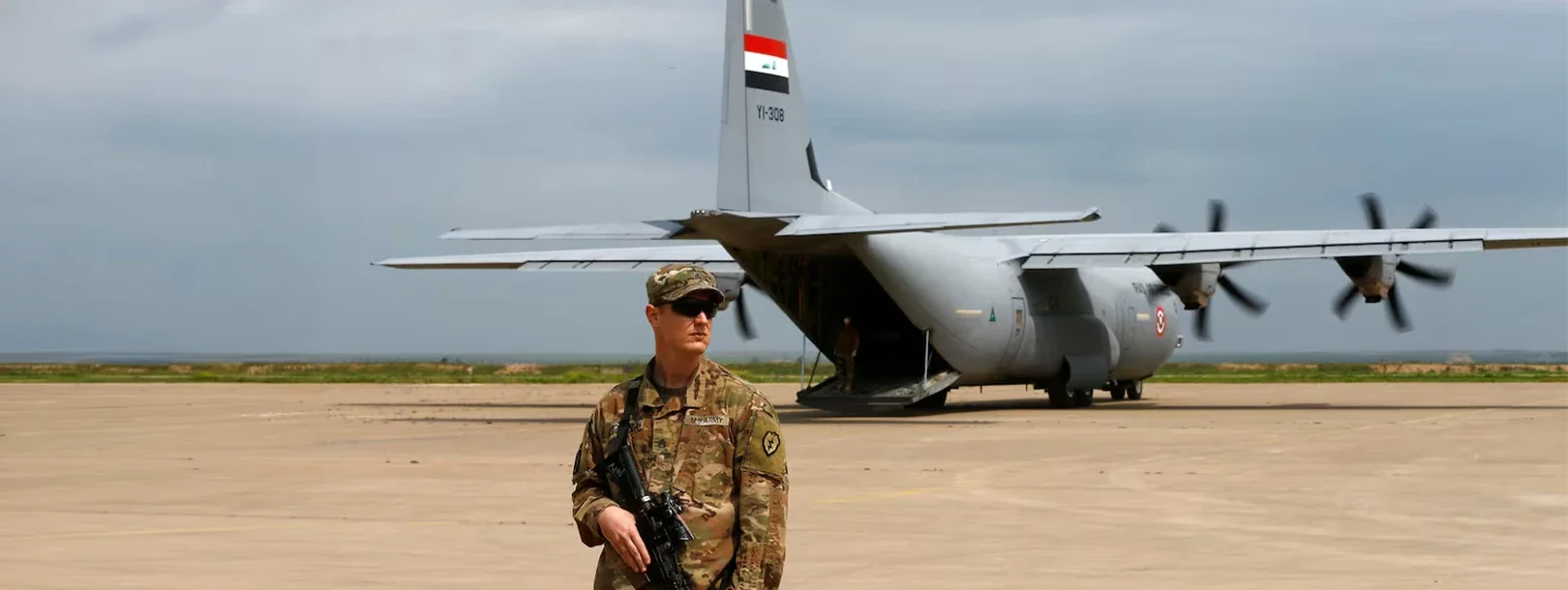
 A U.S. soldier is seen during the hand over of US-led coalition forces to Iraqi Security Forces at Qayyarah Airfield West in the south of Mosul, Iraq March 26, 2020. REUTERS/Thaier al-Sudani
Iraq's Security the Day After OIR Departure: Immediate Risks and Strategic Options
Director’s Note
For over a decade, the presence of the Combined Joint Task Force – Operation Inherent Resolve (CJTF-OIR) shaped the security landscape of Iraq and the Kurdistan Region in ways that went well beyond the battlefield. The coalition was assembled in 2014 with a specific military purpose, to roll back the so-called Islamic State (ISIS), but it quickly became something harder to define. The coalition became a political fixture whose presence meant different things to different actors, and whose departure now raises questions that military commanders and politicians equally ponder.
When former Prime Minister Mohammed Shia al-Sudani came to power in late 2022, his government was not pushing for a swift exit of the OIR. Quite the opposite, Iraqi officials at the time stressed that the coalition remained necessary and that any reduction in its role would have to be measured by demonstrated improvements in the readiness of Iraqi forces. What changed over the following two years was less about the security situation and more about the political environment around it. A set of external factors, compounded by pressures from within Iraq's own fractured political landscape, gradually narrowed the space for Sudani to maintain his earlier declared position. By early 2024, the framing had shifted towards the concept of protecting the sovereignty of Iraq. In September of that year, a two-phase transition agreement was announced in New York at the margins of the UN General Assembly. The Americans labelled it as “transition," not “withdrawal," and that distinction in the language mattered.
Depending on where one stands in Iraq, the coalition's legacy looks quite different. For the federal government in Baghdad, OIR provided a security blanket at a moment of existential crisis, while also acting as a counterbalance to the armed factions that Baghdad could neither fully control nor willingly and openly confront. For the Kurdistan Region, the coalition was more of a strategic anchor, a safeguard on the relentless pressures from the center, and a source of security guarantees that Kurdish leaders have found difficult to replace. The fact that the KRG has expended considerable effort to keep the U.S. and coalition forces in the region past the agreed timeline says a great deal about what their departure represents for KRI.
This report tries to work through both of those realities and to set the stage for what comes after.
Imad A. Farhadi
Executive Summary
This report examines the strategic implications of the formal end of the Combined Joint Task Force – Operation Inherent Resolve (CJTF-OIR) mission in Iraq. The coalition’s military mission in Iraq, which began in 2014 to help defeat the Islamic State (ISIS), officially ended in September 2025 under a two-phase agreement between Baghdad and Washington in September 2024. The remaining U.S. advisory and counterterrorism presence in the Kurdistan Region of Iraq (KRI) will be reduced by the end of 2026. The transition comes as Iraq and the Kurdistan Region face new threat vectors against a backdrop of renewed regional instability following the February 2026 U.S.-Israeli strikes on Iran. The report covers the mission’s definition, coalition partners and accomplishments, the procedural pathway to the 2024 agreement, what forces remain and where, and what the post-OIR environment means for Iraq’s federal government and the Kurdistan Regional Government (KRG). It concludes with a list of strategic implications and opportunities for policymakers and analysts.
Background
Definition of Mission
Operation Inherent Resolve (OIR) was the U.S. military campaign to defeat the Islamic State (ISIS). The operation started in August 2014 with targeted airstrikes in Iraq and was officially designated the Combined Joint Task Force–Operation Inherent Resolve (CJTF-OIR) two months later to advise, assist, and enable local forces until they could operate independently against ISIS in Iraq and Syria. This was an approach to developing a broader U.S. strategy on long-term security reform. The legal basis for Iraq’s appeal to the United Nations Security Council was Article 51 of the UN Charter. Operational activities were kept intentionally narrow in scope and limited to areas held by ISIS in Iraq and Syria.
Partners
At the height of the operation, CJTF-OIR comprised over 80 coalition nations, and the Global D-ISIS Coalition eventually expanded to a total of 87 members. Key military partners included the following:
- The most capable partners of the coalition in Iraq are the Iraqi Security Forces (ISF), which include the Iraqi Army, Iraqi Air Force, Federal Police, and Counter Terrorism Service (CTS).
- The Peshmerga forces of the Kurdistan Regional Government (KRG) were heavily involved in offensive and defensive operations in northern Iraq.
- Syrian Democratic Forces (SDF) and their Arab partner components conducted ground operations in Syria.
- U.S. Special Operations Forces, air assets, and conventional advisory elements, as well as major British, French, Canadian, Australian, and other allied contributions.
The 2024 Agreement: Background and procedural steps
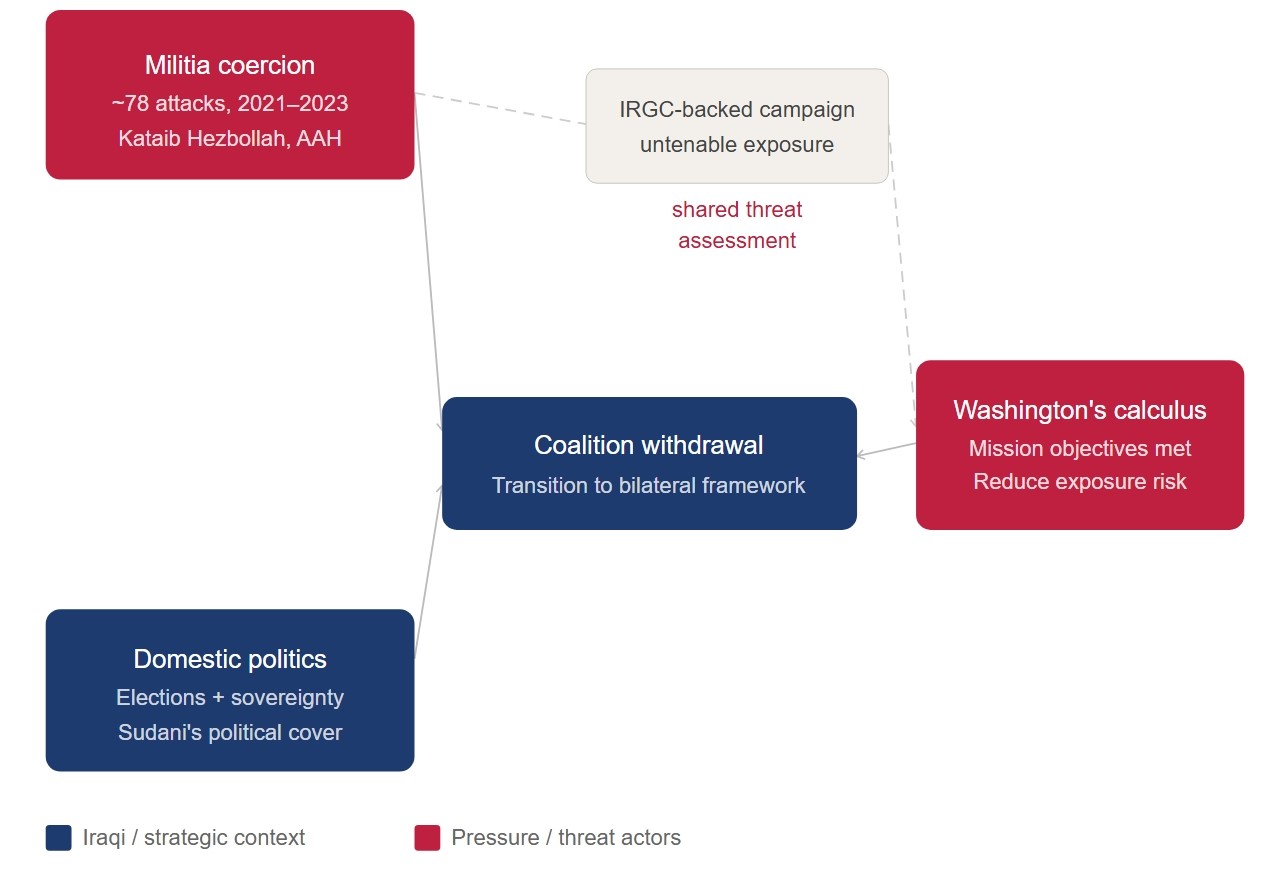
The initiative to terminate Operation Inherent Resolve's coalition mandate was driven by Iraq but shaped by the United State’s own calculations. Prime Minister Mohammed Shia al-Sudani, who took office in October 2022 backed by the pro-Iran Coordination Framework, initially emphasized in early 2023 that Iraq continued to stress that the U.S. and the coalition forces remain essential to mitigate the risk of the regrouping of ISIS. He stipulated any drawdown would be contingent upon the demonstration of the operational readiness of Iraqi forces. By early 2024, however, under escalating pressure from Tehran and its militias, Sudani changed his position, calling for a "complete end to foreign military presence" and framed his demand as a matter of sovereignty.
Several converging pressures drove this shift
Procedural Steps to the Agreement
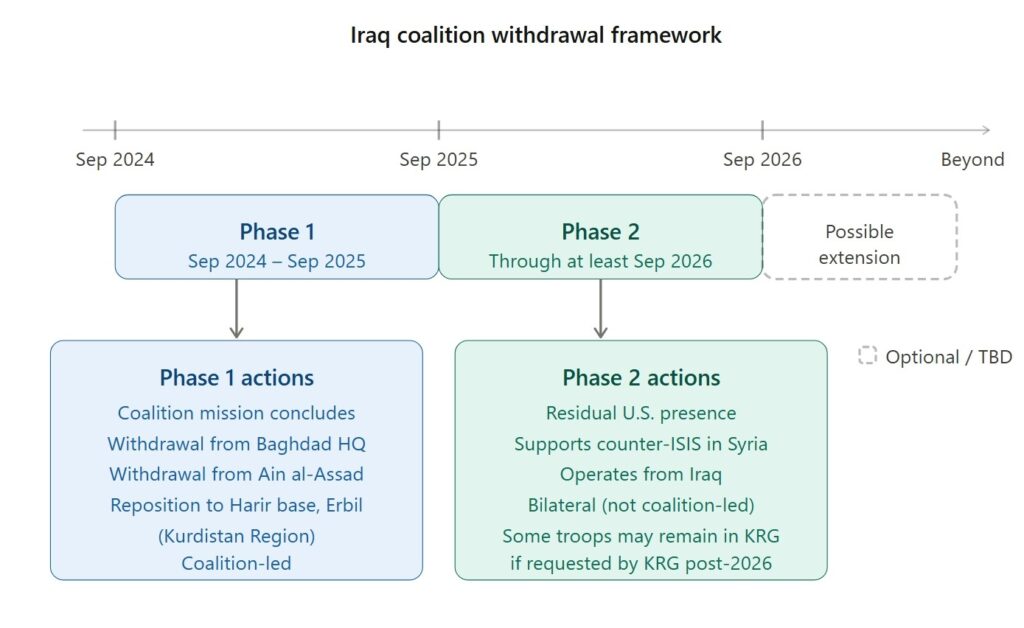
The path to the September 2024 agreement involved a structured diplomatic and military process:
- In August 2024, as Sudani was negotiating the end of OIR, Iran-backed Iraqi militias agreed to an undeclared truce conditioned on U.S. forces not attacking them or using Iraqi airspace to strike Iran. This truce was held through the announcement of the agreement.
- On September 27, 2024, on the margins of the UN General Assembly, U.S. and Iraqi officials jointly announced a two-phase transition plan. Senior U.S. officials described it explicitly as a “transition,” not a withdrawal, emphasizing continuity of the bilateral security relationship.
- During the course of 2025, the United States and Iraq maintained sustained talks through the Higher Military Commission and the U.S.-Iraq Joint Security Cooperation Dialogue JSCD. These channels functioned as the main venue for evaluating Iraq's prevailing security landscape and deliberating how a transition coalition might unfold. Their discussions focused on the assessments to prevent operational readiness with Iraq's sovereignty concerns.
OIR During the 2025-26 Regional Conflicts (Continued Presence or Withdrawal?)
Since the announcement of the U.S.-Iraq agreement, regional escalation has characterized the security environment, which complicated the transition process and heightened the questions about force protection. In April-June 2025, the intensification of the Israel-Iran conflict led Iran-aligned militia groups (IAMGs) in Iraq to warn that they would target U.S. interests if Washington participated in Israeli strikes on Iran. Yet, as noted in the Department of Defense Lead Inspector General’s quarterly report on Operation Inherent Resolve, CJTF-OIR assessed these groups as "noticeably reluctant" to engage U.S. personnel or facilities, pointing to Kataib Hezbollah's public statement distancing itself from the broader fight. Nonetheless, U.S. bases in Iraq and Syria came under missile and drone fire in mid-June 2025. Although most of the attacks were successfully intercepted, a number went unclaimed, and several were linked to Iran-backed groups. The escalation of tensions forced a temporary evacuation of U.S. diplomatic staff from Iraq in June 2025.
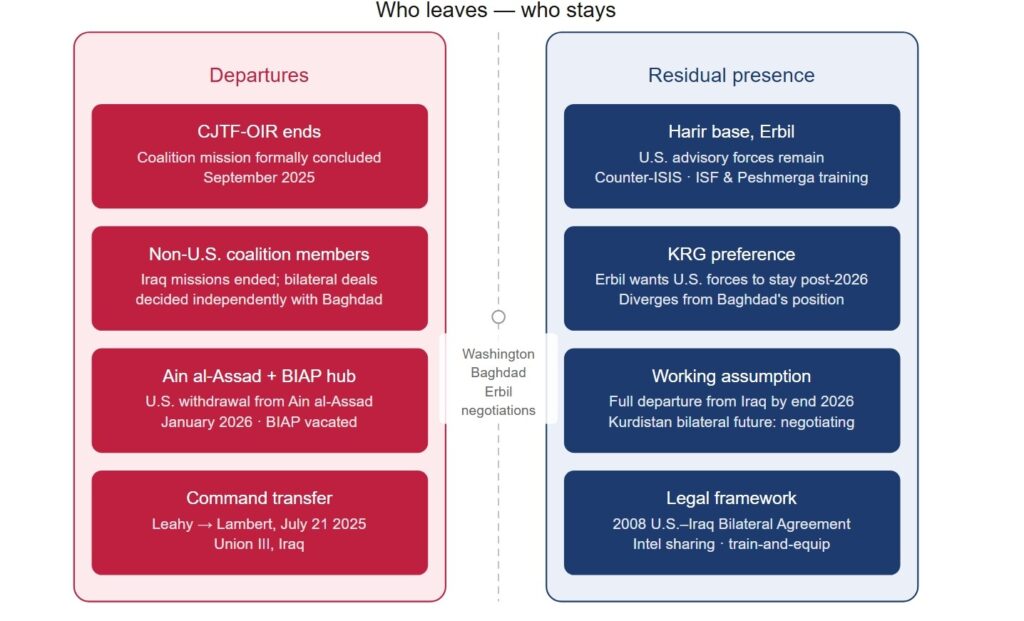
U.S. forces, by January 2026, completed their withdrawal from the Ain al-Assad airbase in Anbar, thereby concluding over twenty years of military presence in western Iraq. Coalition headquarters had previously been vacated in September 2025. The residual U.S. footprint, estimated at 2,500 troops as of mid-2025, was concentrated in the Kurdistan Region bases in Harir and Erbil International Airport.
On February 28, 2026, U.S. and Israeli forces carried out strikes against Iran, triggering attacks by the Islamic Resistance in Iraq (IRI)—an umbrella organization of Iran-backed militias that claimed responsibility for 67 drone and missile attacks on unspecified targets over the first three days of the conflict. Many of these attacks were intercepted in the Kurdistan Region, including the Harir and Erbil International Airport bases. Despite these escalations, U.S. forces remained deployed in the Kurdistan Region, and the Pentagon refrained from ordering an emergency evacuation of military personnel.
What does it mean for Iraq?
The end of OIR’s formal mandate represents the most significant shift in Iraq’s security environment since 2011. Its implications are multidimensional:
ISIS Resurgence Risk
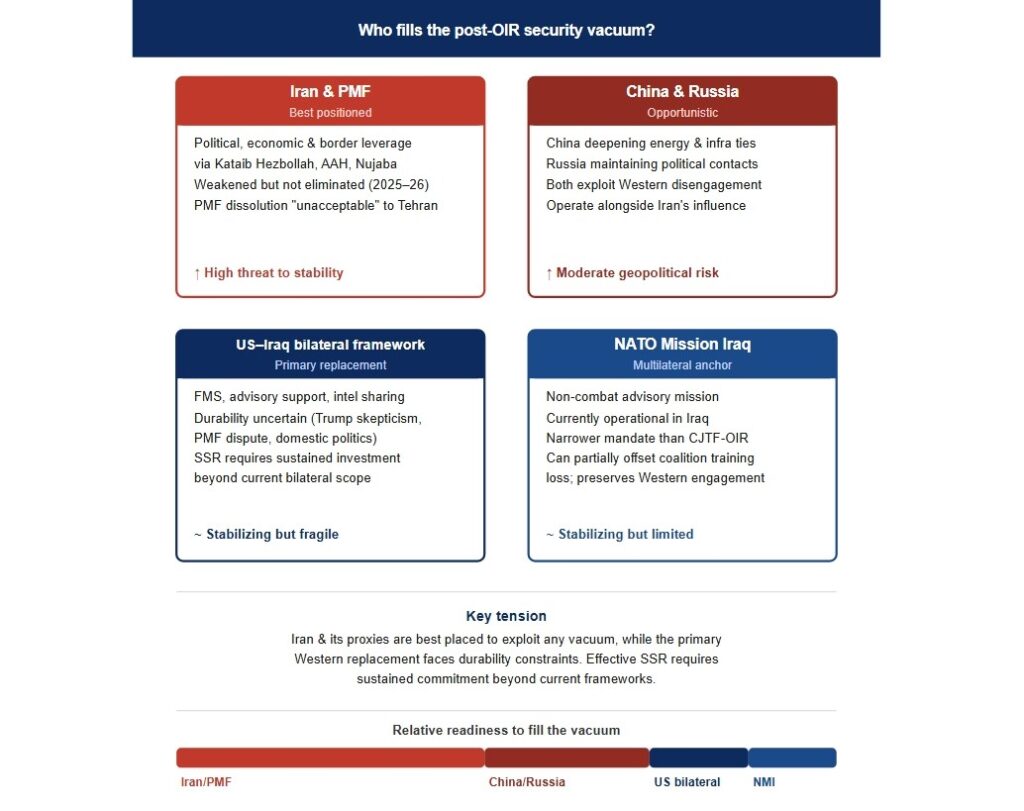
ISIS has not been eradicated, as UN Security Council reporting says the group has concentrated on rebuilding networks along the Syrian border and reinstating capacity in Iraq’s Al-Badia region. Reports suggested that in June 2025 ISIS fighters were re-establishing networks and trying to lay ambushes in Kirkuk and Diyala. The withdrawal of coalition intelligence, surveillance, and reconnaissance (ISR) assets and training teams has removed a vital layer of support for the ISF’s counter-ISIS capacity. Some U.S. officials have warned against a “deploy, withdraw, rush back” cycle if the security vacuum is not managed properly.
The Structural Role of Iran and the PMF
The PMF was created in response to ISIS, and its numbers grew from 122,000 personnel in 2019 to some 238,000 in 2023. With its budget rising from $1.7 billion to $3.4 billion accordingly. In 2025, Esmail Ghaani, the IRGC Quds Force chief, visited Iraq at least three times to bolster and reiterate Tehran’s interests. In the wake of OIR departure, the PMF and its Iran-allied factions are poised to expand their influence over political institutions and territory in central and southern Iraq. A proposed new law that would make the PMF an independent security organization with financial independence would meet strong U.S. objections. Secretary of State Marco Rubio formally conveyed his concerns to former Prime Minister Sudani, warning that the legislation would “institutionalize Iranian influence.”
U.S.-Iraq Bilateral Security Relationship
Washington and Baghdad have both promised to transition OIR’s operations into a bilateral security agreement under the 2008 Bilateral Framework Agreement. This anticipates the continuation of training programs, foreign military sales, and intelligence cooperation. The Trump administration has relied on pressure rather than partnership to address the PMF, including sanctions and the "Free Iraq from Iran Act," leaving little room for a cooperative reform framework. Washington has also introduced legislation, called the “Free Iraq from Iran Act,” that would tie security assistance to Iraq’s ability to dismantle Iran-backed groups.
The Sovereignty Dilemma for Iraq
Former Prime Minister al-Sudani has contended that the cessation of the foreign presence will eliminate the pretext for armed groups to continue operating outside of state control. Skeptics point out, however, that disarming the PMF necessitates confronting factions that were part of the political coalition that propelled Sudani to power. The task is a politically hazardous and structurally challenging endeavor.
The transition to a new government under Prime Minister-designate Ali al-Zaidi, a political outsider and businessman with no prior government experience, offers a narrow opening but limited grounds for optimism. Analysts note that al-Zaidi's premiership is likely to bring continuity rather than change, as he remains backed by the same Coordination Framework coalition that brought Sudani to power. Washington has signaled cautious approval, though analysts warn that a cabinet stacked with Iranian-aligned partners would undermine both Iraq-U.S. relations and the prospects for genuine PMF reform.
The fundamental challenge for Baghdad is to convert the departure of coalition forces into genuine state consolidation, rather than a power vacuum that is filled by non-state actors.
What Does It Mean for the Kurdistan Region of Iraq (KRI)?
A qualitatively distinct set of consequences is presented to the KRI, which combines strategic opportunity with increased exposure:
KRI as the Residual Hub
With U.S. forces consolidated in Harir and Erbil, the KRI is now effectively the primary base for the remaining American military presence in Iraq. The KRG has sought to translate this into political capital in its ongoing disputes with Baghdad over budget allocations, oil revenue sharing, and territorial administration, a dynamic analysts have observed directly, noting that hosting U.S. forces strengthens Erbil's bargaining position while allowing it to claim it is simply filling a void that Baghdad's own expulsion demands created. This tactic is not without precedent: during the 2023–2025 Iraq-Türkiye pipeline standoff, the KRG's reluctance to reopen the line was widely read in Baghdad as an attempt to extract concessions, and Washington ultimately intervened, threatening Iraqi energy officials with sanctions in ways that effectively backed Erbil's position. More recently, the Trump administration publicly praised KRG gas deals with U.S. firms, though it stopped short of pressuring Baghdad to accept them, preferring the role of broker over open patron. Washington has not formally endorsed the KRG using troop presence as leverage, and the KRG's ability to do so is constrained by its own internal divisions and fiscal weaknesses. Still, the KRG has been actively working to keep U.S. troops in the region past 2026, viewing their presence as both a security guarantee and a geopolitical asset in its competition with Baghdad.
The concentration of U.S. forces makes the KRI the prime target for retaliation by Iran and Iran-backed militias. As of the April 2026 ceasefire, attacks on the Kurdistan Region had killed at least 23 people, including six Peshmerga and four civilians and injured over 100 others across more than 800 drone and missile strikes, with attacks continuing even after the ceasefire took effect.
After September 2026, when Operation Inherent Resolve (OIR) concludes, Iraq's federal structure will face its first major scrutiny. A full U.S. withdrawal would cause a significant setback for Kurdish interests, as American forces have historically served as a security blanket against Baghdad's centralization pressures while also guaranteeing Kurdish autonomy. The Shia-led government marginalized Sunnis after the 2011 U.S. troop withdrawal, a dynamic that Kurdish leaders fear will repeat. Despite their differing ties to Tehran, both the KDP and PUK advocate continued U.S. engagement, a stance reinforced by the current regional conflict, which has proven American protection superior to other options.
The crisis has further strained Baghdad-Erbil ties. The KDP-led KRG accuses the federal government of failing to stop militia attacks on the region, while Baghdad's investigative committees have produced few visible results. Post-OIR power dynamics will prove critical as these frictions overlap with enduring disputes over budget transfers and disputed territories such as Kirkuk.
Operation Inherent Resolve — Summary Tables
Collision Against ISIS (CJTF-OIR)/2014-2024
| Achievements — Operation Inherent Resolve | |
| Metric | Value |
| Territory reclaimed from ISIS | 42,000 sq miles |
| People liberated (including Yazidis, Christians, minorities) | ~8 million |
| Iraqi security & police personnel trained | 225,000+ |
| Military equipment provided | $4 billion+ |
| Coalition airstrikes conducted (2014–2019) | 34,573 |
| Senior ISIS leaders eliminated (2014–2017) | 180+ |
| ISIS annual revenue — peak (2014–15) | $1–2 billion |
| ISIS annual revenue — by 2019 | Under $50 million |
| Remaining ISIS fighters (end of combat phase) | 5,000–10,000 (regional) |
| Operational Milestones | |
| Event | Detail |
| Territorial defeat — Iraq | December 2017: all ISIS-held terrain reclaimed |
| Territorial defeat — Syria | March 2019: final clearance operation completed |
| Senior leadership eliminated | At least 180 killed or captured (2014–2017) |
| Caliph al-Baghdadi killed | Barisha Raid, October 2019 — U.S. Delta Force with CJTF-OIR intelligence support |
| Revenue networks dismantled | ISIS income dropped from $1–2B/yr at peak to under $50M by 2019 |
| ISIS reduced to insurgency | Transformed from territorial proto-state to decentralized insurgency |
| Shortcomings — Operation Inherent Resolve | |
| Shortcoming | Description |
| Civilian casualties | Airwars documented 8,220–13,299 civilian deaths from coalition airstrikes in Iraq and Syria, plus 1,437 in other operations, generating lasting political friction |
| Incomplete neutralization | ISIS was territorially defeated but not destroyed. It retained insurgency capacity in Diyala, Kirkuk, and the Anbar–Syria border corridor |
| Operational pauses | All CJTF-OIR training and anti-ISIS operations were suspended in January 2020 following the killing of IRGC commander Qasem Soleimani, exposing structural vulnerabilities in mission continuity |
| Root causes unaddressed | The mission did not resolve underlying governance failures, economic exclusion, or sectarian grievances that had enabled ISIS's rise, all of which remain present in post-OIR Iraq |
Key Strategic Implications
- Risk of ISIS Resurgence: The reduction of ISR coverage, partner training, and special operations pressure has created conditions for ISIS to reconstitute insurgency networks, particularly in the Iraq–Syria border corridor and Diyala province. This risk is further heightened by the destabilization of Syria following the collapse of the Assad regime.
- Iran’s Structural Entrenchment: The post-OIR period carries the risk of Iranian influence over Iraqi state institutions being consolidated through the PMF, especially if the proposed PMF autonomy legislation is enacted. Such developments could accelerate the “Lebanonization” of Iraq’s governance model.
- Kurdistan Region: The Kurdistan Region has become the focal point of both Iranian retaliatory targeting and residual U.S. presence. The 2026 regional conflict demonstrated that hosting U.S. forces in the KRI provides deterrence benefits but also exposes the region to direct attack risks.
- U.S. Credibility and Deterrence: A full U.S. withdrawal from Iraq could erode Washington’s ability to shape Iraqi political dynamics and deter militia attacks on partners, particularly during periods of heightened tension.
Opportunities
- Sovereignty Dividend: Iraq's framing of the coalition's departure as a sovereignty gain creates political space for potential PMF reform—but only if international partners apply sustained pressure. Sudani expanded the PMF membership from 122,000 to 238,000 (budget: $3.6B), approved a PMF-affiliated company, and integrated militia leaders into his coalition, yet stated Iraq can disarm factions only after full U.S. withdrawal. The end of OIR removes militias' political justification for operating outside state authority, even as the new government balances militia integration with assertions of state control.
- Bilateral Deepening: Moving from the multilateral OIR coalition to a bilateral U.S.–Iraq security framework (announced 2025) provides a more stable partnership that is less exposed to the political risks of 2,500+ multinational troops. This model enables counter-ISIS cooperation without occupation optics that fuel militia attacks.
- Economic Engagement as Leverage: Washington's push for U.S. energy investment (Chevron and ExxonMobil) and reducing Iraq's dependence on Iranian gas (~40% of electricity generation) provides non-military leverage. However, conditioning benefits on governance/PMF reform faces resistance: Sudani's government has expanded militia power rather than reformed it
- KRI as Regional Anchor: The Kurdistan Region’s willingness to host U.S. forces and its relative political stability make it a viable long-term base for counter-ISIS operations in Syria, intelligence collection, and crisis response. A negotiated, durable KRI-based presence would advance both U.S. strategic interests and the autonomy interests of KRI.
- Regional Coalition Architecture: The non-military dimensions of the D-ISIS Global Coalition—foreign fighter tracking, counter-financing, counter-messaging, and civilian stabilization—remain relevant and could be sustained without a combat mission, preserving multilateral counterterrorism cooperation.
Content Type:Special Reports