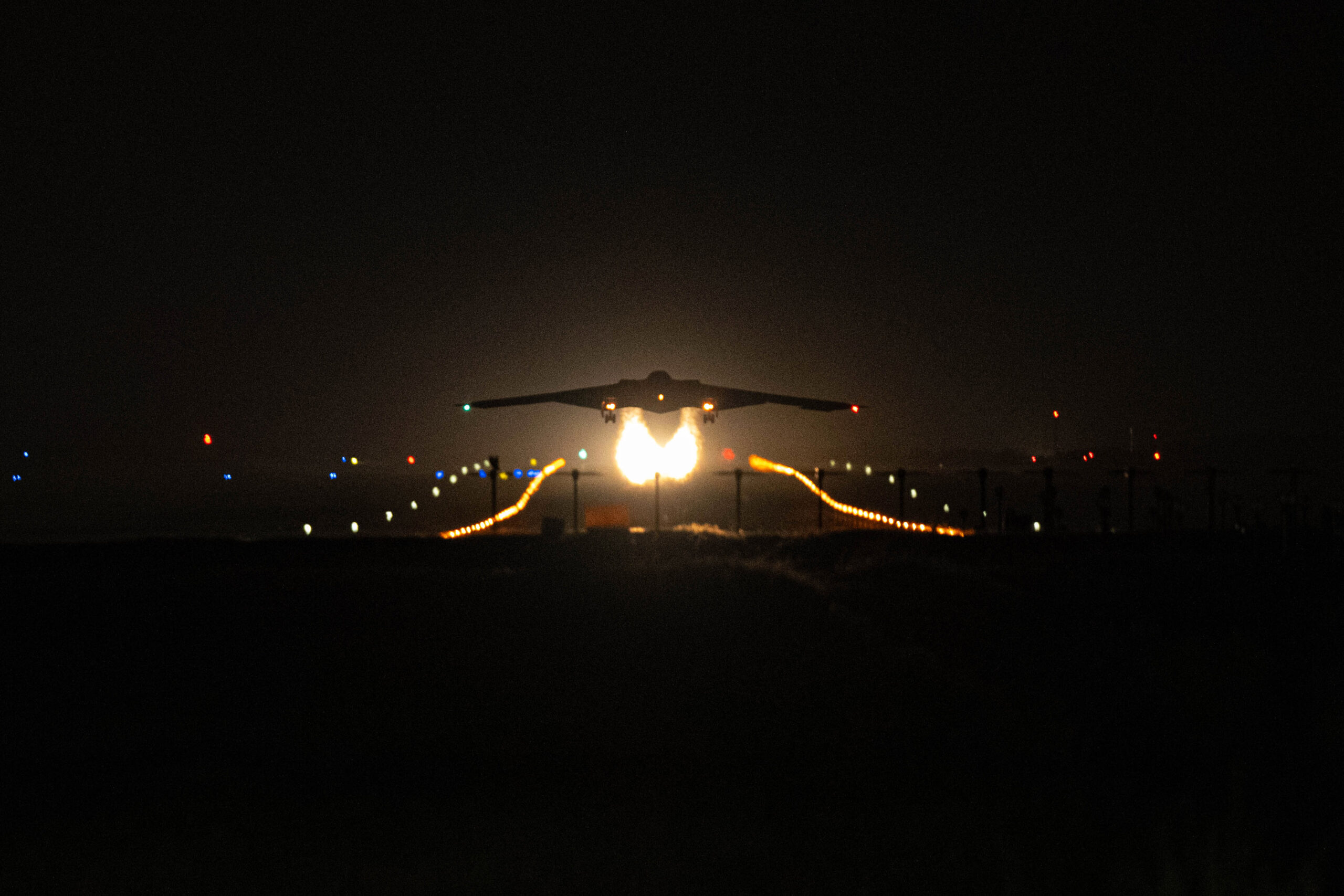
 A U.S. Air Force B-2 Spirit takes off to support Operation MIDNIGHT HAMMER at Whiteman Air Force Base, Missouri, June 2025.
Operation Midnight Hammer: The Strike That Decided the Iran War
Operation Midnight Hammer should be understood as the decisive military event in the US-Iran conflict that allowed the United States to establish escalatory dominance over Iran before a wider war could fully begin. By demonstrating overwhelming capability, narrowing the conflict to strategic targets, and leaving Tehran with fewer credible options, the operation became the single most important factor pushing Iran toward negotiation.
The 100-day war launched by the United States and Israel on February 28, 2026, was vast, destructive, and region-wide. It drew in Gulf states, triggered Iranian missile and drone attacks, and culminated in a memorandum signed on June 18, 2026, at the Palace of Versailles, establishing a 60-day framework for negotiations toward a mutual agreement. Though, the war’s outcome was shaped before the first day of that campaign, namely Operation Epic Fury. Midnight Hammer exposed Iran’s central vulnerability and its inability to protect the strategic infrastructure on which its deterrence depended.
The success of Operation Midnight Hammer can be measured less by battlefield territory gained and more by political leverage created. The United States did not need to occupy Iran, topple its government, or sustain a prolonged campaign. Instead, it used a limited but highly consequential strike to reshape Iran’s strategic calculation. Launched in June 2025, Midnight Hammer struck Fordow, Natanz, and Isfahan, the core sites of Iran’s nuclear program. The operation used B-2 Spirit stealth bombers, GBU-57 Massive Ordnance Penetrators, submarine-launched Tomahawk missiles, and a large support package involving more than 125 aircraft.
US officials described the strike as focused and limited, aimed at severely damaging Iran’s nuclear infrastructure without directly targeting Iranian citizens or launching a regime-change campaign. The limitation in size and scope was the source of the operation’s strategic power that showed the United States could reach Iran’s most protected facilities with precision and without entering a broad ground war. The strike effectively undercut Tehran’s assumption that geography, hardened sites, or regional proxies could shield its most valuable assets and it eventually changed Tehran’s calculation overnight.
Midnight Hammer showed that Iran could be made vulnerable at the strategic level, where the following Operation Epic Fury merely widened that effect across the Islamic Republic’s military posture.
The Case for Operation Midnight Hammer
The first reason Midnight Hammer mattered more than the later 100 days of war is that it destroyed Iran’s confidence in protected escalation. Before the strike, Tehran could assume that its nuclear program, buried facilities, missile arsenal, and proxy network created enough risk to deter direct American action. This was an assumption shared by established experts and leaders from the Iranian and American elites who shared a basic premise that direct US military intervention was next to impossible. Midnight Hammer, an operation 15 years in the making and the first direct “preemptive containment” mission since Operation Praying Mantis in 1988, proved otherwise. The United States reached Iran’s most sensitive and hardened nuclear facilities with precision and without first committing to a broad ground war. That changed the psychological balance long before February 2026.
The second reason is that Midnight Hammer created the military logic for Operation Epic Fury. Instead of beginning from a blank slate, the February 28 campaign began after Midnight Hammer had demonstrated that Iran’s most valuable strategic assets could be degraded and politically isolated. Epic Fury expanded the target set, first starting with Iran’s strategic leverage asset, the nuclear sites and then reaching leadership hierarchy of the Islamic Republic, ballistic missile stockpiles, production facilities, naval capabilities, and regional military infrastructure. However, its conceptual foundation was laid in 2025. Midnight Hammer showed that Iran could be made vulnerable at the strategic level, where the following Operation Epic Fury merely widened that effect across the Islamic Republic’s military posture.
The third reason is that Midnight Hammer converted force into diplomatic leverage. The later war, known as the Iran-US-Israel War, inflicted broader damage, but it also introduced broader risks. Iranian retaliation across the Gulf, attacks on Israel and US bases, strikes against partner countries hosting US forces, and an expanding regional battlefield that pulled in Iraq, Syria, Türkiye, Cyprus, Azerbaijan, Jordan, and Lebanon. By contrast, Midnight Hammer was cleaner and more focus-oriented in strategic meaning. It delivered the message to Tehran that the United States had both the capability and the will to impose direct costs on the nuclear program, while still leaving Iran a path to negotiation. That combination of punishment without total closure of diplomacy turned out to be the US’s real source of leverage.
Escalation did not restore deterrence for Iran. Once Iran’s most important objective to protect its nuclear facilities had failed, escalation became a way to deepen losses rather than improve bargaining power.
This outcome is why the 100-day war should be read less as the decisive contest and more as the proof of Midnight Hammer’s earlier conclusion. Nonetheless, Iran could still escalate through firing barrages of missiles, swarms of drones, and activating proxies. It struck Gulf states and US partner countries and tried to turn the region’s dependence on energy routes into a weapon by moving against the Strait of Hormuz. But the important point to remember is that escalation did not restore deterrence for Iran. In essence, it backfired, and the more Iran widened the war, the more it justified a stronger US-led regional response, including naval pressure and blockade measures that made Iran’s own economic position more fragile, in addition to its strategic allies, especially China.
It is hard to lose sight of the fact that framing the Iran-US-Israel war as a win-or-lose contest was the strategic trap Midnight Hammer had engineered from the start. Iran still had tools of retaliation, but they were no longer tools of leverage.
Attacking Gulf states and US partners raised the cost of the conflict for the region, but it also expanded the coalition of states with an interest in containing Tehran. Threatening or disrupting the Strait of Hormuz signaled danger, but it also invited the kind of US naval response that could choke Iran’s own options, similar to the US naval intervention in the Strait of Hormuz that pressured Tehran into a ceasefire with Iraq in 1988. In the current state of affairs, it is worth noting that each escalation shows that Iran could hurt others, though none indicate that Iran could reverse the central fact that its nuclear facilities have already been penetrated and degraded.
Midnight Hammer changed Iran’s calculation in a single-issue strike that reset the nuclear clock by at least a decade.
The Distinction between Midnight Hammer and Epic Fury
Critics may argue that the broader war, not Midnight Hammer, forced Iran into a potential deal. After all, Epic Fury involved leadership decapitation, attacks on missile infrastructure, and a region-wide exchange that lasted 100 days with massive economic losses for Iran and the region. Iran’s attacks on Gulf countries, Iraq, Türkiye, Azerbaijan, Jordan, Israel, and US positions showed that Iran possesses a robust and resilient defense posture. However, the key point to remember is that Midnight Hammer changed Iran’s calculation in a single-issue strike that reset the nuclear clock by at least a decade.
The distinction between Midnight Hammer and Epic Fury matters within military and geopolitical contexts. Wars are often remembered by their duration, casualty levels, and visible destruction. Strategy, however, is judged by whether one side changes the choices available to the other. The abovementioned reasons well explain that Midnight Hammer did that more effectively than the 100-day war. It removed Iran’s belief that its nuclear infrastructure could remain a protected bargaining chip. It forced Tehran to confront the possibility that refusing a deal would not preserve leverage but invite further dismantling of the very assets that made Iran a growing threat in the first place.
The war proved Iran could still impose costs across the region, but it also proved that those costs no longer translated into strategic leverage. Once Iran’s most important objective to protect its nuclear facilities had failed, escalation became a way to deepen losses rather than improve bargaining power. Midnight Hammer achieved its strategic objective of establishing long-term nuclear deterrence. It also demonstrated US airpower's unmatched speed, range, precision, and lethal capabilities to enable global reach and decisive strategic effects.
In the end, the United States may not be able to claim outright victory in its 100-day war with Iran. However, Operation Midnight Hammer decisively tilted the balance in Washington’s favor, striking first at the core of Iran's strategic nuclear leverage and ensuring the terms of any conclusion would favor the United States later.
References
Funderburke, Joe. “The Gathering Storm: US and Israeli Military Posturing and the Coming Reckoning with Iran.” Small Wars Journal, February 19, 2026. https://smallwarsjournal.com/2026/02/19/the-gathering-storm/
Froman, Michael. “Assessing the Effect of the US Strikes on Iran.” Council on Foreign Relations, June 27, 2025. https://www.cfr.org/articles/assessing-effect-us-strikes-iran
Grossi, Rafael Mariano. “IAEA Director General Grossi’s Statement to UNSC on Situation in Iran.” International Atomic Energy Agency, June 20, 2025. https://www.iaea.org/newscenter/statements/iaea-director-general-grossis-statement-to-unsc-on-situation-in-iran-20-june-2025
Lamay, Hen. “Operation Midnight Hammer: Mastering Deception in Warfare and Cybersecurity.” Deceptive Bytes, June 26, 2025. https://www.deceptivebytes.com/operation-midnight-hammer-mastering-deception-in-warfare-and-cybersecurity/
Lopez, C. Todd. “‘Historically Successful’ Strike on Iranian Nuclear Site Was 15 Years in the Making.” US Department of War, June 26, 2025. https://www.war.gov/News/News-Stories/Article/article/4227082/historically-successful-strike-on-iranian-nuclear-site-was-15-years-in-the-maki/
Rodgers, Joseph. “What Operation Midnight Hammer Means for the Future of Iran’s Nuclear Ambitions.” CSIS Nuclear Network, June 25, 2025. https://www.csis.org/analysis/what-operation-midnight-hammer-means-future-irans-nuclear-ambitions
Vergun, David. “Defense Agency Contributed Toward Operation Midnight Hammer Success.” US Department of War, July 10, 2025. https://www.war.gov/News/News-Stories/Article/Article/4240876/defense-agency-contributed-toward-operation-midnight-hammer-success/
Widjajanto, Andi. “The Complexity of Operation ‘Midnight Hammer.’” Kompas.id, June 30, 2025. https://www.kompas.id/artikel/en-kompleksitas-operasi-midnight-hammer
Sen Gupta, Pathikrit. “Praying Mantis, Midnight Hammer & Epic Fury: How US-Iran Warfare Became Algorithmic Over 4 Decades.” News18, March 3, 2026, Praying Mantis, Midnight Hammer & Epic Fury: How US-Iran Warfare Became Algorithmic Over 4 Decades | Explainers News - News18
List of attacks during the 2026 Iran war. 2026. List of attacks during the 2026 Iran war - Wikipedia
Content Type:Commentaries