 Credit: The National Context.
Mapping of Kurdish Groups and Forces in Eastern Kurdistan
Kurdish National Political Movements in Eastern Kurdistan
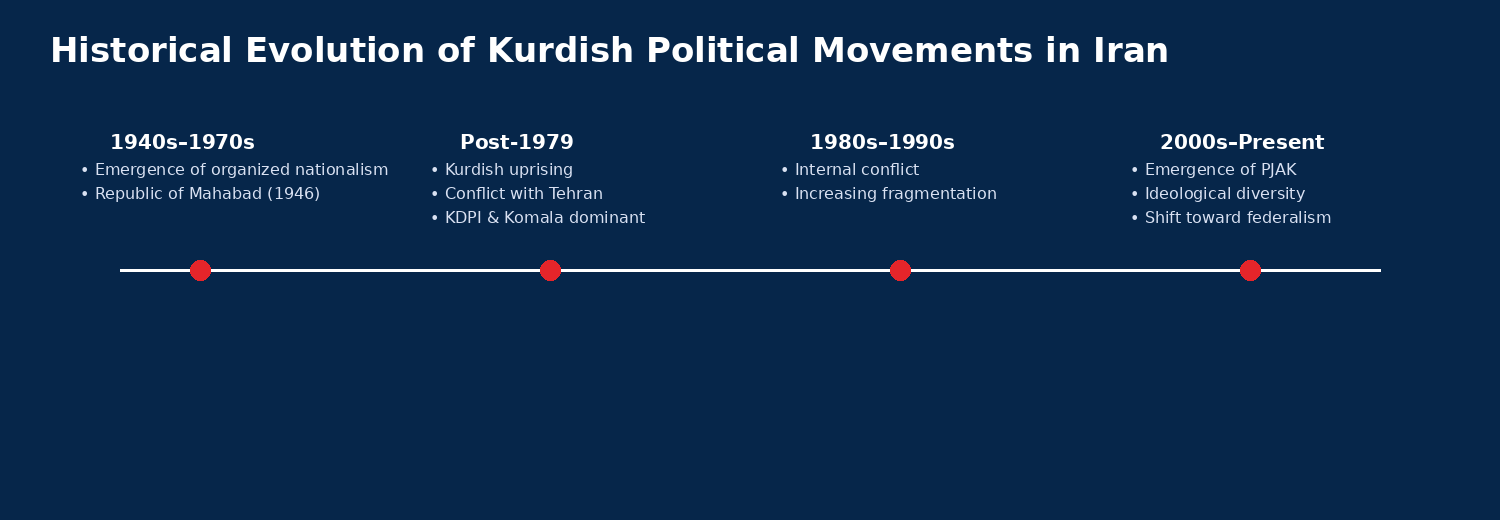
Kurdish national political movements in Eastern Kurdistan, also called “Rojhalat” in Iran have re-emerged as strategically relevant actors in the context of escalating regional conflict, not because of their internal strength, but because of the shifting balance between external pressure and state vulnerability. Kurdish parties from Eastern Kurdistan are primarily exiled opposition groups based in the Kurdistan Region of Iraq, where some are known for advocating for Kurdish autonomy or secession from Iran. These actors do not operate in isolation, nor do they function as unified opposition. They exist within a constrained political space, one that has been shaped over decades through confrontation, division, and containment.
More importantly, the current moment, fueled by the Iran–US/Israel confrontation/war and the broader instability it produces, has created an opening in which Kurdish forces and groups attempt to reposition themselves. Yet this repositioning does not erase the structural conditions that have historically limited their unity, political stance, and overall coherence. The multiplicity of parties, competing ideological frameworks, and divided leadership structures are not simply the result of internal disagreements but reflect a longer trajectory in which division has become embedded in the political nature of Iran itself.
To understand the current positioning of these groups, this paper provides an overview of the main Kurdish political and armed actors in Eastern Kurdistan, outlining their historical development, ideological orientations, leadership structures, and areas of influence, while also highlighting recent developments in coordination and emerging political alignments.
Core Kurdish Political Actors
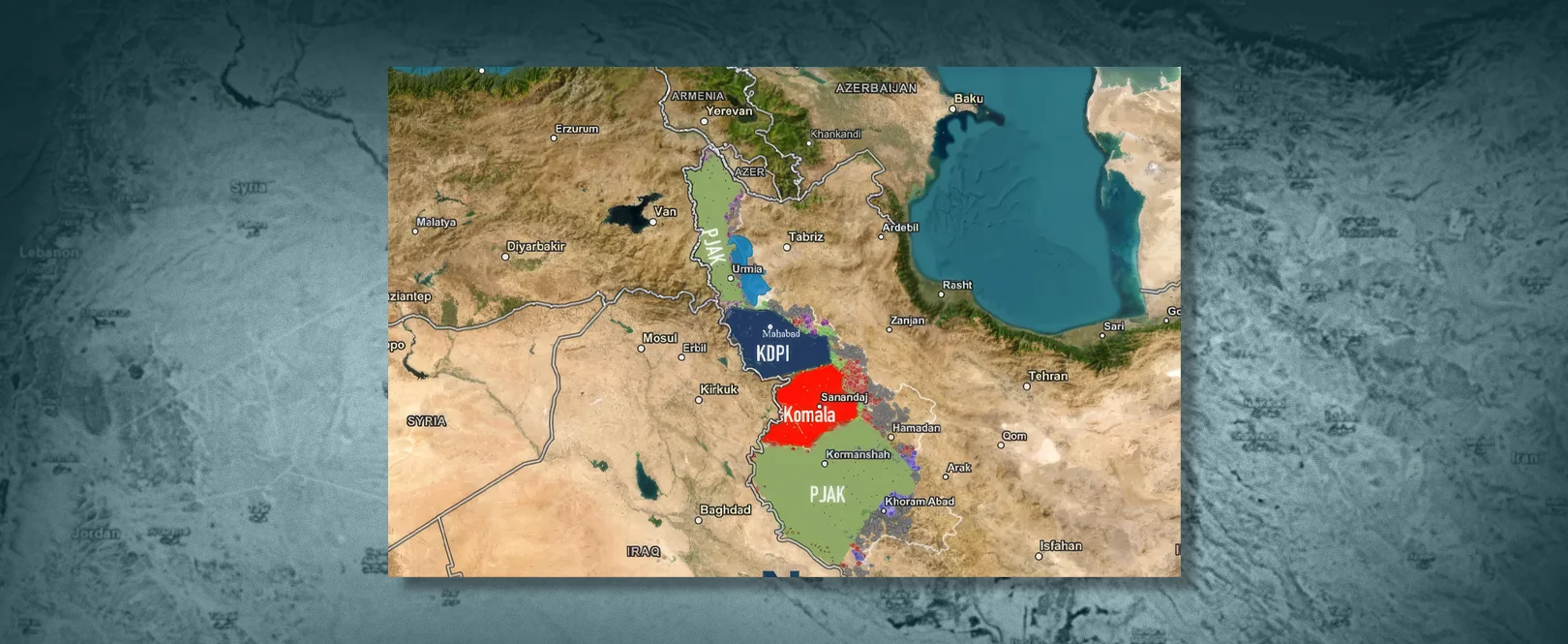
The primary Kurdish political actors in Eastern Kurdistan consist of several established opposition parties and movements, many of which operate in exile from the Kurdistan Region of Iraq. These groups differ in their historical origins, ideological orientations, and organizational structures but collectively represent the main Kurdish opposition and political stance in Eastern Kurdistan, Iran, as shown in Table 1.
| Kurdish Party/group | Historical Background | Ideology / Political Vision | Leadership | Power Base / Area of Influence |
| Democratic Party of Iranian Kurdistan (KDPI / PDKI) | Founded in 1945 in Mahabad. It assumed a central role in the Republic of Mahabad (1946) and led insurgency after the 1979 revolution | Kurdish nationalism, federalism, democratic governance within Iran | Mustafa Hijri | Iraqi Kurdistan Region (exile bases) and underground networks in Eastern Kurdistan |
| Komala Party of Iranian Kurdistan (Mohtadi faction) | Originated in the 1960s–70s as a Marxist movement. It was a key actor in post-1979 uprisings which later moderated | Originally Marxist-Leninist. And now social democracy and federalism | Abdullah Mohtadi | Iraqi Kurdistan Region. political networks inside Iran and diaspora |
| Komala – Communist Party of Iran (CPI faction) | Split from Komala during ideological fragmentation in the 1980s–90s | Marxist / communist ideology | Ibrahim Alizadeh | Iraqi Kurdistan Region, and has limited underground presence in Iran |
| Komala of the Toilers of Kurdistan | Breakaway faction reflecting internal splits within Komala | Leftist / socialist with Kurdish national framing | Reza Kaabi | Smaller exile-based presence |
| Kurdistan Free Life Party (PJAK) | Founded in 2004, with links to PKK ideological framework. It has active insurgent presence in northwest Iran | Democratic confederalism, decentralized governance, and supports a “democratic nation” | Siamand Moini, and Zîlan Vejîn | Mountains along Iran–Iraq border. It also has Qandil-linked networks |
| Kurdistan Freedom Party (PAK) | Emerged in the 2000s, and participated in anti-ISIS operations in Iraq | Kurdish nationalism, and some factions support independence | Hussein Yazdanpanah | Military units in Iraqi Kurdistan and diaspora networks |
| Organization of Iranian Kurdistan Struggle (Khabat) | Founded in 1980, and is rooted in Islamic Kurdish activism post-revolution | Kurdish nationalism with Islamic orientation | Baba Sheikh Hosseini | Iraqi Kurdistan Region |
| KDP–Iran (Moloudi faction) | Split from KDPI due to internal disputes | Kurdish nationalism and federalism | Mostafa Moloudi | Limited exile-based political presence |
Recent Developments: Kurdish Party Coordination
Recent developments indicate increased efforts toward coordination among Kurdish opposition groups in Eastern Kurdistan. The Coalition of Political Forces of Iranian Kurdistan (2026) represents a notable attempt to unify major Kurdish actors in response to heightened regional tensions and internal developments in Iran. Participating groups include KDPI, PJAK, Komala factions, PAK, and Khabat. Objectives of the Coalition include advancing Kurdish political rights and self-determination, increasing political and strategic coordination, and positioning Kurdish actors within a changing regional and domestic context.
The formation of the coalition coincides with broader anti-government protests in Iran, growing internal pressure on the state, and shifting regional security. While the initiative reflects an effort toward coordination, longstanding ideological and organizational divisions remain present among participating groups.
The Iran Freedom Congress and Opposition Coordination
The Iran Freedom Congress, held in London on March 28–29, 2026, brought together a diverse range of Iranian opposition actors, including political figures, civil society representatives, and diaspora groups, with the aim of discussing potential pathways for political transition beyond the Islamic Republic. The initiative reflects an effort to establish a more coordinated and pluralistic opposition platform, built around shared principles such as democratic governance and political inclusion. At the same time, early reporting indicates that the Congress also exposed underlying tensions regarding representation and participation, highlighting the continued challenges of unifying a divided opposition environment.
Exclusion of PJAK: Representation and Fragmentation within the Opposition
Despite recent coordination efforts, divisions among Kurdish actors remain evident. The “Iran Freedom Congress” held in London (March 28–29) brought together various Iranian opposition groups to discuss potential political transition scenarios. The Kurdistan Free Life Party (PJAK) was excluded from participation in the London conference. PJAK-affiliated voices and statements criticized the decision, describing it as politically motivated and reflective of selective inclusion within the opposition framework.
The exclusion of PJAK highlights differing approaches among Iranian opposition actors regarding legitimacy, representation, and acceptable political participation. As an organization associated with armed activity and linked ideologically to the PKK network, PJAK occupies a distinct position within the Kurdish political ranks, which may contribute to its contested status among both Iranian opposition groups and external stakeholders.
This development highlights broader structural tensions within the opposition environment. While initiatives such as the Iran Freedom Congress seek to promote unity, they also reveal the persistence of fragmentation, competing political visions, and differing thresholds for inclusion. In this context, the exclusion of PJAK illustrates the challenges of constructing a cohesive opposition platform that accommodates diverse actors while maintaining political consensus.
Key Observations
The Kurdish political movement in Eastern Kurdistan is best understood as divided, ideologically diverse, and organizationally fragmented. Multiple actors operate across distinct political frameworks, including nationalist parties, leftist movements, transnational ideological groups, and militarized organizations, each with its own leadership structure and strategic orientation. These groups primarily function in exile from the Kurdistan Region of Iraq, with varying degrees of underground presence inside Iran. This external positioning shapes their operational capacity, limits direct political engagement within Iran, and reinforces their reliance on regional actors and external developments.
Recent efforts toward coordination, including the formation of the Coalition of Political Forces of Iranian Kurdistan, indicate a degree of convergence among these actors. However, longstanding divisions, rooted in ideological differences, historical rivalries, and organizational fragmentation, continue to influence the scope and sustainability of such cooperation. Overall, Kurdish political actors in Eastern Kurdistan operate within a diverse yet politically charged environment shaped by internal divisions, external pressures, and shifting regional conditions. These factors continue to define both the opportunities for coordination and the limits of unified political action.
Reference List
Center for Terrorism and Counterterrorism (CTC) at West Point. 2020. Iranian Kurdish Militias: Terrorist Insurgents, Ethno-Freedom Fighters, or Knights on the Regional Chessboard? https://ctc.westpoint.edu/iranian-kurdish-militias-terrorist-insurgents-ethno-freedom-fighters-or-knights-on-the-regional-chessboard/
Democratic Party of Iranian Kurdistan. n.d. Official Materials and Historical Background.
Iran International. 2026. Iran says it hit Kurdish fighters near border, Iraqi Kurdish officials deny incursion. Iran says it hit Kurdish fighters near border, Iraqi Kurdish officials deny incursion | Iran International
IranWire. 2026. What Do We Know about the Kurdish Parties Opposing the Islamic Republic? https://iranwire.com.
JINSA. 2026. The Rise of Iran’s Kurdish Coalition. https://jinsa.org/jinsa_report/the-rise-of-irans-kurdish-coalition/
Komala Party of Iranian Kurdistan. n.d. Party History and Ideological Evolution.
Kurdish Peace Institute. 2026. The Coalition of Political Forces of Iranian Kurdistan: Risks and Opportunities. The Coalition of Political Forces of Iranian Kurdistan: Risks and Opportunities – Kurdish Peace Institute
Kurdistan Free Life Party. n.d. Organizational Overview and Leadership.
Kurdistan Freedom Party. n.d. Political and Military Activities Overview.
Middle East Forum. 2026. The Regime’s Worst Nightmare: Iran’s Opposition Unites. https://www.meforum.org/press-releases/the-regimes-worst-nightmare-irans-opposition-unites?utm_source
Organization of Iranian Kurdistan Struggle. n.d. Party Structure and Ideology.
The Jerusalem Post. 2026. Planning for Iran’s ‘pluralist future’: Iran Freedom Conference plans for day after regime falls. Iran opposition convenes in London to plan governance | The Jerusalem Post
The National. 2026. “Kurdish-Iranian Opposition Parties Form Alliance amid Tension and Protests in Iran.” February 23, 2026. https://www.thenationalnews.com/news/mena/2026/02/23/kurdish-iranian-opposition-parties-form-alliance-amid-tension-and-protests-in-iran.
The National News. 2026. Rifts Show Ahead of Iran Opposition Conference in London. https://www.thenationalnews.com/news/uk/2026/03/27/rifts-show-ahead-of-iran-opposition-conference-in-london/?utm_
The New Arab. 2026. “What Role Will Iran’s Kurds Play as the War Expands?” March 5, 2026. https://www.newarab.com/analysis/what-role-will-irans-kurds-play-war-expands.
Content Type:Informational