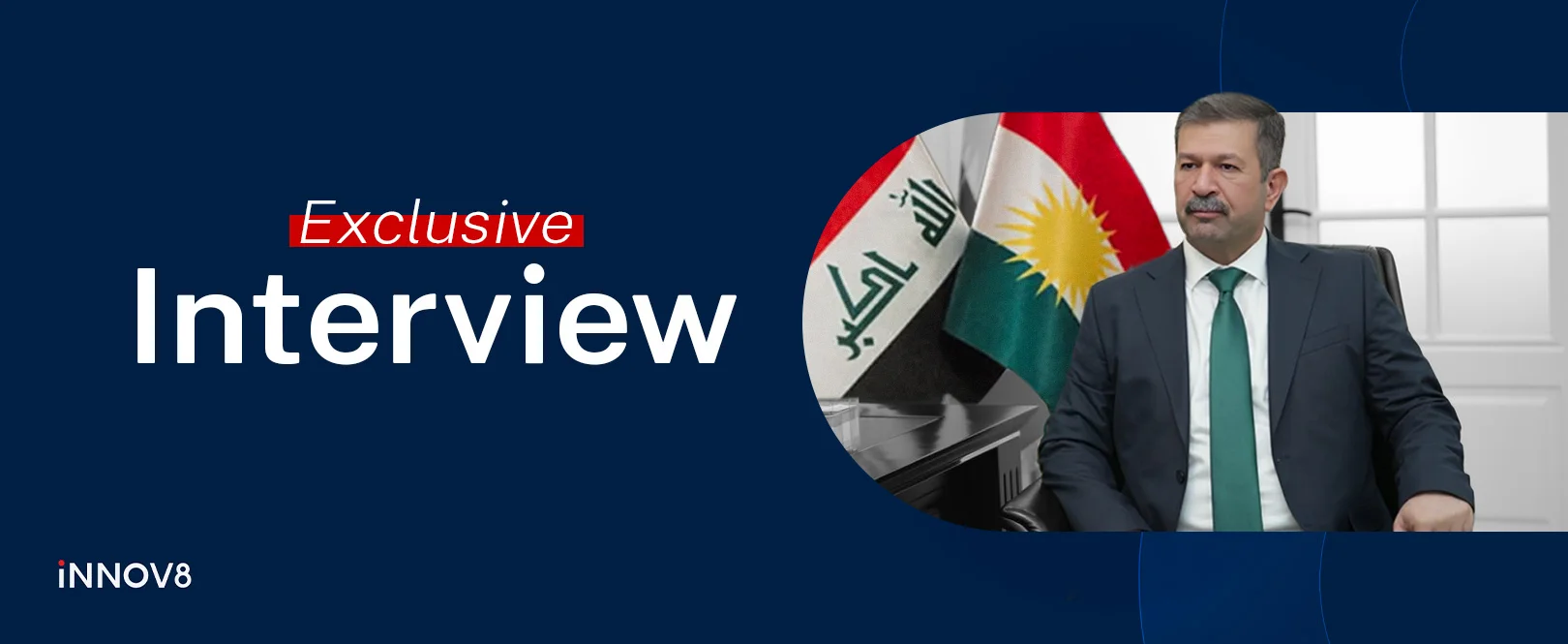
Exclusive Interview with Staff Lieutenant General Bakhtiar Sidiq, the Secretary General of the Ministry of Peshmerga Affairs
To read the policy paper on Peshmerga reforms, please click here. This research draws on insights from this exclusive interview to examine and better understand the reform process and institutional transformation efforts within the Peshmerga forces.
Profile of the Interviewee
Staff Lieutenant General Bakhtiar Mohammed Sidiq is a senior military leader in the Peshmerga Forces of the Kurdistan Region of Iraq, with over 30 years of experience in defense, military training, and operational leadership. He currently serves as Secretary General of the Ministry of Peshmerga Affairs, where he plays a central role in advancing institutional reform, modernization, and international military cooperation.
After completing his early education in Chamchamal and graduating from the Technical Health Institute in Sulaymaniyah, Staff Lieutenant General Sidiq pursued a degree in Business Administration and Computer Science. He began his formal military career at Qalacholan Military College, where he was commissioned as a Second Lieutenant in 1994. He later graduated from the Command and Staff College in Baghdad, earning a Master’s degree under NATO supervision.
Throughout his career, Staff Lieutenant General Sidiq has held a range of leadership positions across both Peshmerga and Iraqi Army structures, including roles in training, command, and administration. He served as a Brigade Commander and held senior positions in military training institutions, contributing significantly to capacity building and professional development within the armed forces. Between 2014 and 2017, he actively participated in operations against ISIS.
In addition to his operational roles, Staff Lieutenant General Sidiq has been closely involved in strategic reform efforts within the Ministry of Peshmerga Affairs. He played a key role in the development of the 2022–2026 Memorandum of Understanding between the Ministry and the United States Department of Defense, and has chaired key committees focused on financial and administrative reform.
Question 1: At what stage is the reform of the Peshmerga forces, and what is the status of the forces' overall numbers and the integration of Units 70 and 80?
Under the Memorandum of Understanding signed between the Ministry of Peshmerga Affairs and the United States, specifically the Department of Defense (Pentagon), it was agreed that the total strength of the Peshmerga forces would stand at 138,000 personnel. Following consultations with all relevant parties within the government and the political parties, the process was formally launched in 2022. Currently, approximately 100,000 Peshmerga are operating under the umbrella of the Ministry of Peshmerga Affairs.
Structure: It was decided that there would be two Area Commands, each composed of divisions, brigades, and battalions. Area Command One covers the Erbil and Duhok border areas and is made up of the forces of Unit 80, organized under six divisions.
What remains pending is Area Command Two, covering the areas of Sulaymaniyah, Halabja, and Garmian, which is composed of the forces of Unit 70. Its redesignation as Area Command Two has not yet been completed due to a number of pending issues, partly technical and partly political in nature. Operational, administrative, financial, and legal authorities have now been approved.
At the same time, the total manpower of the Peshmerga forces currently stands at between 150,000 and 155,000 personnel. However, under the Memorandum of Understanding, the agreed figure is 138,000. The resolution of this discrepancy will be achieved through retirement of the surplus numbers or their transfer to civilian positions.
Question 2: On the financial side, U.S. salary support for the Peshmerga is set to end in September 2026. The question is whether the central government in Baghdad can fill the gap left by that withdrawal.
The Memorandum of Understanding expires in September 2026. That much is clear. Under the terms of that agreement, the support provided to the Peshmerga forces, whether financial, material, training, or advisory, does not cover all of the force's needs. The budget of the Peshmerga forces, including salaries, falls within the general budget of the Kurdistan Regional Government.
At the present time, the salaries of the Peshmerga forces are generally half of what is paid to the federal security forces, for example, those of the Iraqi Ministry of Defense.
Therefore, with the expiration of the Memorandum of Understanding in September 2026, it is necessary at the level of the Kurdistan Regional Government to consider how to replace the support, financial, material, and advisory, that is coming to an end, in coordination with the federal government.
Question 3: The Peshmerga Law No. 19 of 2007 and the Reform Law No. 2 of 2020 - which addresses Peshmerga finances specifically - along with other related legislation, do you believe the legal framework is sufficient to carry the reform process forward?
The Ministry of Peshmerga Affairs has four laws governing it. The first is Law No. 19 of 2007, known as the Law of the Ministry of Peshmerga Affairs. Beyond that, Laws No. 33, 34, and 38 address matters such as honors and decorations, retirement, service conditions, disability provisions, and related issues.
Law No. 2 of 2020 addresses reform and was originally intended to be implemented within six months. Six years have now passed, and all of its provisions remain unimplemented.
At the same time, the reform process has been referenced at multiple levels, in the agenda of the Ninth Cabinet, subsequently in the 2022 Memorandum of Understanding, and earlier still in the 2005 strategic agreement between the KDP and the PUK, which called for agreement on the unification and reorganization of the Peshmerga forces. All of these accumulated efforts and agreements constitute the reform process as it stands today.
Question 4: Is the assistance provided to the Peshmerga being received through a unified financial system such as MyAccount?
Before the reform process began, Unit 70 had its own budget, Unit 80 had its own budget, and the Ministry of Peshmerga Affairs itself had a separate budget.
First: It has now been established within this reform process that the Ministry of Peshmerga Affairs' budget will be unified and brought entirely under the Ministry's umbrella.
Second: The Ministry of Peshmerga Affairs will consolidate the budgets of Area Commands One and Two under the Ministry's own financial directorate (Diwan), with the Ministry responsible for distributing allocations. This includes the submission and receipt of budget requests, the distribution of the budget, the unification of the review and audit balance, and submission to the Ministry of Finance, all subject to full financial oversight in order to achieve transparency.
Third: A payroll system is now in place across the government, with the objective of transitioning all salary payments to electronic processing.
Question 5: In terms of armament, how has the Peshmerga been supported to date, who supplies its weapons, what is the current level of weapons and ammunition needs, and where are the gaps?
The arming of the Peshmerga has never been organized in a structured way, and the weapons inventory is old and worn. Some weapons have been acquired from several sources:
Following the fall of the previous Ba'athist regime, some weapons were obtained; additional arms were acquired as a result of the war against ISIS; and others were provided by coalition partners on the basis of the Memorandum of Understanding and the ISIS war.
With the expiration of the Memorandum of Understanding in September of this year, the source of new weapons for the Peshmerga forces will no longer exist. It is therefore necessary for the Ministry of Peshmerga Affairs and the Kurdistan Regional Government to consider how to renew and modernize the force to acquire new weapons and meet the military requirements of the Peshmerga in a way that enhances its capabilities and aligns with the threats and challenges it faces in the near, medium, and long term.
Question 6: In terms of technological capability, what is the current standing and capacity of the Ministry of Peshmerga Affairs?
The Ministry of Peshmerga Affairs is in a transitional and early stage. A foundation for digitization has been laid, but to reach the level of advanced armies, further investment is needed in centralized data systems, intelligent surveillance technology, and information security. These steps will not only create greater efficiency in administration but will significantly enhance the Peshmerga's defensive and offensive capabilities on the battlefield.
Question 7: Regarding the Peshmerga's need for armament, specifically the acquisition or provision of a defense system have you held discussions with Baghdad on this matter?
On the question of acquiring a defense system, we have raised it with both Iraq and our coalition partners. If we look back at the history of Peshmerga armament, the approach has always been reactive: when the adversary had tanks, we requested anti-tank weapons; when they had combat aircraft, we requested anti-aircraft systems such as the Bazooka. Today, the changes in the nature of warfare are clearly apparent in this era. This requires us, as the Ministry of Peshmerga Affairs, to have anti-tank capabilities, air defense systems, drones, and counter-drone systems. This has been a consistent request from our side and has not yet been fulfilled.
For example, if we request drones, that requires the approval of the relevant federal Iraqi institutions, which in turn requires negotiation with Baghdad because as the Peshmerga, we are constrained in our ability to independently arm, procure, and acquire weapons and ammunition, whether for technical, legal, or political reasons.
Follow-up Question: When Iraq procures weapons or signs defense and military cooperation agreements with other countries, does it inform the Ministry of Peshmerga Affairs?
In federal Iraq, there is a Ministerial National Security Council, which is supposed to include the Minister of Peshmerga Affairs. There is also a National Security Strategy file/document in which the role, responsibilities, and rights of the Peshmerga forces are not adequately defined as required.
In the federal Council of Ministers there is a senior committee for security sector reform (SSR), but the role of the Kurdistan Region's security institutions within that committee is not represented as it should be.
The participation of the Kurdistan Region's security institutions, including the Peshmerga, in what has been discussed at the federal government level is essential for establishing the rights, responsibilities, and role of the security forces.
Question 8: In your view, what are the most significant achievements of the Peshmerga reform process to date?
As one of the parties engaged in the reform process, one of the most important achievements is that we have been able to work together and remain united throughout. Every effort has been made to ensure that the reforms move forward, and even where progress has been slow at times, the process has never stopped and has maintained its continuity. There is a national will among the Peshmerga to work together. This shared national foundation has bound us together, and we have been able to make national identity and a sense of collective belonging the basis from which we work and advance the reform process.
Question 9: Is there a possibility that a new Memorandum of Understanding will be signed between the Peshmerga and the United States after September?
In my personal view, I do not believe that a new Memorandum of Understanding between the Peshmerga and the Pentagon will be renewed in its current bilateral form. That said, circumstances can change if the security situation shifts, and a new need or justification for renewal emerges.
What is possible is a Memorandum of Understanding between the Iraqi Ministry of Defense and the United States, within which the Peshmerga could be included as a party.
However, in the event that a bilateral Memorandum of Understanding with the United States is signed and renewed, that would very much serve the Peshmerga's interests. But it would require a serious and substantive step from the Kurdistan Regional Government and the Ministry of Peshmerga Affairs, one that demonstrates genuine readiness to implement reform, to unify and reorganize the Ministry of Peshmerga Affairs, and to receive and act upon the advice and recommendations provided by the United States and our coalition partners. We must demonstrate that we deserve their continued presence, and that requires the Ministry of Peshmerga Affairs and the Kurdistan Regional Government to be serious and committed to advancing the reform process.
Content Type:Videos and Interviews