Is Greening and Forestation a Governance Challenge in the Kurdistan Region?
Executive Summary
The Kurdistan Region of Iraq has lost more than half of its forest cover over the past several decades. This degradation was driven by military campaigns, illegal logging, climate change, and institutional neglect. While greening and afforestation initiatives exist, they remain largely symbolic, prioritizing planting over the monitoring, maintenance, and water integration necessary for long-term survival. Responsibility is fragmented across multiple authorities with no unified coordination mechanism, no dedicated budget, and no systematic tracking of outcomes. The KRI does not lack the will to green its landscapes. What it lacks is the institutional capacity to ensure what is planted today survives tomorrow.
A Brief History of Forestation and Greenery in the Kurdistan Region
The Kurdistan Region of Iraq used to be among the most densely forested territories in the Middle East. In the 1950s, British forest expert and scholar G.W. Chapman surveyed approximately 5 million dunams (hectares) which converts to approximately 500,000 hectares of estimated natural forest area. The survey indicated forests that were dominated by native oak trees and covering an estimated 30 percent of the land, representing over ninety percent of Iraq's remaining natural forest cover.1 Chapman specifically described the natural forests of Iraq as confined almost entirely to the northeast region of the country, which he called “mountains occupied by Kurdish tribes.”2 In addition to oak trees, Chapman categorized the following tree species commonly found and mixed with the oak trees:“Juniperus oxycedrus, Pistacia mutica, Pyrus syriaca, Cratoegus azarolus and P. monagyna, Acer monspessulanum. Along mountain stream banks willows, Salix purpurea and S. medemii, plane, Platanus orientalis, popular, Populus euphraca, and ash, Fraxinus rotundifolia, occur, and in some places wild groves of walnut, Juglans regia.”
According to his survey, Pinus brutia occurs mixed with the oak forest in a restricted area of about 500 km2 in the Zawita-Atrush district of Mosul, and apart from the more widely occurring juniper represents the only coniferous forest found in Iraq. That rich forest inheritance has since been systematically diminished. The causes are well-documented for forest loss, such as illegal logging, military operations, prolonged drought due to climate change, and the systematic neglect of forest management budgets during periods of fiscal crisis and conflict.
By 2018, a joint satellite survey conducted by the Kurdistan Regional Government’s Ministry of Agriculture and Water Resources and three Iraqi universities found that green coverage had fallen to just 12.44 percent of total land area, a loss of more than 2.2 million acres in under two decades, which is less than half of what existed within living memory.3
Forest loss, or deforestation, both natural and artificial, traces a familiar moment in the history of the KRI and Iraq’s compounding environmental crises. Given Iraq’s deeply rooted historical conflicts, it can be argued that some forest losses in the KRI are attributed to recurring conflicts and wars. This situation is further compounded by a general lack of environmental awareness among the public as well as weak environmental oversight both in the KRI and Iraq. Human action, in its broad context, accounts for the majority of deforestation alongside climate change.
In some cases, even the very acts of afforestation and reforestation have had little to do with environmental protection per se. The former Iraqi government's tree-planting initiatives are a clear example, as Marouf Majid, environmental activist and Head of the Ayinda Organization for Environmental Protection, stated in an exclusive interview.4 In 1974, following the collapse of the Kurdish armed struggle, the Iraqi government employed approximately 1,000 workers to plant artificial forests, not out of any environmental concern, but simply because these individuals had been left without work, Majid stated.
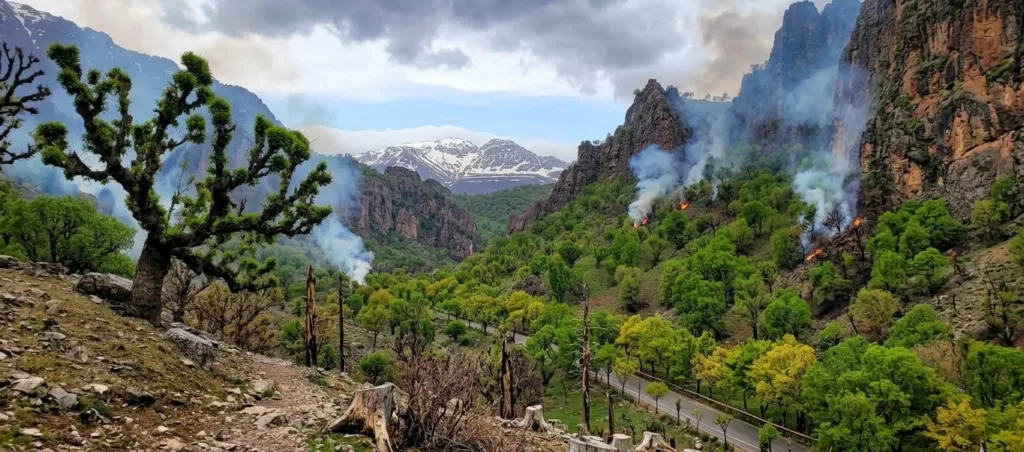
Whatever modest gains that initiative yielded in expanding forest cover were quickly undone. The former government's war-driven policies brought on the economic sanctions of the 1990s, and with them deepened poverty. Stripped of alternatives, households turned to the forests, cutting trees for firewood to get through harsh winters until illegal logging had become widespread.5 Military operations, first during the conflicts of the late twentieth century, and more recently along the northern borders where Turkish forces and the PKK have conducted sustained campaigns since 2020, forests have been scorched at a scale that no planting program has yet offset.
Between 1957 and 2015, official estimates place total forest loss at over 600,000 hectares, and in the nine years since, fire damage alone has affected a further 290,000 hectares.
Agence France-Presse
Historical Developments and Responses to Forest Loss
According to the newest data available, fires linked to bombardment destroyed more than 120,000 hectares in 2024 alone.6 In addition, forest and greenery loss can also be attributed to urban expansion, commercial development, and the prolonged neglect of forest management budgets during fiscal crises, which have compounded the damage.7 Between 1957 and 2015, official estimates place total forest loss at over 600,000 hectares, and in the nine years since, fire damage alone has affected a further 290,000 hectares.8 These losses are unfolding against a backdrop of accelerating and dangerous turns of climate stress.
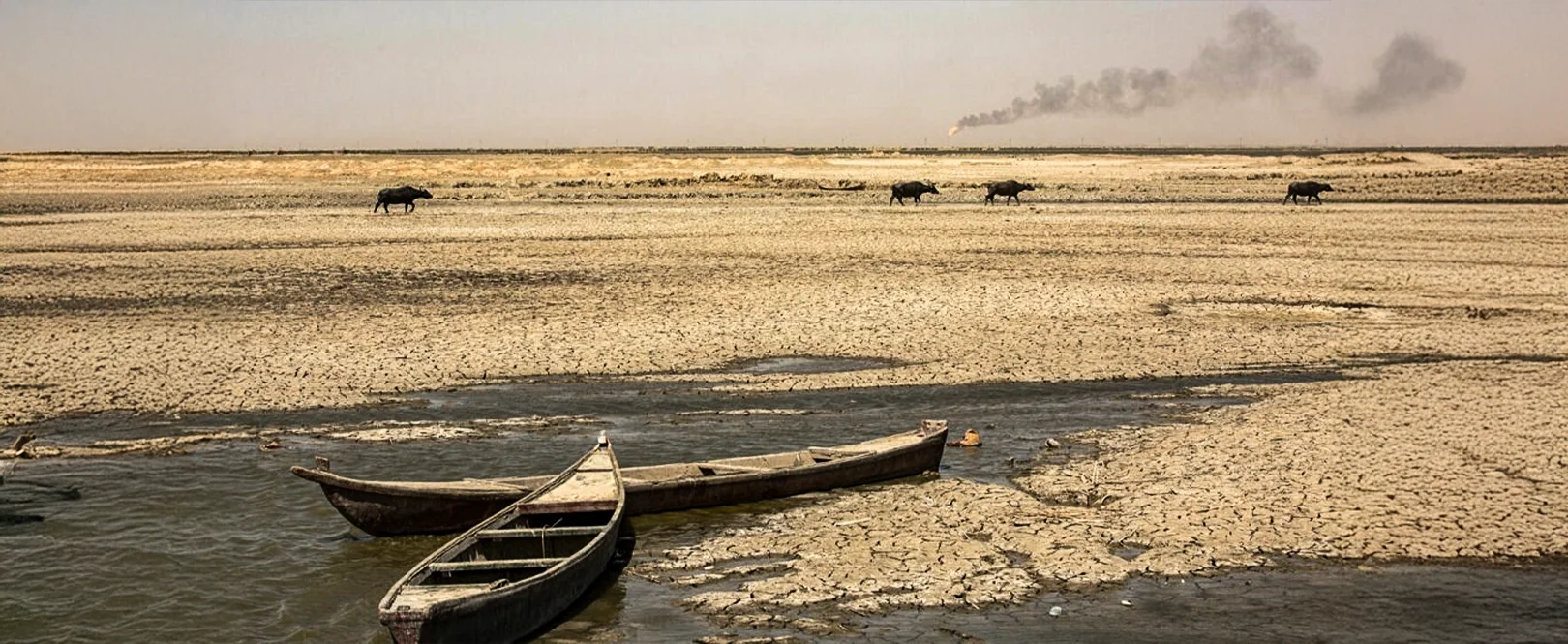
Iraq is ranked the fifth most vulnerable country in the world to climate change by the United Nations Environment Program and the most vulnerable in the Middle East and North Africa.9 Average temperatures across Iraq have risen by over 2.5 degrees Celsius in the past four decades, with projections indicating a further increase of between 1.9 and 3.2 degrees Celsius by 2050 and a nine percent decline in annual rainfall.10 The Kurdistan Region, often assumed to be climatically insulated from Iraq's arid south, has not been spared. There are worsening seasonal droughts, declining and increasingly irregular precipitation, and rising summer temperatures which have all deepened forest vulnerability, accelerating the very losses that reforestation programs seek to reverse.
A central challenge to forestation efforts and greening projects is institutional rather than ecological in nature.
Policy responses, although not proactive, have not been absent completely. The KRG has launched a series of greening initiatives since Dr. Barham Salih’s cabinet, which capably distributed seven million trees among the population in a tree-planting initiative.11 Recently, the Erbil Green Belt Project prominently advances on that initiative, which plans a 78-kilometer forested perimeter around the regional capital designed to absorb up to 210,000 tons of carbon dioxide annually.12 In 2024, similarly in an effort to battle the destructive effects of deforestation, with the support of the World Food Program (WFP), annual sapling of several trees increased sixfold, from 250,000 to 1.5 million saplings in Sulaymaniyah.13 The WFP has committed to planting 38 million trees across 61,000 hectares over five years, and has helped the Sarchinar nursery, the oldest in Iraq, to develop some 40 varieties to be planted later in forests or given to farmers, among them pines, cypresses, junipers and oaks, the emblematic tree of the Kurdish forest.14
In addition to government responses, civil society organizations have led localized campaigns planting hundreds of thousands of drought-resistant oak trees along roadways and in degraded areas, which are now a vulnerable species in the KRI.15 However, a central challenge to forestation efforts and greening projects is that they are more institutional than ecological in nature. The ambition embedded in these tree-planting initiatives and programs is genuine. Whether it is institutionally sustainable is the question this report sets out to examine.
Environmental policymaking in the region is not the mandate of a single specialized ministry.
The Institutional Problem
The question of institutionally sustainable environmental initiatives is central to establishing accountability systems that measure outcomes, not just outputs, in the KRI. Environmental policymaking in the region is not the mandate of a single specialized ministry. Instead, responsibility is distributed across multiple authorities, primarily by the Board for Environmental Protection and Improvement and the Ministry of Agriculture and Water Resources. This fragmentation makes institutional coordination not merely useful, but essential to the successful implementation of environmental initiatives across the region.
The Ministry of Agriculture and Water Resources, municipal bodies responsible for urban greening, environmental boards, and local governorates is responsible for greening projects, while the Board for Environmental Protection and Improvement is a governmental institution reporting to the Council of Ministers. Its mandate constitutes oversight, follow-up, and advisory functions. This is not unusual for a regional government, though what is unusual is the absence of a clear coordinating mechanism that can ensure these actors are working toward shared, measurable goals.
In general, Iraq’s environmental governance architecture constitutes institutional mandates across the environment, water, and agriculture ministries. However, the problem is that “none of Iraq's institutional mandates prescribe specific timelines, long-term or short-term, for proposed plans,” and thus absent timelines inherently weaken pathways for accountability.16 When applied to the KRI context, where environmental and greening initiatives sit at the intersection of at least four institutional entities, these structural gaps become directly relevant. Dr. Sanaan Mohammed the Spokesperson for the Board of Environment pointed to the same structural gaps that hinder, for instance, achieving unified action in drafting national environmental plans. While Dr. Mohammed highlighted that a degree of coordination and a unified framework for environmental work exist among the relevant KRG actors, though meaningful structural challenges remain.17
The outstanding institutional obstacles that complicate long-term environmental coordination result in planting campaigns that indicate activity and visibility without generating the institutional continuity needed to sustain results. For instance, in Sulaymaniyah, observers documented how investors were permitted to clear thousands of trees, including pine forests between the city and Tasluja, an area of approximately 15,000 to 20,000 trees, for commercial development, with no accountability enforced for environmental violations.18 This reflects the absence of an institutional framework robust enough to uphold its own regulations.
The Hidden Constraints: Planting, Water, and Maintenance
The most consequential governance gap in greening, reforestation, and afforestation programs is the one that opens up between the moment a tree is planted and the years of care that follow. Planting trees creates visibility and fulfills budgetary milestones. Maintaining them requires sustained funding, sustainable water resources, designated institutional responsibility, and genuine community engagement. All these elements are absent from the environmental planning and policy process in the KRI.
In responding to the question of “who is institutionally responsible for sustaining forests and green areas after planting campaigns conclude,” Dr. Mohammed acknowledged that annual tree-planting campaigns are held, but the emphasis tends to fall more heavily on the act of planting than on what follows, despite the fact that the measure of a tree's survival and persistence is the quality of monitoring it receives.19 He recommended that the correct course of action for planting campaigns should be grounded in a combined principle of planting and monitoring, with long-term survival as the guiding objective. Dr. Mohammed also emphasized that such procedures should be established as the standard framework for all campaigns and initiatives.
The issue of budget mismanagement is a structural obstacle to greening projects. Without adequate monitoring, maintenance, or technologically advanced systems, projects have wasted water, stalled, or collapsed entirely, undoing the gains of whole tree-planting campaigns.
A further structural obstacle is the absence of sustainable financial support or any dedicated budget allocation for the entities responsible for environmental management. The KRG's own forestry directorate, which is under the Ministry of Agriculture, has acknowledged this issue explicitly. Dildar Abdullah Malazada, head of the forestry department at the Ministry of Agriculture, attributed a significant portion of forest loss directly to budget shortfalls: "The necessary budget to protect and maintain natural and manmade forests was not dedicated due to the financial crisis in the past four years."20 He further noted that the police force tasked with forest protection was reassigned to other duties during the anti-ISIS campaign, leaving natural areas unguarded promptly when they were most vulnerable.
Compounding this is the problem of budget mismanagement, which has contributed to years of forest loss and stunted greening initiatives. Without adequate monitoring, maintenance, or technologically advanced systems, projects have wasted water, stalled, or collapsed entirely, undoing the gains of whole tree-planting campaigns. "This situation is a failure of institutional design and resource mismanagement," said Marouf Majid, head of Ayinda Organization for Environmental Protection.21
Water Management and Integration
No discussion of forestation, reforestation, afforestation, and greening initiatives in the KRI can be separated from the region's deepening water crisis. The gap between water demand and supply is already substantial and growing.
According to Carnegie's assessment, the gap between Iraq's water demand and availability is projected to widen from approximately 5 billion cubic meters today to 11 billion cubic meters by 2035.22 In the KRI specifically, a population increase of 28 percent driven by internally displaced people and Syrian refugees has placed additional pressure on water resources, while a shift toward more water-intensive agricultural practices has further strained management capacity.23 Despite the region’s relative abundance in water, the KRG has sometimes been responsible for the mismanagement of water resources, failing to put in place the kind of institutions and legal frameworks that might mitigate the dual pressures of growing water demand and water scarcity.24 Forestation without integrated water planning is, in this context, not merely suboptimal but also potentially unsustainable.
The Erbil Green Belt project has addressed these issues in part by drilling ten irrigation wells and deploying smart irrigation infrastructure. But across the region's broader greening efforts, there is no integrated water allocation framework that formally coordinates irrigation demands from afforestation with agricultural and domestic water needs. Environmental activists point to a growing inequality in access to green spaces based on geographical location, namely the city of residence. Some activists note that a single park in Erbil receives more funding and employs more staff than all of Sulaymaniyah's 512 green spaces combined.25 Without sustainable water resources and adequate staffing, trees planted in green spaces lacking a guaranteed water source quickly become a liability rather than an asset.
Tree planting must therefore be carried out in a planned and consultative manner, ensuring that water supply is guaranteed in advance and that tree species are selected for their resilience to climate change and challenging environmental conditions.
Dr. Mohammed, Spokesperson, the Board for Environmental Protection and Improvement.
Dr. Mohammed, the Board of Environment's spokesperson, addressed the issue of water security and integration from a specific climate-related context in three phases. First, he emphasized that climate change is compounding the impacts that define the context in which the KRI is operating. It is impacted by variables such as declining rainfall, a projected water crisis, advancing desertification, shrinking green coverage, and rising emissions, all of which place intensifying pressure on available water resources. Tree planting must therefore be carried out in a planned and consultative manner, ensuring that water supply is guaranteed in advance and that tree species are selected for their resilience to climate change and challenging environmental conditions.
Second, given the current environmental pressures, most countries are actively encouraging farmers to adopt modern irrigation systems, such as drip irrigation as well as the reuse of treated greywater for parks and green spaces, and the responsible management of groundwater as a national resource for future generations. This approach is a successful model that the KRG should adopt to proactively combat environmental pressures.
Third, a clear balance must be established between the water demands of greening projects and household consumption, with household water use taking precedence. Water security and food security are two essential factors in protecting the ecosystem and supporting the long-term stability of communities in their places of residence. The Region's water management system must therefore be strengthened to reliably guarantee both.
Institutional Reform and Environmental Accountability
One of the solutions to institutional reform and improving environmental accountability is to adopt metrics that measure long-term tree survival and total area of green coverage. This is important because a governance system cannot improve what it does not measure. Across the KRI, environmental and climate policy dissemination mainly takes place at conferences and official ministerial events, and when it comes to implementing these policies, transparency and accountability seem to be an empty slogan.26 This shift from symbolic greening to measurable, evidence-based policy is the backbone of meaningful environmental reform. A logical starting point is the amendment of KRG Environmental Law No. 8 of 2008, which in its current form fails to adequately address the environmental realities of today, particularly given that climate change and industrial development have since sharply reduced green coverage across the region.
In the KRI, there is growing demand for greener spaces, and people at community-level initiatives have already greened spaces that were the responsibility of the government.
Evidence-based policies apply with particular force to forestation efforts, where the most important metric, which is survival rates of planted trees, is rarely tracked, publicly reported, or used to adjust program design at both institutional and community levels. Without this evidence base to support policymakers, it is difficult to distinguish programs that are working from those that are not. It is critical to recognize that political incentives naturally favor reporting activity over outcomes. This is a structural tendency and not a moral failing, and it is common to governments operating under fiscal pressure and political visibility constraints, in this case the KRG. But the lack of real policy work that targets environmental issues has a practical and long-term consequence where resources are misallocated, and the public, whose landscapes, air quality, and livelihoods are at stake, cannot hold anyone accountable for results they can’t see.
In the KRI, there is growing demand for greener spaces, and people at community-level initiatives have already greened spaces that were the responsibility of the government. The environmental, public health, and psychological case for greener spaces is real, particularly for communities shaped by generations of conflict, displacement, and ecological loss. What is urgently needed now is a governance framework that can translate that demand into durable outcomes. That means clarifying institutional responsibilities across agencies, embedding maintenance obligations and multi-year funding commitments into program design, integrating water allocation frameworks into forestation, afforestation, and reforestation strategies, and developing monitoring systems that track survival rates and ecosystem recovery rather than saplings distributed.
One thing is clear; the KRI does not lack the will or the resources for green landscapes. What it requires is the institutional capacity to ensure that what is planted today is still standing a decade from now. The policy shift from symbolic greening to sustained, accountable environmental management is where the work is hardest and where it matters most.
Policy Recommendations and Key Takeaways
- The KRG should amend Environmental Law No. 8 of 2008 to introduce binding timelines, measurable targets, and enforceable accountability mechanisms that reflect the current scale of climate change and forest loss in the region.
- A dedicated, ring-fenced budget line for environmental monitoring and post-planting maintenance should be embedded into every greening and afforestation initiative from the planning stage, not treated as an afterthought once funds run low.
- Institutional responsibility for greening outcomes should be formally assigned to a single coordinating body with the authority to hold the Board for Environmental Protection and Improvement, the Ministry of Agriculture, and municipal bodies jointly accountable for results.
- An integrated water allocation framework specifically addressing the irrigation demands of afforestation projects should be developed, one that formally balances those demands against agricultural and household water needs before projects are approved and funded.
- The KRG should adopt a public environmental monitoring system that tracks and reports tree survival rates, green coverage change, and ecosystem recovery annually, making performance data accessible to civil society, researchers, and communities whose landscapes are directly affected.
Acknowledgements
This paper benefited greatly from the time and insights generously offered by two practitioners whose fieldwork and institutional experience gave shape to its central arguments. The author extends sincere gratitude to Dr. Sanaan Mohammed, Spokesperson of the Board for Environmental Protection and Improvement, for his candid and detailed account of the institutional landscape governing environmental affairs in the Kurdistan Region. Equal thanks are owed to Marouf Majid, founder and Head of Ayinda Organization for Environmental Protection, whose two decades of field experience and unflinching assessment of governance failures on the ground proved invaluable to this research. Both interviews were conducted as part of iNNOV8's Environmental Awareness Week and informed the paper's analysis in ways that no published source could have substituted.
- Halkawt Ismail, Director of Forestry, KRG Agriculture Ministry, quoted in "Saving the Vanishing Forests of Iraq's Kurdistan," Global News / AFP, August 2024. Read More. See also: "Oak Forests in the Kurdistan: The Lungs of Iraq," Kurdish Globe, Read More ↩︎
- G. W. Chapman, "Forestry in Iraq," Unasylva 2, no. 5 (1948), Food and Agriculture Organization of the United Nations, accessed May 21, 2026, Read More. ↩︎
- Dildar Abdullah Malazada, KRG Ministry of Agriculture and Water Resources, quoted in "2.2 Million Acres of Forest Lost to Fire, Deforestation, Budget Cuts: KRG," Rudaw, October 17, 2018. Read More ↩︎
- Marouf Majid, environmental activist and Head of the Ayinda Organization for Environmental Protection, interview by author, Sulaimaniyah, May 19, 2026. ↩︎
- Shafaq News. "Kurdistan's Forests Under Threat: War, Climate, and Efforts to Rebuild." Shafaq News, March 27, 2025. Read More. ↩︎
- Ibid. ↩︎
- Mamshai, Farhad. "The Politics of Environment in the Kurdistan Region: Unveiling the Crisis of Deforestation and Forest Fires." Iraq Climate Change Center, August 12, 2024. Read More. ↩︎
- Halkawt Ismail, quoted in "Saving the Vanishing Forests of Iraq's Kurdistan," AFP / Global News, August 2024. ↩︎
- United Nations Iraq. “Migration, Environment, and Climate Change in Iraq.” UN Iraq, August 11, 2022, Read More ↩︎
- Joy, Arkeh and Nourane, Awadallah, "Climate Change and State Fragility in Iraq: Budgeting, Governance, and the Future of Sustainability," Carnegie Endowment for International Peace, May 2025, Read More. ↩︎
- Marouf Majid, environmental activist and Head of the Ayinda Organization for Environmental Protection, interview by author, Sulaimaniyah, May, 2026. ↩︎
- Kurdistan Regional Government, ” Kurdistan Prime Minister Masrour Barzani Launches Erbil Green Belt Project to Combat Climate Change and Boost Youth Employment,” KRG, October, 2025, Read More ↩︎
- The Arab Weekly, ” Millions of trees to save vanishing forests of Iraq’s Kurdistan,” The Arab Weekly, August 22, 2024, Read Morelions-trees-save-vanishing-forests-iraqs-kurdistan ↩︎
- Ibid ↩︎
- Hasar Orgnaization,” "Kurdistan's Oak Forests: Nurturing a Now Vulnerable Species," Hasar Organization, December 23, 2021, Read More ↩︎
- Joy, Arkeh and Nourane, Awadallah, "Climate Change and State Fragility in Iraq: Budgeting, Governance, and the Future of Sustainability," Carnegie Endowment for International Peace, May 2025, Read More. ↩︎
- Dr. Sanaan Mohammed, the Spokesperson for the Board of Environmental Protection and Improvement. Interview by author, Erbil, May, 2026. ↩︎
- Mamshai, Farhad. "The Politics of Environment in the Kurdistan Region: Unveiling the Crisis of Deforestation and Forest Fires.“ Iraq Climate Change Center. ↩︎
- Dr. Sanaan Mohammed, the Spokesperson for the Board of Environmental Protection and Improvement. Interview by author, Erbil, May, 2026. ↩︎
- Malazada, Rudaw, October 17, 2018. Read More ↩︎
- Marouf Majid, environmental activist and Head of the Ayinda Organization for Environmental Protection, interview by author, Sulaimaniyah, May, 2026. ↩︎
- Shuker, Zainab. ” Afro-Iraqis, Climate Change, and Environmental Injustice in Basra.” Carnegie Endowment, March 2026, Read More ↩︎
- Arab Center Washington DC. "Water Politics in the Tigris-Euphrates Basin," Arab Center DC, May 2023. Read More ↩︎
- Arif, Lara. ” In the Midst of the Riparians: Kurdistan’s position at the center of an impending water crisis in the Tigris-Euphrates River Basin.” Washington Kurdish Institute. February 15, 2023. Read More ↩︎
- Data collected by Marouf Majid, environmental activist and Head of the Ayinda Organization for Environmental Protection, interview by author, Sulaimaniyah, May, 2026. ↩︎
- Sulaiman, Khaled. "Climate Information Transparency in the MENA Region." Carnegie Endowment for International Peace, January 2025, Read More ↩︎
Content Type:iNNOV8 Policy Briefs