Blank and Null Voting: Protest Through Ballot
Case Study: Iraq’s 2025 Elections and the Rise of Blank Ballot Protests
Executive Summary
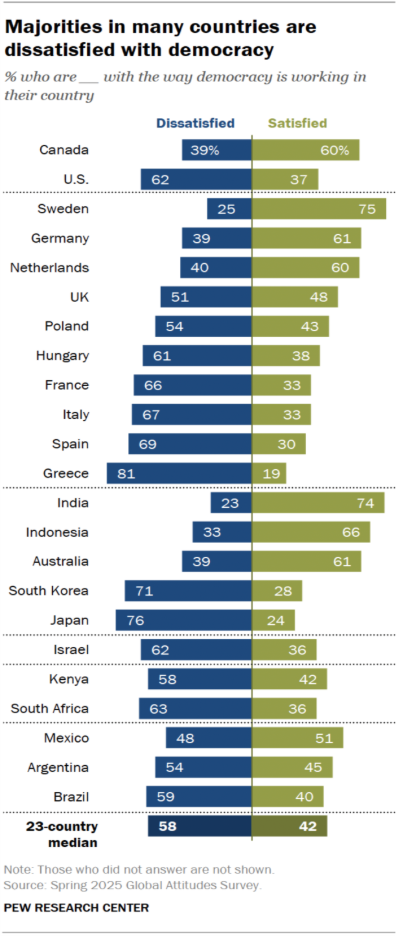
Trust in the government can look entirely unique depending on where you are in the world. In Switzerland, the highest trust level in government reached 62%, and the lowest level dropped to 32% in the United States, based on the global survey that was carried out in 2025. The survey reveals a widespread dissatisfaction with political systems worldwide, with 58% of adults expressing dissatisfaction with the functioning of democracy, compared to just 42% who expressed satisfaction across 23 countries. This tendency is observed not only in developed democracies but also in newer or non-democratic states. Dissatisfaction reflects discontent with incumbent leaders and institutions and the perception that government is unresponsive, rather than a rejection of democracy itself. Most people believe that their voices are not reflected appropriately. This global disillusionment with democracy can be seen in Iraq’s 2025 election, demonstrating how dissatisfaction can reflect on the voters' decisions.
This report looks at how public dissatisfaction influences voting across different regions and with different political systems. It examines how public discontent leads to protest voting, where voters cast blank or spoiled ballots in an attempt to express their demand for change. The Iraq 2025 election is the striking case; the increased number of invalid ballots revealed the depth of public cynicism and the growing gap between voters and the political system.
Key Concepts: Satisfaction, Trust, and Protest Voting
Public Satisfaction vs. Dissatisfaction
Public satisfaction generally refers to citizens' contentment with their government services and institutions, which is linked to the efficiency and fairness of the public and responsiveness of these services. Dissatisfaction, by contrast, happens when people’s expectations don’t match the reality that the government offers to the public. This dynamic is often explained through the expectancy disconfirmation model (EDM), it is widely used when the government falls short of expectations. High satisfaction lastly corresponds with a sense of trust in authorities and a legitimate system, but when dissatisfaction grows, trust fades and people start doubting whether the system is fair. Political legitimacy itself means the public belief that the government is entitled to rule. When legitimacy is strong, people are open to new decisions even if they do not match their beliefs, but when it is weakened due to chronic dissatisfaction, citizens often withdraw support or seek other ways of expressing discontent.
When governments deliver a strong result to the public, it can build legitimacy even in a non-democratic state.
Trust in Government
Public satisfaction is often measured through the level of trust in the government. Global survey instruments, such as the World Values Survey, Afrobarometer, Latinobarómetro, and Gallup World Poll, use questions like, “Do you have confidence in the national government?” or “How satisfied are you with the way democracy works in your country?” Results show significant differences in measures across democracy and authoritarian states. Gallup reported in 2022 that only about one in three adults in the UK (33%) and U.S. (31%) trusted their national governments- The lowest levels among G7 democracies.
By contrast, some authoritarian or semi-authoritarian states report a much higher level of trust in government. Surveys (including the Edelman Trust Barometer) report strong public confidence in places like China, Saudi Arabia, Singapore, and the UAE, all states known for rapid economic growth and narrow political control. When governments deliver a strong result to the public, it can build legitimacy even in a non-democratic state. However, in certain democracies, trust has declined due to subpar performance or political stagnation.
Protest Voting and Blank/Null Ballots
A protest vote is a form of dissent that expresses dissatisfaction with political candidates, the system, or policies of the government. In other words, it’s a way of expressing discontent, and it can appear in several forms. People find ways to protest not only in the street collectively but rather by voting for fringe or unconventional candidates as a way to reject mainstream options. Another form, particularly relevant in Iraq, is casting a blank or null ballot. A blank ballot means no candidate is selected (empty vote), while a null (or spoiled/invalid) ballot is marked incorrectly or deliberately defaced, thereby making the vote invalid. Blank and null voters are counted in many electoral systems (unlike simply not voting, which is abstention); these votes are often intentional. Voters use them to show that “none of the above” is acceptable. Blank or null ballots (not voting at all) are a way to show protest. Spoiled voting is widely interpreted as a sign of public unhappiness with the candidates or the political system. In summary, casting a blank or null vote is a way to take part in an election while saying, “I don’t support any of these choices.”
Trust scores in authoritarian states may reflect state influence rather than genuine sentiment.
Measuring Public Satisfaction and Political Legitimacy
How do we measure something as broad as “public satisfaction” or trust in government, and do these measures apply globally across democracies and authoritarian states? The main tools are surveys of public opinion, which offer several standard indicators:
| Measurement Aspect | Description | Examples /Findings |
| Satisfaction with Democracy/Government | Surveys ask respondents if they are satisfied or dissatisfied with democracy or government performance. | Pew Research: 64% dissatisfied vs. 35% satisfied on average among 12 countries. |
| Trust and Confidence Indicators | Measures trust in institutions such as parliament, the judiciary, or the government as a whole. | OECD and Gallup track confidence worldwide; e.g., ~33% trust in US/UK government vs. >80% in China. |
| Political Legitimacy Indicators | Inferred from surveys along with turnout rates, protest activity, and protest voting behaviors. | High turnout and low protests indicate legitimacy; spikes in protests signal deficits. |
| Cross-regime Application | These measures apply globally, but interpretation varies for democracies to show dissent through voting or protests, while in authoritarian regimes, through unofficial channels. | Satisfaction relates to perceived government effectiveness, fairness, and improving citizens' lives. |
| Challenges | Authoritarian regimes may suppress open expression in surveys, making interpretation complex. | Trust scores in authoritarian states may reflect state influence rather than genuine sentiment. |
Key correlates to examine include governance quality, levels of democracy, and the strength of the economy.
Drivers of Public Satisfaction: A Comparative Perspective
To understand why some societies are happier with their government than others, a comparative analysis may provide some context. This paper examines a sample of countries with both high and low satisfaction, noting the variables that coincide with these outcomes. Important factors to consider include how well government works in a broad picture. Key correlates to examine include governance quality, levels of democracy, and the strength of the economy.
High-Satisfaction Cases
Sweden is a leading example of a country with high population satisfaction within a stable democracy in Europe. Recent Surveys shows that about 75% of Swedes are satisfied with their country’s democracy, which makes it one of the highest rates in the world. It’s not a secret that Sweden is widely recognized for its effective and strong government, low corruption, and excellent social services. The Netherlands and Canada often reported high satisfaction levels in global surveys, likely due to their strong economies and effective democratic systems historically. In Asia, both India and Indonesia also reported above-average satisfaction with both democracy and economy. As reported by the Pew survey, in 2025, these countries showed higher than average satisfaction with politics as well. It appears that in both cases, recent economic growth and improvements in living standards seem to have boosted public happiness.
Governments win public approval when they provide prosperity, security, and worthwhile services.
Some of the world’s highest satisfaction levels are found in the countries that are not fully democratic but have delivered rapid development: a clear example is Singapore. Despite limited political opposition, the country provides excellent public services and consistently ranks high in public satisfaction in governance rankings. China is another notable case, even though it has a one-party authoritarian system. Surveys have found a high proportion of Chinese citizens trusting the government’s decision-making as their leader. This sense of trust is often tied to a national pride that citizens carry, with economic growth in the country as the main factor. Trust in government is often “stronger in authoritarian countries that are growing and investing rapidly, such as China, Saudi Arabia, Singapore, and the UAE”; in contrast, satisfaction rates in older democracies such as France, Germany, the UK, and the U.S. tend to be lower. These cases support a theory of performance legitimacy. Governments win public approval when they provide prosperity, security, and worthwhile services. High public satisfaction is commonly observed in countries that enjoy stable or improved economic conditions, effective and low- corruption governance, and a sense of the country’s progress or stability. These essential factors appear both in democratic countries like Sweden and in authoritarian contexts like the UAE living standard, but the direct relation of satisfied citizens is more strongly related to its economy than the type of political system the government is ruling.
Low-Satisfaction Cases
Some countries are struggling with low public satisfaction and trust in government; a striking example is Greece, where only about 19% of people are satisfied with how their democracy works. With more than four-fifths of the population dissatisfied, Greece’s financial crises, austerity measures, and political turbulence have badly affected citizens’ satisfaction in the country during the past ten years. Economic troubles or political scandals can affect the citizen’s satisfaction in a very high range. In European countries such as France, Italy, and Spain have also experienced growing disillusionment due to the same reasons. In Asia, countries such as Japan and South Korea are dissatisfied with both the economy and politics. During 2010, in South Korea’s case, corruption scandals and leadership crises left many citizens dissatisfied with their government's responsiveness to the public. When it comes to the functioning of democracy in Latin America and Africa, specifically in countries such as Brazil, Mexico, Kenya, and South Africa, people’s view on democracy is not as positive as it may seem. In South Africa, 63% of citizens are dissatisfied with democracy and its outcome, while only 36% are satisfied, reflecting frustrations with corruption, inequality, and poor public services on a daily basis.
The common threads of low satisfaction with government often stem from citizens’ perception of weak economies or recession, high unemployment, visible corruption or abuse of power, poor services, and a sense that entrenched elites ignore people’s daily basic needs.
In the Middle East, waves of discontent were visible, especially during the Arab Spring, when the population expressed their grievances on a massive scale. For example, Lebanon and Iraq have both faced mass protests in recent years, fueled by dissatisfaction with sectarian political systems and the failure of basic services. In Iraq, prior to 2023, trust in the government was extremely low due to the conflict and corruption the country had been going through. A poll recorded 56% of participants expressing confidence in the national government, following some improvement in security and governance, though nearly half of the population remained distrustful and not satisfied with the government. Meanwhile, Lebanon’s population has overwhelmingly lost faith in the system, which collapsed amid economic breakdown and political deadlock. The common threads of low satisfaction with government often stem from citizens’ perception of weak economies or recession, high unemployment, visible corruption or abuse of power, poor services, and a sense that entrenched elites ignore people’s daily basic needs.
Governance Quality and Economic Correlates
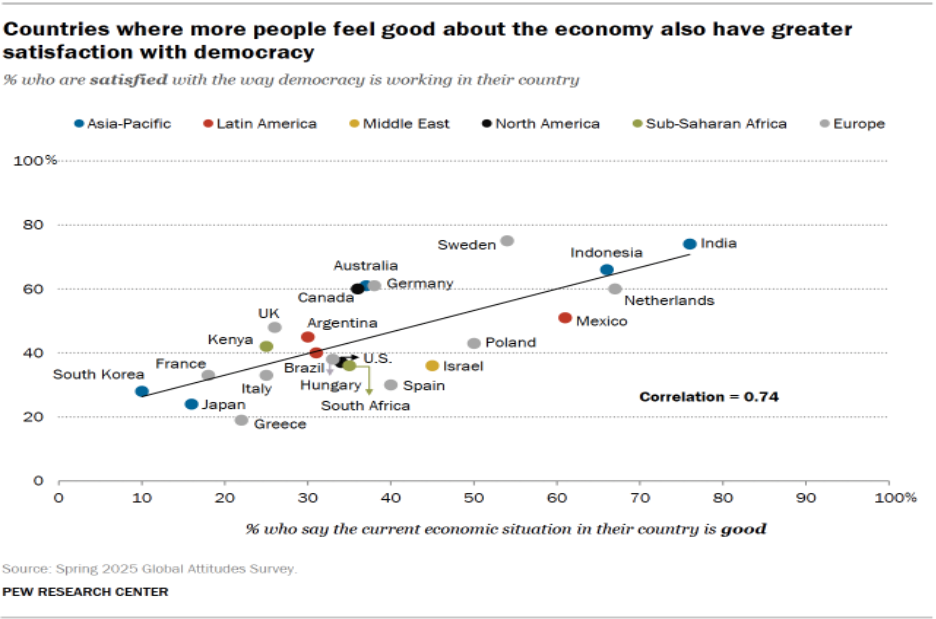
Empirical evidence supporting these qualitative findings shows that there is a strong correlation between citizens’ views of the economy and their satisfaction with their government. Countries where most citizens state that the economy is doing well also tend to have higher satisfaction with democracy. Conversely, when the economy is negatively affected, satisfaction tends to be low. Countries such as Sweden, the Netherlands, India, Indonesia, and Mexico were highlighted as places where people feel good about the economy, and it goes hand in hand with higher satisfaction with the political system. By contrast, in places like France, Greece, Italy, Japan, and South Korea, public views of the economy are largely negative, and satisfaction with democracy is correspondingly low. Beyond economics, governance quality also shapes trust; high-satisfaction societies tend to rank better on these governance metrics, while low-satisfaction societies suffer from perceived institutional failure. This shows that regardless of the regime type, ”delivery for citizens is crucial to guarantee support for government”. When governments provide security, services, and fair processes, they earn trust and legitimacy; when they fail to deliver, dissatisfaction brews, sometimes pushing people to look for alternative leaders or systems.
From Dissatisfaction to Protest: How Public Discontent Shapes Voter Behavior
When citizens are dissatisfied with their government or political system, it often shows up in their behavior at election time or in whether they vote at all. There are several ways in which voters act:
Key Voter Responses to Dissatisfaction
| Voter Action | What It Means | Real-Life Examples | Why It Matters |
| Skipping the Vote | People stay home from elections because they think their choice won't change anything | Iraq: Turnout fell from 60% (2014) to 45% (2018); many planned to skip 2025 over distrust | Helps powerful groups win with few votes |
| Voting for Outsiders | People show up but pick new or anti-government candidates to send a message | USA (Trump in 2016), Greece (Syriza party) | Voters express their dissatisfaction at the ballot box |
| Messing Up the Ballot on Purpose | People vote but mark ballots wrong to say "no" to every candidate | Peru 2000 (31% bad ballots), France 2017 (8%) | Makes protest clear; can force new elections in places like Colombia |
| "None of the Above" Option | Ballots have a button to pick "I don't choose any candidate." | Nevada (just a symbol), Colombia (counts for real) | Provides a straightforward option to reject all candidates. |
Case Study: Iraq’s 2025 Elections and the Rise of Blank Ballot Protests
Two decades after the fall of Saddam Hussein, Iraq’s political system has evolved into a tightly managed order where elections happen regularly but rarely redistribute power. The post-2003 power distribution is controlled by “Muhassasa,” which many citizens view as the primary source of both corruption and the current weak government. Despite Iraq's oil wealth, basic services like electricity, water, and healthcare are inconsistent, with more than 90% facing service outages. Mounting frustration over these conditions erupted by late 2019; anger led to a mass protest, “the Tishreen movement,” where thousands rallied against the ruling elite, demanding jobs and services to end the corruption. In response, the government promised to implement reform and call early elections, held in 2021, hoping to ease the unrest. Yet the 2021 election turnout fell to the lowest record, with only 41% of eligible voters participating. Empty polling stations and voter apathy in 2021 became a clear signal of Iraq’s deep disillusionment, as people doubted that election could deliver meaningful change. As one report noted, “disillusionment defined 2021,” the prevailing sentiment was that Iraq’s electoral process maintains continuity of the same elites over change.
As Iraq headed into the November 2025 parliamentary election, the perception among the public was not hopeful. In fact, the public was more cautious and skeptical. Many Iraqi citizens stated they were willing to vote if candidates proved they could deliver a real change. The turnout could hit a historical low, as legitimacy continued to erode despite relative calm. Muqtada al-Sadr's boycot of the election in 2025 underscored this disillusionment, while the government took steps such as changing the electoral law and disqualifying candidates, which were seen by critics as tightening control. This further alienated voters, who already believed that the system was biased against genuine change.
The number of invalid votes is substantial, roughly equal to the entire voter base of provinces like Karbala or Maysan in Iraq.
The result of the election in 2025 was around 729,923 invalid ballots across the country. The highest numbers were recorded in the Kurdistan Region, followed by Nineveh and Basra, highlighting a significant portion of voters who either made technical mistakes while filling out the ballot or intentionally chose to invalidate their vote. The number of invalid votes is substantial, roughly equal to the entire voter base of provinces like Karbala or Maysan in Iraq. The scale of these blank/null votes surprised many observers, and the main reason behind this result is a form of protest through voting. The important point to look at is that these voters did not stay at home and ignore voting; but rather, they chose to show their voices differently.
After 20 years, people in Iraq see voting as more of a routine than a decision to change their lives.
An anonymous voter in Kirkuk
To analyze these blank votes, we should look at Iraq’s unique and historical landscape of voting systems. Iraq used to use a proportional representation system of voting in 2018, which gave chances for minorities to gain seats and participate in the parliament, but in 2025 same as 2021, Iraq shifted back to a single district system, which favors the powerful parties and ensures them gaining more votes. Moreover, Iraq’s political system has been dominated by the same elite parties, which have traded powers among themselves since 2003. In this case, an election is more like “recalibrating power among elites”, This gives citizens a sense of looking at elections more like reshuffling insiders than delivering a change for the public. Iraqi citizens are aware of this pattern that happens every four years; they see it as “disillusioned with the ability of elections to deliver change”. The 2025 election clearly shows a form of protest voting, and those who did vote expressed low expectations. After 20 years, people in Iraq see voting as more of a routine than a decision to change their lives, as one of the voters in Kirkuk stated “..voting has become something we do out of habit, much like people who pray simply because it’s part of their routine”. These voices reflect the society where participation in elections is either out of duty or desperation rather than faith in the current system.
The elevated blank/null percentages reveal a collective rejection of candidates, extending voter disillusionment into electoral protest; Iraq mirrors Spain's Basque mobilization and Colombia's re-election trigger, underscoring political dissatisfaction despite void votes not counting toward seats. Higher rates in Kurdistan highlight regional grievances against party dominance and centralized politics. Visual spikes emphasize protest voting's significance in fragile democracies.
It is important to note that Iraqi voters had other ways to protest; some stayed at home and chose not to participate by boycotting the polls. Some voters chose an alternative option, which is to vote for an independent candidate who calls themself a civil candidate. Yet, the 2025 Iraqi election result dealt with major setbacks as most of the independent candidates lost, and the established blocs (particularly the ruling Shia coalition) retained control.
Public Trust, Satisfaction, and Political Attitudes in Iraq
| Indicator | Data / Percentage | Year | Source Notes |
| Trust in Government | 34% | 2024 | Arab Barometer – trust rose by 8 points since 2022. |
| Confidence in National Government | 56% | 2023 | Gallup International Association poll (reported via Business Insider Africa). |
| Trust in Political Parties | 6% trust / 94% distrust | 2020 | The IRI survey shows extremely low trust in parties. |
| Trust in Parliament | 17% trust / 83% distrust | 2020 | The IRI survey indicates weak legislative legitimacy. |
| Trust in Electoral Commission | 26% trust / 74% distrust | 2020 | IRI findings show low confidence in election administration. |
| Youth Political Attitudes | The majority feel excluded from political system | 2022 | Chatham House analysis on youth frustrations and exclusions. |
| Top Causes of Discontent | Corruption, unemployment, poor services | 2022–2024 | Arab Barometer & Chatham House identify consistent causes of dissatisfaction. |
Interpreting Blank and Nullified Ballots: What the Iraq Model Tells Us
The blank and invalid ballots can have an entirely unique definition based on whether they arise from organized mobilization or individual disillusionment. The comparison between Iraq, Spain, and Colombia shares the same cases of invalid ballots and dissatisfaction, but the driver for nullified votes differs significantly and shapes their political impact.
Spain and Colombia: Organized and Strategic Protest Voting
In the 2024 Basque elections in Spain, about 13% of votes were blank or invalid, which was not accidental; it was part of coordinated campaigns by the Basque nationalist movement after their party was banned, which indicates that the blank ballots were a collective action, not an individual act, and the spoiled ballots were filled intentionally, symbolizing rejection of electoral constraint.
In Colombia, the role of the “voto en blanco” is even more distinct; it's not just symbolic protest, it has legal consequences, which makes the vote a formal election option. Legally, when the blank votes exceed 50%, the election must be repeated. This means that the protest votes turn into blank ballots with strategic consequences, or the system allows voters to reject the candidates or vote for them.
The Spain and Colombia nullified ballots demonstrate examples where the action of invalidating the ballots was strategically mobilized, politically coordinated, and collectively executed.
The Iraq scenario stands in contrast to collective movements like Spain’s and institutional protest mechanisms like Colombia’s case.
Iraq: A Protest Without Coordination
In the case of Iraq, there is no evidence that the nullified ballots were the result of a coordinated effort by individuals or political groups. In Iraq, the scale of nullified ballots represents a widespread voter's frustration and disengagement without collective guidance. Voter behavior in the case of Iraq can be summarized as:
- The invalid votes largely resulted from individual choices rather than orchestrated strategy.
- The protest was fragmented, not unified under a political movement.
- The message was personal but consistent: voters wanted to participate yet rejected all presented options.
- Voters lacked trust in the election process, fearing that political parties could manipulate blank ballots to their advantage.
Muqtada Al-Sadr and his followers' decision to openly boycott the election was the only noted coordinated action. However, Sadr’s campaign called for boycotting, not ballot nullification. Therefore, the spike in invalid ballots cannot be attributed to his organizational influence. The Iraq scenario stands in contrast to collective movements like Spain’s and institutional protest mechanisms like Colombia’s case.
Blank and Nullified Ballots Comparison
| Aspect | Iraq iraqinews | Spain (2024 Basque Elections) | Colombia ("Voto en Blanco") sciencedirect |
| Ballot Rate | Exceeded 700,000 invalid ballots in 2025 parliamentary elections (innov8) | ~13% blank or invalid reuters | Legally tracked; >50% triggers repeat sciencedirect |
| Nature | Individual disillusionment and fragmented dissent, not coordinated 1001iraqithoughts | Organized collective action by Basque nationalists after party ban | Strategic, legalized protest option with formal consequences |
| Coordination | No unified movement; separate personal choices despite participation desire | Coordinated campaigns symbolizing rejection of constraints | Mobilized as institutional mechanism to reject candidates |
| Political Impact | Signals widespread distrust in unchanged system, distinct from Sadr's boycott | Collective protest with clear political direction | Forces election rerun if threshold met, empowering voters systemically |
| Key Driver | Personalized frustration without organization drawmedia | Nationalist movement strategy | Legal framework for collective rejection |
The Outlook
The Encyclopedia Britannica regards elections as a fundamental contributor to democratic governance. Equally, voting rights are profoundly valuable, serving as the cornerstone of democratic participation, individual empowerment, and collective governance. Iraq joined the ranks of pseudo-democratic nations in 2005 when it conducted its first democratic elections after the fall of the previous dictatorship regime in 2003. In the past 20 years, Iraq’s elections have been going through cycles with amendments to the election laws, redistricting, and changes in the political party representations. The Iraqi people's will and desire to vote was the only constant over the years. Voter appetite, behavior, and trust have gone through cycles as well. Further research may be necessary to find the catalyst that reveals various winds of change that hit the sails of Iraq’s voter base and to direct the currents of dissatisfaction towards a positive and productive shore.
Content Type:Special Reports